What is cross stitch?
Cross stitch is embroidery made of small X-shaped stitches, usually counted from a chart onto a cloth with an even weave. Each X is one square of the chart.
On this page
What cross stitch is
Cross stitch is one stitch, repeated. Two short diagonal stitches cross to make an X, and hundreds of Xs side by side make a picture, the way squares of color make a mosaic.
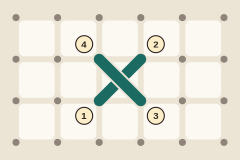
Three things make it work:
- The cloth has an even weave. Most people stitch on Aida, a cotton cloth woven in small squares with a hole at each corner. The needle goes up and down through those holes, so every X comes out the same size. The count of the cloth is the number of squares to the inch: 14 count has 14.
- The design is a chart. A chart is a grid. Each square that holds a symbol is one X, and each kind of symbol is one color of thread. A key beside the chart says which thread each symbol stands for.
- The thread is six-strand cotton floss. You pull the strands apart and stitch with a few of them, usually two on 14 count.
You count squares on the chart, count the same squares on the cloth, and make an X there. That is the whole method. How to cross stitch teaches the stitch itself.
Counted cross stitch and stamped cross stitch
What is described above is counted cross stitch: the cloth is blank and you count from a chart. In stamped cross stitch the design is printed on the cloth, and you stitch over the printed marks with nothing to count. The two are compared in Stamped vs counted cross stitch. Every cross stitch pattern on this site is a counted chart.
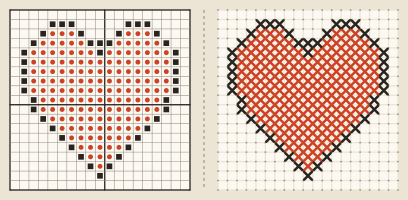
The chart on the left and the stitches on the right are one design, square for square. The thick lines on the chart come every ten squares, to help you count. They do not mark the middle. It is the small red heart with a dark outline, one of the patterns here.
Where it sits among other embroidery
Cross stitch is one kind of counted-thread embroidery: needlework in which each stitch is placed by counting the threads of the cloth. Blackwork belongs to the same family. The other big family is free, or surface, embroidery, where the stitches follow a drawn design and take no notice of the weave. Needlepoint, which is worked on canvas, is a close relative of cross stitch.
Two guides compare the crafts side by side: Embroidery and cross stitch compared and Needlepoint vs cross stitch.
A short history
- The Middle Ages. The crossed stitch is one of the oldest in embroidery. Museums and needlework schools date the earliest surviving pieces differently, anywhere from the sixth century to the thirteenth, depending on what they count as the first.
- The 1500s. Before printed patterns, a stitcher kept a sampler: a cloth of stitches and motifs to copy from later. The first printed pattern books appeared in Germany in the 1520s. The earliest sampler known to carry a stitched date was made in England in 1598.
- The 1600s and 1700s. Samplers became practice pieces for girls learning to sew, with alphabets for marking household linen: stitching the owner's name or initials on it. In the 1700s they turned into pictures to hang on the wall, and cross stitch became the main stitch on them.
- The 1800s. Berlin wool work, stitched in wool on canvas from patterns printed on squared paper, was the fashion. Today's cross stitch charts, printed in color square by square and often shaded like a painting, come down from it.
- The later 1900s. Counted cross stitch came back as a hobby done for pleasure, and it has stayed.
Is cross stitch hard?
No. It is one of the easiest kinds of needlework to learn, because there is only one stitch and the cloth shows where it goes. The care is in the counting.
A pattern is easy when it has:
- full crosses only, with no fractional stitches;
- few colors;
- a small size;
- Aida cloth, which is what beginners usually start on.
Every cross stitch pattern on this site is charted in full crosses. The Easy patterns are the ones marked Beginner or Easy, the Beginner ones first.
A pattern gets harder with:
- quarter and three-quarter stitches, parts of an X, which end in the middle of a square and are easier to place on evenweave or linen (cloths of single threads, with no squares woven in) than on Aida;
- single stitches scattered about in many colors, which stitchers call confetti;
- a finer cloth, such as linen, where each X is stitched over two threads of the cloth each way.
How it is spelled
Both ways. Dictionaries write it with a hyphen: cross-stitch, and for the verb cross-stitched and cross-stitching. Needlework guilds and schools mostly write two words: cross stitch. Counted cross stitch is the same craft named in full. This site writes cross stitch.
Questions people ask
Is cross stitch sewing? In a wide sense, yes: it is done with a needle and thread. Sewing in the everyday sense fastens pieces of cloth together, and cross stitch decorates one piece. Both belong to needlework, along with embroidery, needlepoint and quilting.
Is cross stitch embroidery? Yes. It is a kind of counted-thread embroidery, and a very popular one.
Is it an art or a craft? Both, and it depends on the piece. A craft is a skill put to use, and following a chart well is that. Work made to be looked at for its own sake, in thread, is also called textile art or fiber art.
Who does cross stitch? Anyone. In Europe it was long taught to girls, but nothing in it belongs to women: men design and stitch it, and a British charity has taught needlework to prisoners, most of them men, since the 1990s. Children manage it on a large-holed cloth. Charts of cars, fishing, pixel art and anything else are the same Xs.
Is cross stitch just for kids? No. Children can learn it early, because there is one stitch and the holes show where it goes: teaching a child has a first lesson. But it is just as much a hobby of grown people, young and retired, women and men. The patterns here run from a tiny motif in a few colors to the challenging patterns, each of 12,000 stitches or more.
What do you call someone who cross stitches? A cross-stitcher, or just a stitcher.
Is there another word for it? Counted thread work is the family name, and counted cross stitch the full one. In French it is point de croix. Cross stitch terms has it in other languages.
Is cross stitch expensive? Not to begin. These are the kinds of cost:
| Cost | When it comes | How to keep it down |
|---|---|---|
| Cloth, needle, a few skeins (small bundles) of thread | Each first piece | Choose a small design in few colors |
| A pattern | Each piece | The patterns here are free |
| Small scissors, and a hoop (two rings that hold the cloth tight) | Once | Scissors you own will do to start |
| Thread for many colors, hand-dyed cloth | As designs grow | Use the thread you have first |
| Framing | When a piece is done | A hoop or a ready-made frame |
Cross stitch supplies lists what to buy first and what to leave.
Who invented it? Nobody is known to have. Crossed stitches turn up in old cloth from several countries, and the dates given for the first depend on who is counting, as the short history above says.
Did Victorian women cross stitch, and how has it changed? Yes. In Victorian times, 1837 to 1901, women worked Berlin wool work: cross stitch, or tent stitch (one slanting stitch, half of a cross), in bright wool on canvas, from charts printed on squared paper. They marked bed linen and handkerchiefs with names or initials in red cross stitch, and girls stitched alphabets and verses on samplers at school. See old samplers, the Berlin work patterns and the Victorian patterns. Then and now:
| In Victorian times | Today | |
|---|---|---|
| Cloth | Canvas, linen, woolen cloth | Aida, evenweave, linen |
| Thread | Wool, some silk, and red cotton for marking | Cotton floss in six strands |
| Pattern | A printed chart on one sheet | A chart on paper or on a screen |
| What for | Cushions, chairs, marking, lessons | Pictures, cards, pillows, sayings |
The steps before and between are in "A short history", above.
What is it for? Once it marked sheets and shirts with initials, and decorated linen and clothes. Now it is mostly pictures for the wall, cards and small gifts, and a quiet thing to do.
What crafts are close to it? Needlepoint uses canvas and covers it all. Hand embroidery follows a drawn line. Diamond painting sets gems on the same kind of grid. Punch needle makes loops. Blackwork counts threads in straight stitches. Crochet and knitting can be worked from a cross stitch chart.
What did a prisoner of war hide in his cross stitch? A message in Morse code. Major Alexis Casdagli, a British officer, was captured on Crete in 1941 and held in camps in Germany. There he stitched a sampler with wool from another prisoner's pullover. The dots and dashes in its borders spell God Save the King, and a curse on Hitler. It hung in one camp after another for years. His captors admired it, and none of them read it.
A few facts
- Mary, Queen of Scots and her household stitched panels in cross stitch on canvas, most of them copied from the woodcuts of printed books. More than a hundred survive.
- The oldest known sampler with a stitched date, England, 1598, also carries the birth of a child two years before.
- Many early alphabets have no J and no U. Old cross stitch samplers says why.
- Palestinian embroidery, called tatreez, much of it cross stitch, was added to the United Nations' list of living heritage in 2021.
Where to go next
New to it? Cross stitch for beginners sets out a first project and what to learn in which order. To see what people stitch, browse cross stitch patterns by subject.