Cross stitch guide
How to read a cross stitch pattern
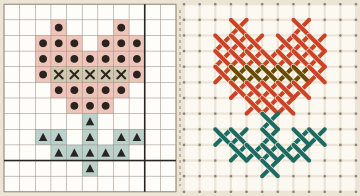
Each square of the chart is one stitch, and the symbol in the square tells you which color to use. The key matches every symbol to a thread number. A square with nothing in it is left as bare cloth.
On this page 7 parts
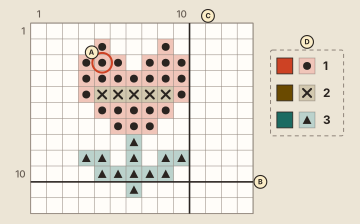
The parts of a chart
- A square is a stitch (A). A chart is a grid of small squares. One square of the grid is one block of Aida cloth. A square with a symbol in it is one full cross on that block. On evenweave or linen stitched over two, one square is two threads of the cloth each way.
- A symbol is a color. Every square that holds the same symbol is stitched in the same thread. Many charts also tint the square with the thread's color. Others are printed in black and white, with symbols alone. Both kinds tell you the same thing.
- The key (D) lists each symbol beside its thread. It is also called the legend. Find the symbol in the key, read the thread number next to it, and thread your needle with that color.
- A heavier line after every tenth square (B) cuts the chart into blocks of ten by ten. They let you count in tens instead of ones.
- Numbers on the top and side edges (C) count the columns and rows, often at 1 and at every ten, so you can find your place again.
- Center marks are small arrows outside the grid, one at the top and one at the side, and on some charts at the bottom and the other side too. Where the lines between them cross is the middle of the design.
Do you stitch the white squares?
No. A square with nothing in it is not stitched: the cloth shows there. The empty part of the grid stands for bare fabric, and only a square that holds a symbol is a stitch.
One thing can catch you out. A white or very pale thread prints as a pale square, but it still has a symbol in it and a line in the key. If there is a symbol, stitch it. If the square is empty, leave it.
Finding the center
Most stitchers begin near the middle of the design, so that it ends up in the middle of the cloth. Follow the arrow at the top straight down and the arrow at the side straight across. They meet at the center.
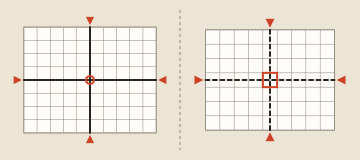
When a design is an even number of stitches wide, its middle is a grid line. When the number is odd, the middle is a square. The same goes for the height. So the center can be a corner where four squares meet, one square, or the edge between two.
What a Floss Field chart prints
Every cross stitch pattern here downloads as a PDF with a cover page and the chart after it.
The cover gives the size in stitches, the number of full crosses and the number of colors. It says where the center is, in words: for example "column 46, between rows 77 and 78". It lists the fabric, the size to cut, the needle and the number of strands, and the stitched size on other fabric counts. The thread key is here too: the thread's own color, its square exactly as the chart prints it, its DMC number and name, and how many stitches it has. A design with more than 24 threads has its key on a page of its own.
The chart pages show every stitch as a tinted square with a symbol. A very dark thread is a deep square with a white symbol, so it still reads. Column 1 and row 1 are the first stitches of the design, and the numbers along the edges mark 1 and then every ten. Arrows outside the grid point at the middle column and row, with a heavier line between them. That line is solid when it falls on a grid line, and dashed when it runs through a middle square. A short key sits under the grid or beside it on every chart page.
Where a chart runs over more than one page, each page says which columns and rows it holds, and the cover has a small map of the pages. The first two rows or columns of a later page are printed in gray: they repeat the edge of the page before, to help you line the pages up. Do not stitch them twice.
All cross stitch charts here are full crosses only. On a chart from somewhere else you may also meet a line drawn over the squares, which is backstitch, and a round dot, which is usually a French knot. That chart's own key will say.
Reading as you stitch
- Find the center of the chart and the center of your cloth.
- Pick a symbol close to the center and look it up in the key.
- Count how many squares of that symbol sit side by side in the row, and stitch that many crosses.
- Count across to the next group, using the heavier lines as steps of ten.
Keep the chart and the cloth the same way up. Turning both upside down together is fine. A quarter turn is not: the top legs of your new crosses would lie the other way from the ones already made.
Common mistakes
- Counting lines instead of squares. A stitch is a square, not a line.
- Stitching the gray squares again. They are the page before, shown once more.
- Taking a pale thread for a blank square. Look for the symbol.
- Counting far across empty cloth. A long jump over bare fabric is the easiest place to miscount. Work outward through the stitches you have already made when you can.
Where to go next
Print the chart so the symbols are easy to read, then learn to keep your place on it. How to count cross stitch and how to start take it from the first stitch. Or choose a chart to read from all the patterns.