Cross stitch guide
Cross stitch hoop size chart
To stitch in, a hoop of 5 to 8 inches (13 to 20 cm) suits almost any design, because a hoop can be moved across the cloth. To hold a whole design, for stitching or for display, choose the smallest hoop that is 1 inch (2.5 cm) wider than the design measured corner to corner. The charts below work that out.
On this page 9 parts
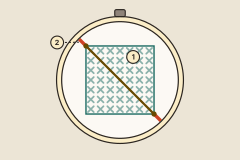
How a hoop is measured
A hoop's size is its diameter: the distance straight across the ring. Round hoops are sold from 3 inches (8 cm) up to 12 inches (30 cm) and larger.
Which hoop for which job
To stitch in. Pick the hoop that is comfortable in your hand, not the one that fits the design. A hoop of 5 to 8 inches (13 to 20 cm) is easy to hold. Larger ones are awkward without a stand. If the design is bigger than the hoop, stitch the part inside it, then move the hoop on.
To hold the whole design. A design that fits inside the hoop never has the ring pressing on its stitches. It is also what you need when the hoop will be the frame. For that, the hoop has to clear the design's corners, not only its sides.
The rule behind these charts
The charts use this site's own rule, the same one the fabric calculator uses. Measure the design from corner to corner (1 in the picture): that is the longest line across it. Add 1 inch (2.5 cm), which leaves half an inch (1.3 cm) of clear cloth at each end (2). The answer is the smallest of these hoops that is at least that wide: 3, 4, 5, 6, 7, 8, 9, 10 or 12 inches (8 to 30 cm).
Other guides give rougher rules. Some say a hoop about 1 inch (2.5 cm) wider than the design. Others say 2 inches (5 cm) wider. For a round design, whose longest line is its own width, the first is the same rule and the second comes out about a size larger. For a square one, measuring across the corners is what keeps the corners inside the ring.
Hoop size chart for 14 count
| Design, in stitches | Stitched size | Smallest hoop |
|---|---|---|
| 20 × 20 | 1 3/8 × 1 3/8 in (3.6 × 3.6 cm) | 4 inch (10 cm) |
| 30 × 30 | 2 1/8 × 2 1/8 in (5.4 × 5.4 cm) | 5 inch (13 cm) |
| 40 × 40 | 2 7/8 × 2 7/8 in (7.3 × 7.3 cm) | 6 inch (15 cm) |
| 50 × 50 | 3 5/8 × 3 5/8 in (9.1 × 9.1 cm) | 7 inch (18 cm) |
| 60 × 60 | 4 1/4 × 4 1/4 in (10.9 × 10.9 cm) | 8 inch (20 cm) |
| 70 × 70 | 5 × 5 in (12.7 × 12.7 cm) | 9 inch (23 cm) |
| 80 × 80 | 5 3/4 × 5 3/4 in (14.5 × 14.5 cm) | 10 inch (25 cm) |
| 100 × 100 | 7 1/8 × 7 1/8 in (18.1 × 18.1 cm) | 12 inch (30 cm) |
| 120 × 120 | 8 5/8 × 8 5/8 in (21.8 × 21.8 cm) | Over 12 inch (30 cm): use a frame |
The hoop leaves half an inch (1.3 cm) of cloth all round the design, measured corner to corner.
Hoop size chart for 16 count
| Design, in stitches | Stitched size | Smallest hoop |
|---|---|---|
| 20 × 20 | 1 1/4 × 1 1/4 in (3.2 × 3.2 cm) | 3 inch (8 cm) |
| 30 × 30 | 1 7/8 × 1 7/8 in (4.8 × 4.8 cm) | 4 inch (10 cm) |
| 40 × 40 | 2 1/2 × 2 1/2 in (6.3 × 6.3 cm) | 5 inch (13 cm) |
| 50 × 50 | 3 1/8 × 3 1/8 in (7.9 × 7.9 cm) | 6 inch (15 cm) |
| 60 × 60 | 3 3/4 × 3 3/4 in (9.5 × 9.5 cm) | 7 inch (18 cm) |
| 70 × 70 | 4 3/8 × 4 3/8 in (11.1 × 11.1 cm) | 8 inch (20 cm) |
| 80 × 80 | 5 × 5 in (12.7 × 12.7 cm) | 9 inch (23 cm) |
| 100 × 100 | 6 1/4 × 6 1/4 in (15.9 × 15.9 cm) | 10 inch (25 cm) |
| 120 × 120 | 7 1/2 × 7 1/2 in (19.1 × 19.1 cm) | 12 inch (30 cm) |
The hoop leaves half an inch (1.3 cm) of cloth all round the design, measured corner to corner.
Hoop size chart for 18 count
| Design, in stitches | Stitched size | Smallest hoop |
|---|---|---|
| 20 × 20 | 1 1/8 × 1 1/8 in (2.8 × 2.8 cm) | 3 inch (8 cm) |
| 30 × 30 | 1 5/8 × 1 5/8 in (4.2 × 4.2 cm) | 4 inch (10 cm) |
| 40 × 40 | 2 1/4 × 2 1/4 in (5.6 × 5.6 cm) | 5 inch (13 cm) |
| 50 × 50 | 2 3/4 × 2 3/4 in (7.1 × 7.1 cm) | 5 inch (13 cm) |
| 60 × 60 | 3 3/8 × 3 3/8 in (8.5 × 8.5 cm) | 6 inch (15 cm) |
| 70 × 70 | 3 7/8 × 3 7/8 in (9.9 × 9.9 cm) | 7 inch (18 cm) |
| 80 × 80 | 4 1/2 × 4 1/2 in (11.3 × 11.3 cm) | 8 inch (20 cm) |
| 100 × 100 | 5 1/2 × 5 1/2 in (14.1 × 14.1 cm) | 9 inch (23 cm) |
| 120 × 120 | 6 5/8 × 6 5/8 in (16.9 × 16.9 cm) | 12 inch (30 cm) |
| 150 × 150 | 8 3/8 × 8 3/8 in (21.2 × 21.2 cm) | Over 12 inch (30 cm): use a frame |
The hoop leaves half an inch (1.3 cm) of cloth all round the design, measured corner to corner.
Other shapes and counts
The charts show square designs. For a design that is not square, or a fabric count not listed here, open the fabric calculator on a design of 50 by 70 stitches. It names the hoop the design fits. Evenweave and linen stitched over two threads count as half their number: 28 count over two is the same size as 14 count.
If you already own a hoop and want to know what fits in it, the calculator answers that too. Choose "I have the fabric, hoop or frame" and enter the hoop's size: what fits in a 6 inch (15 cm) hoop.
How much cloth the hoop needs
A hoop grips the cloth between its two rings, so the cloth has to be larger than the hoop. For a piece that will be displayed in its hoop, the fabric calculator allows 2 inches (5 cm) of cloth on every side of the design. That leaves cloth for the rings to grip, and cloth to gather behind the hoop afterwards.
Moving a small hoop across a large piece
- Put the hoop on over the part you will stitch first.
- Stitch everything inside the ring.
- Take the cloth out, shift it, and put the hoop on again over the next part.
- Take the cloth out of the hoop when you stop for the day. A hoop left on creases the cloth.
Hoops, frames and stands shows how to put a hoop on and tighten it, and what to use when a design is too big for a hoop. To mount the finished piece in its hoop, see finishing in a hoop.