Cross stitch guide
Less common fabric counts
Cross stitch cloth is woven from 6 squares to the inch to 40 threads to the inch and finer. The chart below covers the counts that have no page of their own: how many stitches each gives to the inch, what 100 stitches measure, and the needle and strands to start with.
On this page 10 parts
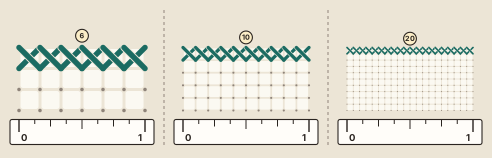
How to read a count
The count is the number of squares, or of threads, in one inch (2.54 cm) of the cloth. A low count means big squares and big stitches. A high count means small ones.
Aida and other block-woven cloths are stitched over one square, so the count is also the number of stitches to the inch. Evenweave and linen are usually stitched over two threads, so they give half their count in stitches: 36 count over two is 18 stitches to the inch.
The less common counts in one chart
| Fabric | Stitches to the inch | 100 stitches measure | Tapestry needle | Strands |
|---|---|---|---|---|
| 6 count Aida | 6 | 16 5/8 in (42.3 cm) | Size 18 | 4 or more |
| 7 count | 7 | 14 1/4 in (36.3 cm) | Size 18 | 4 or more |
| 8 count Aida | 8 | 12 1/2 in (31.8 cm) | Size 20 | 4 or more |
| 10 count | 10 | 10 in (25.4 cm) | Size 20 | 4 or more |
| 12 count | 12 | 8 3/8 in (21.2 cm) | Size 24 | 2 |
| 20 count Aida | 20 | 5 in (12.7 cm) | Size 28 | 1 or 2 |
| 20 count, over two | 10 | 10 in (25.4 cm) | Size 20 | 4 or more |
| 24 count, over two | 12 | 8 3/8 in (21.2 cm) | Size 24 | 2 |
| 26 count, over two | 13 | 7 3/4 in (19.5 cm) | Size 24 | 2 |
| 27 count, over two | 13.5 | 7 3/8 in (18.8 cm) | Size 24 | 2 |
| 30 count, over two | 15 | 6 5/8 in (16.9 cm) | Size 24 | 2 |
| 36 count evenweave or linen, over two | 18 | 5 1/2 in (14.1 cm) | Size 28 | 1 or 2 |
| 40 count evenweave or linen, over two | 20 | 5 in (12.7 cm) | Size 28 | 1 or 2 |
6, 7 and 8 count: the largest squares
These are the coarsest cloths, with the biggest holes. They are the ones to give a child, or anyone who needs to see every hole plainly, and they make bold, chunky stitching. Aida is woven at 6 and at 8 count.
Size is the thing to watch. A design 100 stitches wide is more than 16 inches (42 cm) wide on 6 count.
The needle grows as the holes do. Published needle charts give a size 20 for 8 count and a size 18 for 6 count, as the chart above does; one calculator goes larger still, to a size 16, for 6 and 7 count. Three strands look thin on squares this big. Two published calculators give four strands from 7 to 10 count, and one chart gives all six strands for 6 and 8 count. Stitch a few crosses, and add strands until the cloth no longer shows through.
10 and 12 count
Both sit close to 11 count and are stitched in much the same way. 10 count is easy to plan for, since ten stitches make an inch. Needle charts give a size 20 for 10 count, as the chart above does, and a size 22 for 12 count, one size larger than the chart above. Published strand advice for 12 count runs one higher than the chart as well: three strands, where the chart gives two. On 10 count it is four.
20 count
20 count is the finest Aida in most makers' lists. Over one square it gives 20 small stitches to the inch, worked with one strand, or two for heavier cover, and a size 28 needle or a 26. Evenweave and linen are woven at 20 count as well. Over two threads they give 10 stitches to the inch and are stitched like 10 count.
24, 26, 27 and 30 count
These are evenweave and linen counts that fall around the more usual 25 and 28. All are usually worked over two threads, which gives 12, 13, 13.5 and 15 stitches to the inch. Treat each like its nearest neighbor: two strands to begin with, and a size 24 or 26 needle (one chart gives a 28 for 24 to 27 count). The closer a count is to 11 stitches to the inch, the more likely it is to want a third strand: two published calculators give three strands at 12 and 13 stitches to the inch, which is 24 and 26 count over two.
36 and 40 count
These are fine linens. Over two threads they give 18 and 20 stitches to the inch, the same size as 18 and 20 count Aida, on a ground of very fine threads. They are chosen for delicate, detailed pieces. Use one strand, or two for full cover, and a size 28 needle: most needle charts give a 28 for 36 count, as the chart above does.
Common mistakes
- Reading a linen count as stitches to the inch. Over two threads it is half the count.
- Keeping the 14 count habit of two strands on coarse cloth. On 6 to 10 count, two strands leave the cloth showing.
- Guessing the count of an unlabeled piece. Measure off one inch (2.54 cm) with a ruler and count the squares or threads inside it.
Questions people ask
What is the easiest count to see? The lowest. 6 count has the largest squares of any cloth here.
What is the finest Aida? 20 count in most lists, 18 count in some. Finer cloth than that is evenweave or linen.
Does a pattern have to be stitched on the count it names? No. Any counted chart works on any count. Only the size changes.
Where to go next
For a count that is not in any chart, choose "Another count" in the fabric calculator and type it in. To draw a design on a roomy grid, print 10-count graph paper. The usual counts each have a page: 11 count, 14 count, 22 count, 25 count, 28 count and 32 count. For a first project on 6 or 8 count, see teaching a child to cross stitch, and for 36 and 40 count, linen for cross stitch.