Knots · Easy
Colonial knot
A colonial knot is a round, raised knot made by winding the thread around the needle in a figure eight. It comes out a little larger and more raised than a French knot, and it is the knot used in candlewicking.
How to work it
Bring the needle up

Bring the needle up at A, where you want the knot to sit, and pull the thread all the way through.
Slide the needle under the thread

Hold the thread out to one side with your other hand. Slide the needle under the thread, so the thread lies across the top of the needle.
Wind the thread back in a figure eight

With your other hand, bring the thread back over the needle near the tip and tuck it under. The thread now crosses the needle twice, in opposite directions, like a figure eight.
Go down right beside A

Turn the tip back to the fabric and push it in at B, very close to A.
Snug the knot and push through

Pull the held thread so the figure eight tightens around the needle and slides down to the fabric. Push the needle through to the back, holding the thread until the last of it follows.
The finished knots

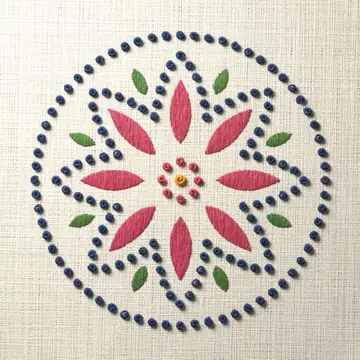
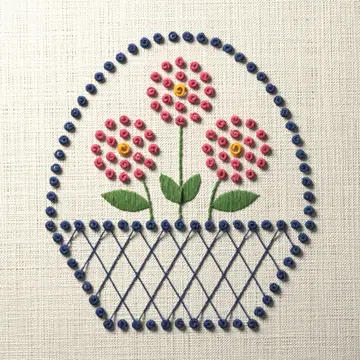
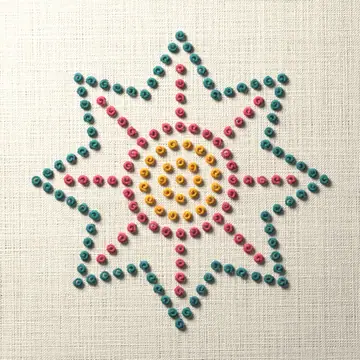
Each knot sits on the surface as a round, raised dot. In candlewicking, some traditional patterns are worked in colonial knots alone.
At a glance
- Also called
- candlewicking knot, figure eight knot
- Used for
- candlewicking; flower centers and accent dots; textured fillings; anywhere a French knot is called for
- Thread
- The thickness of the thread, or the number of strands in the needle, sets the size of the knot. Candlewicking traditionally uses a soft, unbleached cotton thread.
- Needle
- A milliner (straw) needle slides through the figure eight most easily because its eye is no wider than its shaft. For a thick thread such as candlewick cotton, a chenille needle has a large eye and a sharp tip.
Tips
- Think of it as two half turns: first the needle goes under the thread, then the thread goes over and under the needle the other way.
- Pull the thread to tighten the figure eight around the needle before you push through, and keep holding it so the wrap does not loosen or slip off.
- Keep hold of the working thread until the needle is almost all the way through, just as you would for a French knot.
- Change the size with the thread, not with extra turns. A colonial knot always has one figure eight.
- The knot takes both hands on the surface: one holds the needle and the other keeps tension on the thread.
When it goes wrong
- The thread slips off the needle before the knot forms
- Keep light tension on the held thread and wind close to the tip, then tighten the eight as soon as it is made.
- The knot looks like a French knot
- Both turns went the same way. The second turn must go around the needle in the opposite direction to the first.
- The knot is loose or has a loop sticking out
- Slide the eight down to the fabric and keep the thread taut until the needle is nearly through.
Left-handed
Hold the needle in your left hand and the thread in your right, and mirror the diagrams. The knot is the same as long as the two turns go in opposite directions.
Variations
- French knot. The thread is wrapped around the needle in plain turns, all in the same direction. The knot is a little smaller and less raised, and it can be made with one or two wraps.
- Pistil stitch. A knot on a stalk. The needle goes down a short distance from where it came up, leaving a straight stitch with the knot at its end.
- Candlewicking. A whitework tradition from the United States, worked in unbleached cotton thread on unbleached muslin. Some traditional patterns use colonial knots as the only stitch.
Patterns that use it
Questions
- What is the difference between a colonial knot and a French knot?
- A French knot wraps the thread around the needle in plain turns. A colonial knot winds it in a figure eight. The colonial knot comes out a little larger and more raised. In finished work the two look much alike, and you can use either in place of the other.
- Is a colonial knot easier than a French knot?
- Some stitchers find it easier, and some find the French knot easier. The figure eight forms more of a hitch on the needle than a plain twist. Try both and use the one that works for you.
- What is a colonial knot used for?
- It is the knot used in candlewicking. It also works anywhere a French knot would, such as flower centers, single dots and textured fillings.