Outline stitches · Easy
Coral stitch
Coral stitch is a line of thread with small knots tied along it at even intervals, like beads on a string. Each knot is made by taking a tiny stitch under the laid thread and through a loop.
How to work it
Come up at the start

Right-handed stitchers work coral stitch from right to left. Bring the needle up at A, at the right end of the line.
Lay the thread along the line

Lay the working thread along the pattern line to the left and hold it down with your thumb.
Go down just above the thread

Where you want the first knot, put the needle down at B, just above the laid thread. Pull slowly and stop while a loop of thread still lies below the line.
Come up just below, inside the loop

Bring the needle up at C, straight below B on the other side of the laid thread. It must come up inside the loop, so the needle takes a tiny stitch under the laid thread.
Pull the knot tight

Pull the thread through, in the direction you are stitching, until the loop closes into a small knot on the line.
Repeat along the line

Lay the thread along the line again and tie the next knot a short way along. Keep the spaces between the knots the same.
At a glance
- Also called
- coral knot stitch, German knot stitch, beaded stitch, snail trail
- Used for
- textured outlines; stems and tendrils; curved lines; knotted fillings worked in rows
- Thread
- Three strands of six-strand floss give a bold knotted line. One or two strands give a finer line with smaller knots.
- Needle
- An embroidery (crewel) needle with a sharp point. Sizes 7 and 9 are the most widely used. Choose a larger needle, which has a lower number, for thicker thread. A chenille needle suits wool.
Tips
- Keep the tiny stitch under the laid thread short, only two or three fabric threads from B to C.
- Space the knots evenly. They can sit close together or far apart, depending on the look you want.
- Pull each knot tight along the line, in the direction you are stitching. Pulling the thread toward yourself makes a buttonhole stitch, not a knot.
- Once the stitch feels familiar, you can go down at B and come up at C in one small scoop under the laid thread, with the loop under the needle tip.
When it goes wrong
- No knot forms and the thread pulls flat
- The needle came up outside the loop, or the thread was pulled toward you. Make sure the loop lies around C, then pull the thread through in the direction you are stitching.
- The knots are different sizes
- Take the same tiny stitch under the line each time and pull every knot to the same tension.
- The line sags between knots
- Before each knot, pull the laid thread straight along the pattern line and hold it there with your thumb.
- The knots sit crooked on the line
- Keep B and C straight across the line from each other, one just above the laid thread and one just below.
Left-handed
Work from left to right and mirror the diagrams. Lay the thread to the right, hold it with your right thumb, and let the loop fall below the line as before.
Variations
- Scroll stitch. A close relative worked from left to right, with the thread looped around both ends of the needle. The line between its knots is wavy instead of straight.
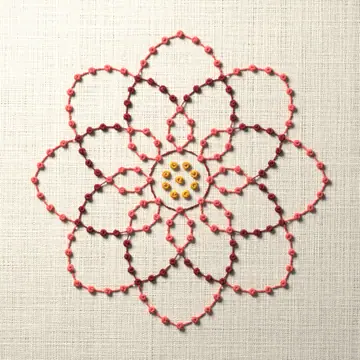
- Coral stitch filling. Rows of coral stitch are worked close together, with the knots of each row set between the knots of the row before.
- Double knot stitch. Also called Palestrina stitch. Each knot is made in two movements over a small straight stitch, which gives a fuller, more raised knotted line.
Patterns that use it
Questions
- What is coral stitch used for?
- It is a textured outline stitch. It suits stems, tendrils and any line that should look knotted. Rows of it worked close together also make a filling.
- What is the difference between coral stitch and scroll stitch?
- Both are lines with small knots. In coral stitch the thread lies straight between the knots, and it is usually worked right to left. In scroll stitch the thread is looped fully around the needle, which makes a wavy line, and it is worked left to right.
- Is coral stitch the same as a French knot line?
- No. French knots are separate knots, each one made on its own. Coral stitch knots are tied into one continuous thread, so the line and the knots are made together.