Knots · Easy
Pistil stitch
Pistil stitch is a French knot at the end of a straight stitch: a thin stalk with a knot at its tip. It is named after the pistil at the center of a flower, which it resembles.
How to work it
Come up at the base of the stalk

Bring the needle up at A, where the stalk begins, and pull the thread all the way through.
Wrap the needle twice

Hold the thread taut with your other hand. Hold the needle near where the thread comes out of the fabric and wind the thread around it two times.
Go down a stalk length away

Keep the thread taut and put the needle tip into the fabric at B, where you want the knot. The distance from A to B is the length of the stalk.
Snug the wraps and push through

Pull the held thread until the wraps slide down to the fabric and the stalk lies straight. Push the needle through to the back, and keep holding the thread until the last of it follows.
The finished stitches

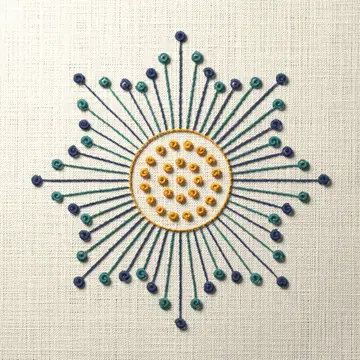
Each stitch is a straight stalk with a knot at its tip. Worked in a fan from one point, they make the pistils of a flower.
At a glance
- Also called
- long-armed French knot, French knot on stalks, elongated French knot, long French knot
- Used for
- the pistils inside embroidered flowers; flower centers; scattered fillings
- Thread
- As with a French knot, the weight of the thread sets the size of the knot. More strands give a bigger knot and a thicker stalk.
- Needle
- A milliner (straw) needle is the easiest choice because its eye is the same width as its shaft, so it passes through the wraps easily. An embroidery (crewel) needle also works.
Tips
- Slide the wraps down to the fabric at B before you push the needle through, so the knot forms at the end of the stalk.
- The stitch can look a little loose at first. It pulls straight and snug when you start the next stitch or fasten off on the back.
- You can mix pistil stitches with plain straight stitches, or with straight stitches tipped with French knots, in the same flower.
- Where you hold the working thread changes the knot a little. Holding it all the way around to one side adds about half a wrap and makes the knot slightly larger.
When it goes wrong
- The knot sits in the middle of the stalk
- The wraps were not against the fabric at B when the needle went through. Pull the held thread to slide them all the way down first.
- The stalk is slack or curved
- Keep tension on the working thread as you pull the needle through. The stalk also straightens when you start the next stitch or fasten off.
- The knot is loose or loopy
- Hold the thread until the last of it passes through the wraps. Letting go early lets the wraps open up.
- The needle sticks in the wraps
- Ease your hold a little, or switch to a milliner needle, whose eye is no wider than its shaft.
Left-handed
Hold the needle in your left hand and keep the thread taut with your right. Mirror the diagrams. The finished stitch looks the same.
Variations
- French knot. The same knot with no stalk. The needle goes down right beside the point where it came up.
- One-wrap pistil stitch. A single wrap makes a smaller knot.
- Straight stitch with a French knot. A plain straight stitch with a separate French knot worked at its tip. The knot comes out a little plumper. The two methods look much alike and can be mixed.
Patterns that use it
Questions
- What is the difference between a pistil stitch and a French knot?
- Only where the needle goes down. For a French knot it goes down right beside where it came up. For a pistil stitch it goes down a short distance away, which leaves a straight stalk leading to the knot.
- How many wraps does a pistil stitch need?
- One or two. Two wraps give a larger knot. More than three wraps tend to make an unruly knot that loses its shape.
- What is pistil stitch used for?
- Mostly flowers. It looks like the pistil inside a flower, which is where the name comes from. It can also be used on its own, away from flowers, or scattered as a light filling.