Needlepoint guide
How to make a needlepoint table runner or placemats
A needlepoint runner for a sideboard or a small table is 32 by 10 inches (81 by 25 cm), 416 by 130 stitches on 13 mesh. A placemat is 18 by 13 inches (46 by 33 cm), 234 by 169. Stitch it in short, flat stitches, block it, turn the edges under and back it with firm cotton. Keep hot dishes off it, and never put it in a washing machine.
On this page 12 parts
Which one to make
| Piece | Good for | What it asks |
|---|---|---|
| Table runner | A sideboard, the middle of a table, a holiday | Length, and a scroll frame, whose rollers take up what is not being worked |
| Cloth runner with stitched ends | A long table | Two small panels, some sewing |
| Table square or topper, 14 inches (36 cm) | A lamp, a bowl of fruit, a small round table | The least work that shows |
| Placemats | A set for guests | Four alike, so plan the set |
| Pad under a dish | Show. A trivet, a stand for a hot dish, goes on top of it | An 8 inch (20 cm) square |
What needlepoint can bear on a table. Dry things, cool plates and glasses, and crumbs. It drinks up a spill: wool can hold close to a third as much water as it weighs. It is not a hot pad. Wool does not melt, but paint on a canvas and many shiny threads soften in heat, and the heat goes through to the table. Stand hot dishes on a trivet, and take up the needlepoint when a meal is messy.
The table runner patterns are charts of 32 by 10 inches (82 by 25 cm) and of 14 inches (36 cm) square, on 13 mesh.
Measure the table
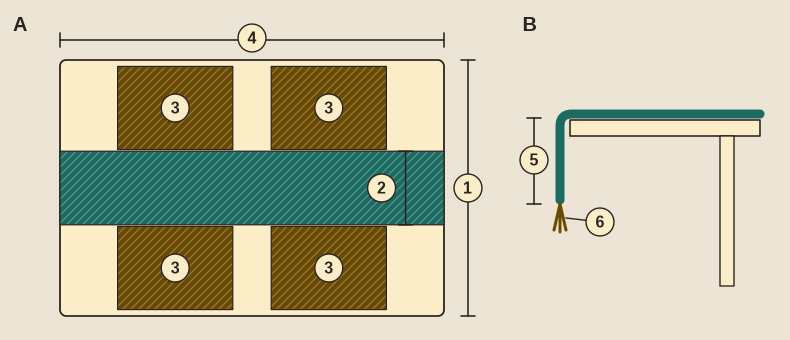
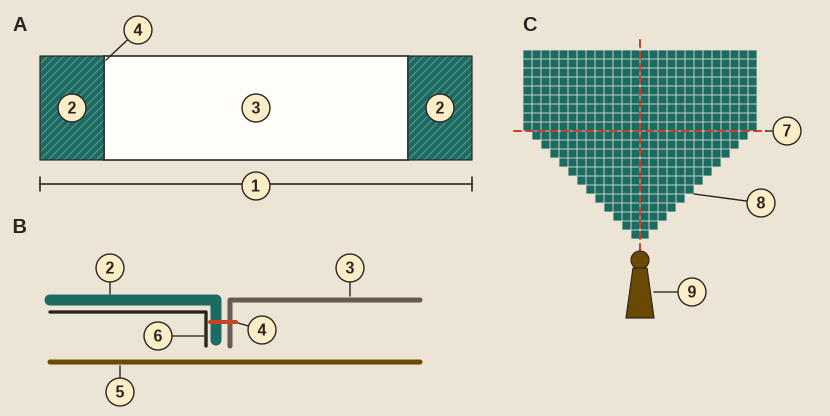
- Measure the length of the table (4).
- Choose the drop (5). A runner may stop short of the ends, or hang over each by 6 inches (15 cm) or more. Needlepoint is stiff at a table's edge, so a stitched runner looks best with no drop: let cloth ends hang.
- Measure the width (1), and take off the mats. A mat 13 inches (33 cm) deep lies 1 inch (2.5 cm) from the edge. On a table 40 inches (102 cm) wide, two of them leave 40 - 2 x 14 = 12 inches (30 cm), so a runner of 11 1/2 inches (29 cm) fits between.
- With no mats, try paper strips of different widths on the table, and choose by eye.
- Decide the view. A runner is seen from both sides. Let the design face both ends, or both long sides, or have no up and down at all.
Sizes and stitches
Mesh is the number of holes to the inch (2.5 cm). The counts are inches times mesh, rounded up, without extra rows. The canvas has room for two extra rows and 2 inches (5 cm) bare all round.
| Piece | Size | 10 mesh | 13 mesh | 14 mesh | 18 mesh | Canvas to cut |
|---|---|---|---|---|---|---|
| Runner, small | 32 x 10 inches (81 x 25 cm) | 320 x 100 | 416 x 130 | 448 x 140 | 576 x 180 | 36 1/2 x 14 1/2 inches (93 x 37 cm) |
| Runner, small table | 36 x 12 inches (91 x 30 cm) | 360 x 120 | 468 x 156 | 504 x 168 | 648 x 216 | 40 1/2 x 16 1/2 inches (103 x 42 cm) |
| Runner, between mats | 48 x 11 1/2 inches (122 x 29 cm) | 480 x 115 | 624 x 150 | 672 x 161 | 864 x 207 | 52 1/2 x 16 inches (133 x 41 cm) |
| Runner, large table | 72 x 16 inches (183 x 41 cm) | 720 x 160 | 936 x 208 | 1,008 x 224 | 1,296 x 288 | 76 1/2 x 20 1/2 inches (194 x 52 cm) |
| Placemat | 18 x 13 inches (46 x 33 cm) | 180 x 130 | 234 x 169 | 252 x 182 | 324 x 234 | 22 1/2 x 17 1/2 inches (57 x 44 cm) |
| Placemat, small | 14 x 11 inches (36 x 28 cm) | 140 x 110 | 182 x 143 | 196 x 154 | 252 x 198 | 18 1/2 x 15 1/2 inches (47 x 39 cm) |
| Placemat, round | 16 inches (41 cm) across | 160 | 208 | 224 | 288 | 20 1/2 inches (52 cm) square |
| Table square | 14 x 14 inches (36 x 36 cm) | 140 x 140 | 182 x 182 | 196 x 196 | 252 x 252 | 18 1/2 inches (47 cm) square |
| Pad | 8 x 8 inches (20 x 20 cm) | 80 x 80 | 104 x 104 | 112 x 112 | 144 x 144 | 12 1/2 inches (32 cm) square |
One mat is 23,400 stitches on 10 mesh and 39,546 on 13. Four are 93,600 or 158,184. Take 10 mesh for a set, 13 for a runner with a picture, 18 for a small square.
Thread, as an estimate, in tent stitch (the small slanted stitch over one crossing): a mat takes about 290 yards (265 m) on 10 mesh and 375 yards (343 m) on 13, and the small runner about 510 yards (466 m) on 13, all colors together. The canvas size calculator does other sizes.
Canvas: four from one, and no seams
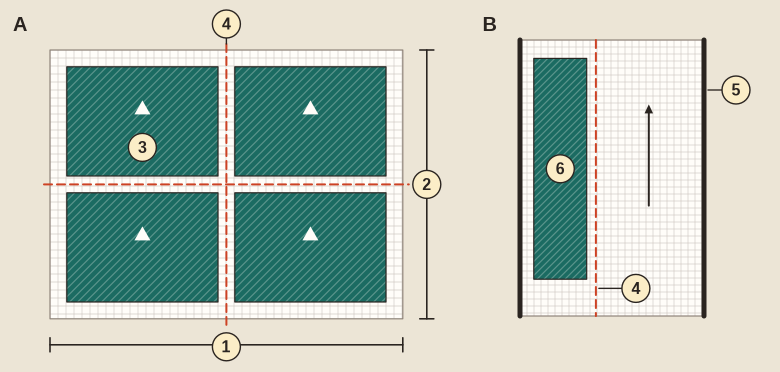
Four mats go on one canvas two by two, with 2 inches (5 cm) bare between them and all round. Add 1 inch (2.5 cm) each way for extra rows. They then come from one roll, with every stitch slanting the same way. Cut them apart after blocking. If that is too much to hold, cut four pieces, and mark the same end of each as its top.
A runner lies along the length of the roll, the arrow in B. It needs a strip only as wide as itself and its margins, so it has no seam at any length. Where you must join, use the overlapped join, planned before you stitch. A long runner can also be several panels, each stitched and blocked by itself.
Buy all the thread for a set at once. Work the background of all four mats from one dye lot, a batch dyed together. If there are two, use both in every mat.
Stitches that lie flat
A glass has to stand level, and forks catch on loops.
| Use | Leave out |
|---|---|
| Basketweave: flat, and stays square | Beads, knots, tufts |
| Mosaic, small Scotch, cashmere | Padded and raised stitches where plates stand |
| Brick, Parisian, bargello over four threads or fewer | Anything longer than four threads |
| Smyrna cross, in a border only | Open stitches, which let crumbs and drips through |
Cotton and wool in plain colors can be damped and blotted if they pass the test for running. Keep overdyed, silk and metallic threads for pieces that are only looked at. Leave out spray-on stain guards: they can react with the dye. Put the darker colors where plates go.
A border makes a set look finished. A side of 18 inches (46 cm) on 13 mesh is 234 threads, and 13 inches (33 cm) is 169. Stitches of three by three fit 234 exactly, 78 of them, and leave 1 over in 169: make the mat 168 threads deep. Borders and corners has the sum.
An oval mat, counted
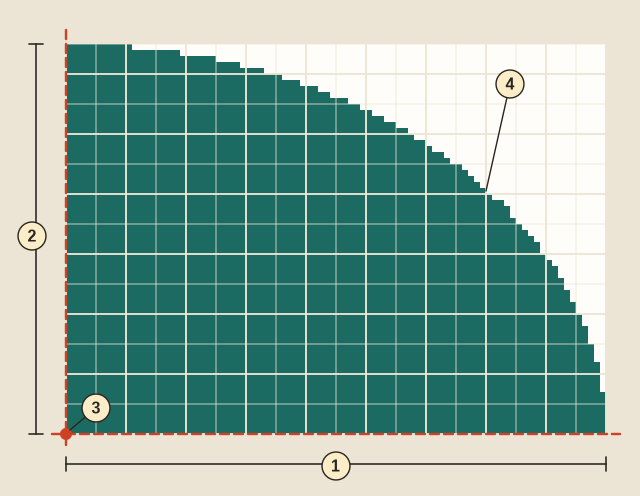
| Row, counted up from the middle | 1 | 11 | 21 | 31 | 41 | 51 | 61 | 65 |
|---|---|---|---|---|---|---|---|---|
| Stitches from the middle line to the edge | 90 | 89 | 85 | 79 | 70 | 57 | 33 | 11 |
- Draw the oblong the oval fits in, with both middle lines.
- Mark the rows of the table. Row 1 lies just above the long middle line and goes 90 stitches to the right of the upright one. Row 11 goes 89, and so on up.
- Join the marks, with the steps of the picture: short ones at the side, longer toward the top. No step goes back.
- Copy the quarter three times: turned over to the left, and both of those turned over downward. All four must match, so count each one from the center.
For another size, the half width of a row is half the width of the oval times the square root of 1 - (h x h), where h is the row's height above the middle divided by half the depth of the oval. At half the height that is 0.87 of the widest row.
The oval is 18,372 stitches, against 23,400 for the oblong.
Bargello for an oval. Its upright stitches lie between canvas threads. The 180 threads of the long middle line take 181 of them, which is 9 repeats of 20 and 1 more.
- Find the center hole. The middle stitch of the pattern stands there, peak or valley.
- Work the first line along the long middle line, from the center to both ends.
- Work the lines above and below, each a row of four threads.
- Stop at the edge with shorter stitches, over three, two or one. Put two rows of tent stitch round the oval: they go over the fold.
Choosing a line, shades and repeat is in how to design bargello. Four-way bargello has its center in the middle of the mat and suits a square one.
Make a stitched runner or mat
You need the stitched piece with two extra rows all round, cotton flannel, firm cotton for the back, and sewing thread. Wash and press the cloths first.
- Mark both middles of the canvas before you stitch, and work from the center out.
- Look for misses against a window when it is done.
- Block it, if its colors pass the test: damp it, pin it out square on a board and let it dry. For a runner you need a board longer than it is: see block something big. Measure both diagonals.
- Trim the bare canvas to 3/4 inch (2 cm), and cut each corner on a slant, half an inch (13 mm) outside the stitching.
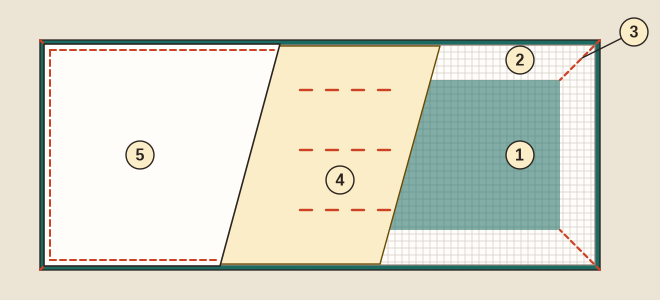
- Fold the margin to the back, between the two extra rows: the inner one is the last you see in front. Fold the corners first and then the sides. Where two folded sides meet on a slant is a miter (3). The rug guide has a picture of the corner.
- Sew the miters with small stitches up the slant, and sew the margin to the backs of the stitches.
- Cut the flannel 1/4 inch (6 mm) smaller than the piece on every side. For mats it may be left out: soft padding tips a glass.
- Hold it with loose stitches 4 inches (10 cm) apart that catch only the backs of the stitches.
- Cut the back half an inch (13 mm) larger than the piece on every side, and press its edges under until it lies just inside the edge.
- Pin it from the middle out, on a flat table, a trifle loose.
- Sew it on with slip stitch, small stitches that hide in the fold.
- Finish the edge, if you want more than a fold: see below.
An oval or round is cut 1/2 inch (13 mm) outside the stitching and snipped every half inch, nearly to the stitching, so that it folds flat. Cover the rim with a cord.
| Edge | Extra rows | Look | Good for |
|---|---|---|---|
| Turned | Two | Flat and plain | Mats, so that they lie flat and stack |
| Binding stitch | None: fold on the first empty row | A braid | Oblong mats that are handled |
| Cord | Two | Round and raised | Ovals, squares |
| Cloth back folded to the front | Two | A flat border of cloth, 1 inch (2.5 cm) | A mat that is too small for the plate |
Cloth back folded to the front. Trim the canvas to 3/4 inch (2 cm) and do not fold it. The mat grows by that on every side.
- Cut the back 2 inches (5 cm) larger than the trimmed canvas on every side.
- Center the mat on its wrong side, the stitching up.
- Fold the back up until its raw edge meets the edge of the canvas, all round. Press.
- Fold it again onto the mat, so that it covers the bare canvas and the two extra rows.
- Sew down two opposite sides close to the fold, and then the other two over their ends.
A cloth runner with stitched ends
| Cloth | Good | Watch |
|---|---|---|
| Heavy linen or cotton duck | As firm as the panel, lies flat, can be pressed | Wash before cutting |
| Wool felt or coating | No hem needed | Not washable |
| Velvet or velveteen | Rich at a holiday | Creeps as it is sewn: baste it, with long stitches that come out later |
| Thin cotton | It ripples beside the stiff panel. Line it with a heavier cloth |
Choose cloth as heavy as the needlepoint or a little lighter. The same heavy cloth makes the plain center of a runner with a stitched strip let in down the middle.
This makes a runner 54 by 13 inches (137 by 33 cm). You need two panels, 1 1/8 yards (1 m) of cloth for the middle, 1 5/8 yards (1.5 m) for the back, sewing thread and a machine, or a sharp needle and small backstitches.
- Stitch two panels, each 13 inches wide and 8 deep (33 by 20 cm), 169 by 104 on 13 mesh, with two extra rows all round. Both face outward, so on the canvas one is the other turned round.
- Block and trim them to half an inch (13 mm) of bare canvas. Sew over the cut edge with a machine zigzag, a stitch that swings from side to side. By hand, whip over it in doubled sewing thread, about five threads deep.
- Cut the cloth 39 by 14 inches (99 by 36 cm) and a back 55 by 14 inches (140 by 36 cm). Both have half an inch (13 mm) for seams.
- Sew a panel to each end of the cloth, right sides together, which means the faces that will show lie against each other, with the needlepoint on top, one row inside the edge of the stitching.
- Press both margins toward the cloth, from the back, the iron off the stitches.
- Lay the back on it, right sides together, and pin from the middle out.
- Sew all round, one row inside the stitching at the panels and in line with that along the cloth. Leave 6 inches (15 cm) open in one long side of the cloth.
- Trim the corners, turn it right side out, and sew the gap closed.
A pointed end. Work the panel straight, and then leave one stitch off at each end of every row until two are left. For a runner 10 inches (25 cm) wide on 13 mesh that is 130 stitches and 64 rows, about 5 inches (13 cm). The edges run on the true slant of the canvas and stretch, so block the point to paper. Work two more stitches at each end of every row, for the seam. Cut the back by the trimmed panel, and in step 7 sew along a straight line drawn on the back of the canvas from the corner to the tip, just outside the counted stitches. Trim the tip straight across near the seam before you turn it. Sew a tassel to the tip.
Plastic canvas mats
For a table outdoors or for children. A sheet of 12 by 18 inches (30 by 46 cm) with 7 holes to the inch (2.5 cm) takes a chart of 117 by 77 stitches and an edge bar all round. Use the stiff kind, worsted yarn and flat stitches, and overcast the edge. There is nothing to block or hem. It wipes clean but it bends in heat: cool plates only. Plastic canvas has the rest.
Care
- Crumbs: shake it and brush it. Do not put it away dirty.
- A spill: lift the piece off the table, blot with a white cloth from both sides, and dry it flat.
- A stain: how to clean needlepoint, by the kind of stain.
- Wax: let it harden. The same guide has the steps.
- Storing: flat with tissue between the mats, or a runner rolled on a tube, face outward.
- Under glass on a small table it stays clean, if the glass does not press on it.
What goes wrong
| What you see | Why | Cure |
|---|---|---|
| The corners curl up | The back is too tight | Unpick one side and sew it on looser |
| A wave along the side of a runner | The back or the canvas was stretched as it was sewn | Unpick, lay it on the table, pin from the middle |
| Mats of different sizes | They were measured and not counted | Count threads. Four on one canvas stay alike |
| A glass rocks | A knot, or a raised stitch | Run ends under. Flat stitches in the middle |
| The runner leans | Continental over a wide field | Block again before backing. Use basketweave |
| A ridge at the seam of panel and cloth | Both margins pressed to the panel | Press them to the cloth, and trim the canvas one to 3/8 inch (1 cm) |
| The oval looks lumpy | A step goes back, or two quarters differ | Count each row from the middle line |
| The bargello is off center | It was begun at the edge | Begin in the center hole |
| Guests see it upside down | One way up only | Face the motifs outward at both ends |
Questions people ask
What size is a needlepoint placemat? 18 by 13 inches (46 by 33 cm) is usual, 14 by 11 (36 by 28 cm) is small. Rounds are about 16 inches (41 cm).
Which canvas for a runner? 13 mesh for most. 10 mesh is quicker to fill and shows bold shapes. 14 is close to 13: use what the chart or your thread suits.
Can I needlepoint on a bought cloth runner? Not by itself: cloth is not stiff or open enough. Stitch a panel on canvas and sew it on, like a patch. Needlepoint on fabric tells what cloth can take.
Is a Christmas runner different? Only in its colors. Keep metallic thread and beads to the ends, where no plate stands. Christmas designs of one size can be set in a row as panels.
Should the set have coasters? They use up the thread that is left: how to make coasters.