Needlepoint guide
Old needlepoint chairs
An old chair and the needlepoint on it are two things with two dates. Turn the chair over, look at the tack holes, the canvas and the wear, and then at the frame. Until you know, leave the cover where it is.
On this page 12 parts
- What to do first
- Where to look, in order
- Is the needlework older, newer, or the same age?
- What kind of chair is it?
- Carved lion heads, claw feet and claw arms
- Golden oak and tiger oak rockers
- Kits and preworked centers on older chairs
- A seat that sags
- Keep the cover or change it?
- Not a chair: fire screens, tables and benches
- What goes wrong
- Questions people ask
What to do first
- Do not sit on it yet, and do not clean it. Lift it by the rails, the wooden bars round the seat, never by its arms or the top of its back.
- Set it on a table, on a blanket, by a window. Take pictures of all four sides, of the underside and of every edge of the cover.
- Look in the order below. Lift nothing, pull no tack and unpick nothing. What you need is at the edges and underneath.
- Write down two dates, one for the wood and one for the needlework. They are often a lifetime apart.
Old needlepoint tells how to care for old seats, and how to date old needlepoint goes through the canvas, thread and nails in detail. This page is about the chair they are on. It says nothing of what a chair would sell for.
Where to look, in order
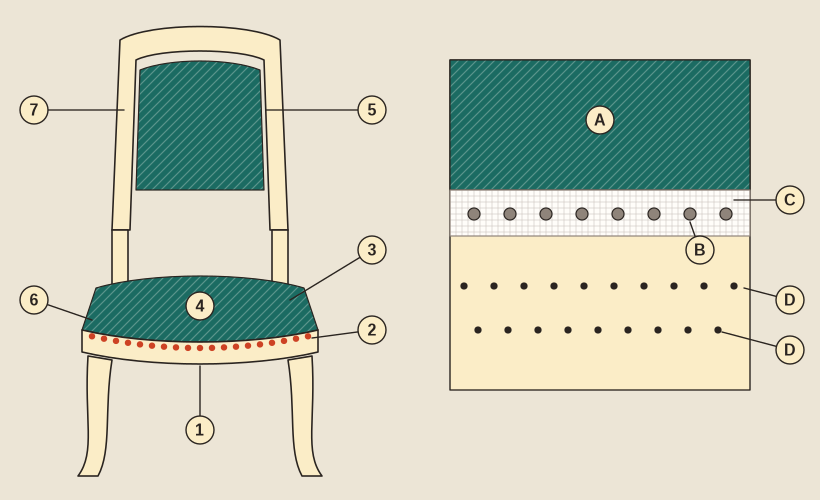
- The underside (1). Is there webbing (strong woven strips), a board, or springs? Coiled springs were still new in about 1845: they came in during the 1820s. Staples say that somebody has worked on it in modern times.
- The holes (D). Where the wood shows along the edge of the cover, count rows of empty holes. One row of tacks in their own holes fits a first cover. Empty holes beside them mean that there was another cover before.
- The canvas (C), where a little is bare. Its weave and its thread give limits: see the tables in how to date old needlepoint.
- The fit (3, 4). Does the design end where the seat ends? A border that runs out of sight at one side, a motif off center or cut in half says that the piece was made for something else.
- The wear (6). A seat wears first along its front edge and at the corners, and the wood wears with it. Worn arms beside a fresh seat do not belong together.
- The colors. Compare the needlework with any part that was hidden from light, if one shows.
- The nails and braid (2). They may be newer than either. They date the last time somebody fitted the cover.
- The frame (7), last of all, with the table of chairs below.
Is the needlework older, newer, or the same age?
| What you find | What it says | A museum chair like that |
|---|---|---|
| One row of holes, a design that fits the seat, the same wear on both | Likely the same age | An English armchair of 1750 to 1760, its seat, back and arms in cross stitch and tent stitch, the short slant, of its own time |
| A design cut off, or made for a seat of another shape | The needlework may be older | An armchair of about 1760 whose seat was stitched about thirty years earlier for another set, and kept |
| A second row of holes, a fresh cover | The needlework is newer | A shield-back armchair of 1775 to 1800. Its cover was long believed original. Underneath were other tack holes and an older cover in bright cross stitch |
| No wear at all, not even at the front | Probably a replacement | A wing chair of the 1730s in tent stitch, judged to have been made new in an old style |
| A frame with no wear and every detail of a famous old design | The chair itself may be a copy | An armchair bought as one of about 1760, now dated 1860 to 1890. Its seat is in gros point, which is large tent stitch |
Even a museum changed its mind about two of these five. Say "probably" for yours.
What kind of chair is it?
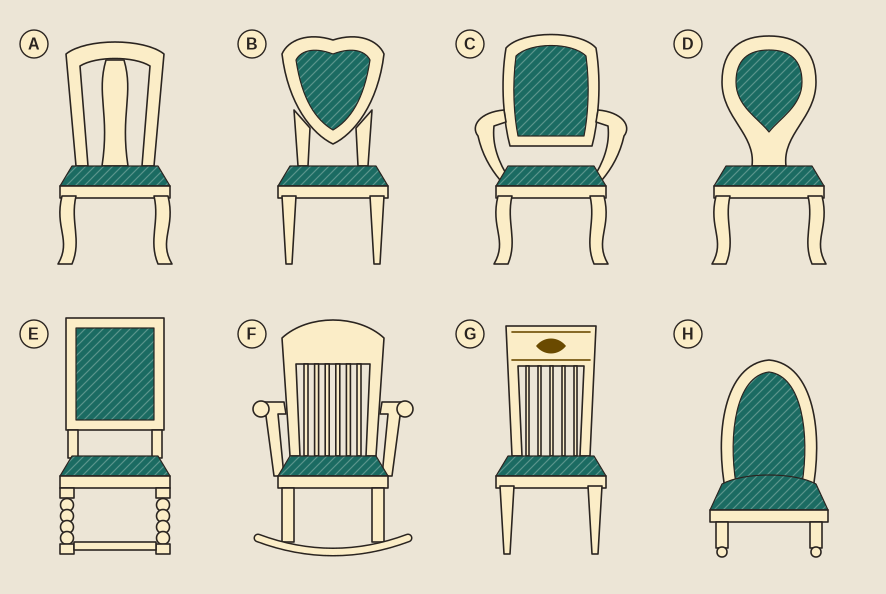
A style gives the earliest date and not the latest: every chair here was copied later.
| Chair | How to know it | When it was first made | Needlework on it |
|---|---|---|---|
| A. Cabriole leg, ball and claw | Legs in an S bend; a foot like a claw gripping a ball; walnut, then mahogany; a drop-in seat, a padded board that lifts out | England about 1740 to 1760; America in the middle of the 18th century. Copied in the 1860s to 1890s, and from the 1870s on by makers who went back to the furniture of colonial America, called Colonial Revival | Wool and silk, flowers on a dark ground. One of 1750 to 1760 has an elephant among trees |
| B. Shield back, and American Federal | A back like a shield, or a light square back; straight legs that taper to a small foot; inlay, thin shapes of other wood let into the surface | The type is named after the English designer Hepplewhite, late 18th century. Federal, about 1789 to 1823 | A small repeat, as the ovals in red and brown on one armchair |
| C. French open armchair | Wood all round, padded back, seat and arm pads | 18th century. Copied ever since: a museum dates one, Louis XV in style and covered in needlework, to about 1890 to 1940 | Flowers and scenes. On many copies a center in petit point, very small tent stitch |
| D. Balloon back | The back is a ring pinched in above the seat | Victorian; one is dated about 1845 | Berlin woolwork, wool stitched from a colored chart: roses and bindweed |
| E. High and square, turned or carved | Straight back, legs joined by bars near the floor, often turned (shaped round on a lathe); heads, lions or leaves carved in it | 17th century, as a Flemish one of 1680 to 1700 | Scrolls and leaves on black, on the Flemish one |
| F. Oak rocker | Carved or pressed back, turned spindles (thin upright rods), arms that end in a knob, a claw or a head | A catalog of 1897 sells them, of solid oak, of quarter-sawed oak and of elm | See below: usually added |
| G. Inlaid mahogany, or spindles (Edwardian) | Dark wood, thin lines of pale inlay, an oval or a shell; slender spindles | About 1895 to 1910. The forms go back to Sheraton and Hepplewhite, English designers of the late 18th century | A small square seat, flowers, often later |
| H. Nursing chair, prayer chair | Low seat, tall back, often on casters | Victorian. A prayer chair, whose back has a ledge to lean on, is dated 1840 to 1860 | Wool on both back and seat |
Mahogany, walnut, oak. The wood alone does not date a chair. It only rules things out when the rest agrees.
Spindle-back and Edwardian chairs
An Edwardian needlepoint chair is usually light in build and dark in wood: mahogany with thin pale inlay in its back, slender spindles in the back or under the arms, a small square seat (G in the picture). A spindle is a thin upright rod of wood, turned round in most chairs and flat in a few. The name is from King Edward VII of Britain, who reigned from 1901 to 1910. Mahogany inlaid in this way was made a little before him, as on a museum's armchair of 1895 to 1900, and copied afterward. A handbook of 1904 says that shells, lines and borders of inlay were then cut by machine and bought ready to let in, so very even inlay suits the date.
| A chair with spindles | How it differs | Needlepoint on it |
|---|---|---|
| Edwardian armchair, or side chair (one without arms) | Inlay, a light frame, a padded seat | The seat, tacked on or dropped in |
| Corner chair | A square seat set cornerwise, with spindles round two sides. Mostly 18th century in style. The seat is of wood, padded, or of rush, which is the stems of a marsh plant, twisted and woven | A padded seat |
| Windsor, from the 18th century on | Round spindles set in a solid wooden seat | Only a loose cushion |
| Country chair with a rush seat | About four flat spindles in a tall back. No inlay | A pad, put on later |
| Oak rocker (F) | Turned spindles under a carved or pressed back | See "Golden oak", below |
Federal dining chairs, and later copies
A Federal dining chair is light, with a square or shield-shaped back, straight legs that taper and thin inlay: about 1789 to 1823. Mahogany is its usual wood. Among eighteen of one museum's American side chairs (chairs without arms) of 1785 to 1815, thirteen are mahogany, and the rest cherry, maple, ash or chestnut. A walnut one is not ruled out, but look twice: the style has been copied since the 1870s.
| What you find | What it says |
|---|---|
| A screw with a cross in its head | The 1930s or later. It may be a repair |
| A seat board of plywood | Common only from the 1880s on |
| Inlay exactly alike on every chair | Cut by machine, as was common by 1904 |
| A mended arm, a newer rail, uneven wear | Repairs come with age. A set with none may be newer |
The needlework has a date of its own, and on an old chair it is usually the later one. Many chairs were given new seats at home in the middle of the 20th century, as told below, and in 1960 the trade sold new chairs with needlepoint on them.
Mahogany chairs sold with a drop-leaf table
Chairs all alike, with needlepoint seats all alike, beside a table on a pedestal are probably a set of the 20th century. Even so, date the table and the chairs apart. A drop-leaf table has a fixed middle and a hinged leaf on each side, and what holds the leaf up is the clue.
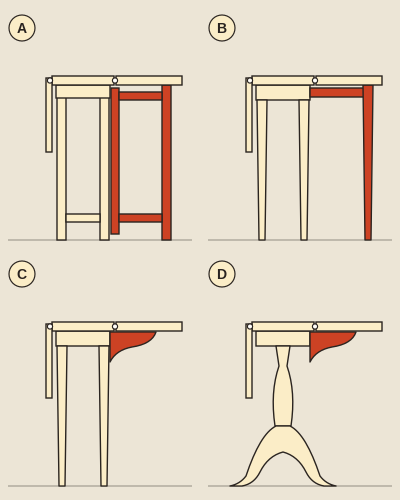
| What holds up the leaf | When it was first made |
|---|---|
| A. A gate: two legs joined by bars, swung out | The 16th and 17th centuries, in oak |
| B. One leg by itself, swung out: one of the four, or one more | The 18th century, in mahogany among other woods |
| C. A bracket, a short arm of wood on a hinge, under a table on four slender legs | The second half of the 18th century, in mahogany among other woods |
| D. A bracket, under a table on one or two pillars with spreading feet, which is a pedestal | About 1800 to 1830 |
All were copied. A catalog of 1930 sells A new. One of 1960 sells tables on slender legs and on a pedestal, with mahogany veneer, a thin sheet of it, glued over other wood. One on a pedestal is 36 by 18 inches (91 by 46 cm) with its leaves down, and chairs to go with it are on the same page. Another catalog of 1960 has the needlepoint: chairs with rosebuds on black, "in mahogany finish". That names the color, not the wood: the same chair is sold there in walnut finish too, and a finisher's manual of 1916 tells how to stain birch to look like mahogany. Look under the seats of such a set for plywood, staples and a printed label.
Carved lion heads, claw feet and claw arms
A carved animal is a fashion that came back again and again, so it gives no date by itself. Lion masks and paw feet are on an English wing chair of about 1732, and heads of women on a fire screen of 1730 to 1750. Carvers have gone back to both ever since.
Look at the carving and the joints:
- Carved from the arm itself, with tool marks and a grain that runs through, or a head glued on?
- Pressed or carved? Sharp, shallow and exactly the same on both sides is the work of a press or a machine.
- Screws. Look at the rockers. Were they made with the chair, or put on legs that were cut short?
Golden oak and tiger oak rockers
Both are dealers' names: "golden oak" for a yellowish finish, and "tiger oak" for oak cut so that pale ribbons cross the grain. The trade's word for that cut is quarter-sawed. A mail catalog of 1897 has page after page of such chairs. Their seats are mostly woven cane or solid wood, a few a sprung pad in silk plush, and none of those pages offers needlework.
So needlepoint on the back, front and seat of an oak rocker was most likely put on later, over a pad that replaced the cane or the plush. The usual signs: a ring of small holes round the seat frame, where cane was once threaded; a board screwed over the opening; newer tacks. That does not spoil it. It only dates it.
A platform rocker, the kind that rocks on a fixed base with springs, often has panels of carpet on its back and seat. They look like needlework and are woven. A child's spindle rocker of 1875 to 1890 in a museum is one, and its own curator took the carpet for a replacement, wrongly. Look for pile, the standing tufts of a carpet, which needlepoint rarely has, and for the slanted stitches over open canvas, which carpet never has.
Kits and preworked centers on older chairs
In the middle of the 20th century many chairs were given new seats at home, and canvases whose flowers were already stitched were sold for it. The signs:
- The middle is very fine and the ground is larger and even: the center was bought ready stitched. See preworked canvases.
- The seats of a set share one ground color, in one wool.
- The canvas has threads in pairs.
- A printed line or a number on the hidden margin.
- Tack holes of one or more older covers.
Such a seat is a later hand's gift to an older chair. It is sound work in most cases and can go on being used.
A seat that sags
Under the pad is the part that carries you. When it stretches, the needlepoint stretches too, so do not leave it.
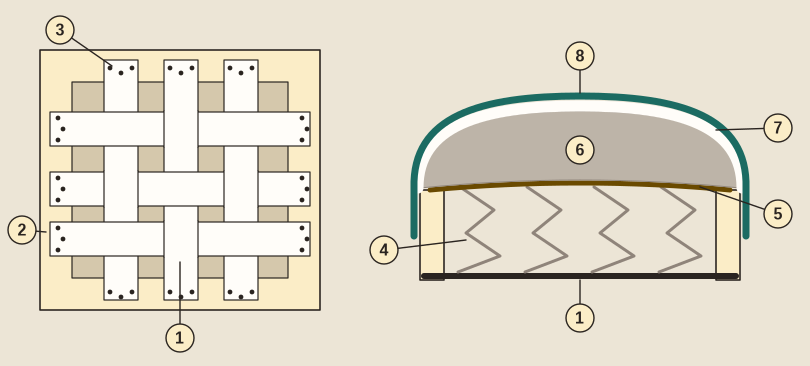
| What you see | What has failed | What an upholsterer does |
|---|---|---|
| The seat dips in the middle, strips hang below the rails | Webbing (1) has stretched or torn | Takes the pad or the cover off, tacks new strips of jute 3 to 3 1/2 inches (7.5 to 9 cm) wide across and down, woven over and under, each pulled tight with a tool called a stretcher |
| Lumps, or a spring (4) that you feel | Twine has broken | Sews the springs to the webbing again, four stitches each, and ties them down to one height |
| Crumbs on the floor | Foam or old rubber has perished | Replaces it with hair, or with foam and cotton |
| A hollow, with sound webbing | Stuffing (6) has moved | Takes out the horsehair, pulls it loose and puts it back with more. Curled horsehair that is clean can be used again |
| The chair creaks | The joints are loose | Glues the frame first |
The whole job in order, from the bare frame up, is in when the seat sags.
Can it be done from beneath? Webbing alone sometimes can: on a chair without springs an upholsterer can put new strips under the old ones, and the cover stays on. Ask this first when the needlework is old.
What you can do meanwhile: put a board under a loose seat, keep people off it, and do not turn the sag into a pull by tightening the cover.
Keep the cover or change it?
| The needlework is | Do |
|---|---|
| Old, or the same age as the chair | Keep it on. Mending and moving it is a textile conservator's work: whom to ask |
| Later, sound, and you like it | Keep it and use it. Dust it through a screen |
| Later and worn at the front | Have it mended, or stitch a new seat and save this one |
| Later, sound, and not to your taste | Have it taken off whole and kept, or framed. A good seat becomes a footstool or a pillow |
| Ruined by moth, damp or breaks | Photograph it, keep a piece with its edge, and cover the chair again: how to cover a chair seat |
If it is taken off, ask the upholsterer to:
- Photograph each layer as it is uncovered, and number the pictures.
- Lift the tacks one by one, and not tear the cover from them.
- Leave a sound old layer on the chair, under the new cover. Your chair's history is in it.
- Keep all that comes off: cover, lining, hair, webbing, a few of the nails.
- Lay the cover flat between sheets of unbuffered acid-free tissue (the kind with no alkali added), with a label: which chair, which part, the date it came off.
May you sit on it? On a sound modern seat, yes. Old needlework is spoiled faster by sitting than by anything else. Set the chair where nobody needs it, or lay a loose cushion on a board over the seat.
Not a chair: fire screens, tables and benches
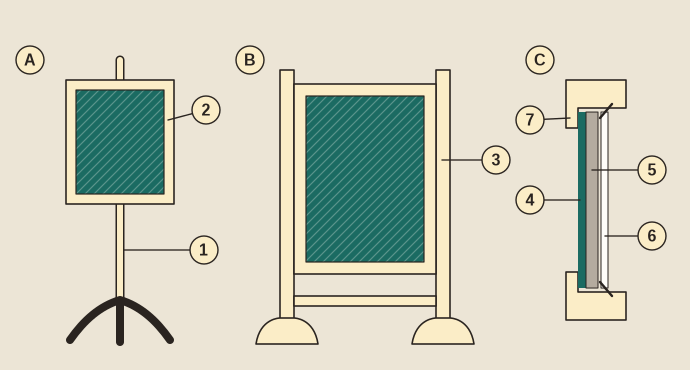
| Thing | What it was for | Dated examples |
|---|---|---|
| Pole screen (A) | A small panel that slides on a pole, to keep the heat of a fire from the face. In fashion from the 1740s | Tent stitch, people in a landscape, 1750 to 1780: the panel is backed with green silk |
| Standing screen, also called a cheval screen (B) | A larger panel on two pairs of feet, before an unused fireplace | Actors on a stage, 1730 to 1750; a cockatoo, flowers and a basket in carved maple, 1850 to 1870 |
| Banner screen | A loose piece weighted with tassels, hung from a bar on a pole | The same family as the pole screen |
| Card table | A stitched cover in the hinged top, where cards slide less and fall quietly. Some show a game in progress. More in old tables with needlepoint tops | One of the 1730s, 33 by 31 inches (83.5 by 78 cm), in gros point and petit point, large and very small tent stitch |
| Bench, window seat, settee | A long cover or a set of covers: see old benches | From about 1540 on |
The wood frame of a screen (C) is made like a picture frame: a wood frame for a fire screen has the steps. The panel is stretched over a board or a light frame, goes in from behind against a lip, and a thin back of wood or cloth closes it. The frame then hangs between the uprights or on the pole. To put a new panel in an old screen, measure the opening behind the lip, not the part you see, and leave 1/8 inch (3 mm) on every side for the canvas. How to frame needlepoint has the lacing. An old panel stays in, and the screen away from fires and radiators.
What goes wrong
| Mistake | Instead |
|---|---|
| Dating the needlework by the chair | Date each by itself, then compare |
| Calling it original because it looks old | Look for a second row of holes |
| Pulling a tack to look beneath | Look at what shows. An upholsterer or a conservator lifts the rest |
| Tightening a loose cover on a sagging seat | Mend the webbing first |
| Throwing away the old cover and stuffing | Keep both, labeled |
| Polishing the frame up to the needlework | Keep polish and oil an inch (2.5 cm) away. They creep |
Questions people ask
How do I find out who made the chair? Look inside the rails for a stamp, a label or a chalk number. A label names a maker or a shop, and those can be looked up. It says nothing of the needlework.
What is a claw foot chair with needlepoint? Usually type A: cabriole legs that end in a claw and ball, with a needlework seat that drops in. Both the 18th century and the 19th and 20th made them.
Is black the old color for the ground? It was liked in many times. The Flemish armchair of 1680 to 1700, the English one with the elephant and a Victorian footstool all have it. It dates nothing.
Can I copy the old seat? Yes, as a chart for yourself: photograph it straight on, count it, and stitch it new. How to transfer a picture and the chair seat patterns help.