Needlepoint guide
How to identify and date old needlepoint
Look at the canvas, the thread, the stitch, the subject and whatever is written on it, in that order. A piece cannot be older than the newest material or mark that belongs to it, and it can be a good deal newer than its style.
On this page 12 parts
What to do first
- Wash your hands and take off rings. Lay the piece on a clean white sheet by a window, out of the sun.
- Open nothing. Do not take it out of its frame, off its seat or out of its backing. Cut no thread. Old needlepoint says how to handle it.
- Take pictures: the front, the back, every edge, every mark, with a ruler in view.
- Work through "Where to look" below, part by part, and write each clue down in one of two lists. Limits are materials, labels and marks that did not exist before a certain year. Looks are subjects and stitches that were in fashion for a time.
- Take the latest limit. The piece is from that year or after it. The looks tell you only what style it is in. "Putting the clues together" shows how. Then read what cannot be told.
This page is about age and kind. What a piece would sell for is another question, and not one that a page can answer.
Where to look
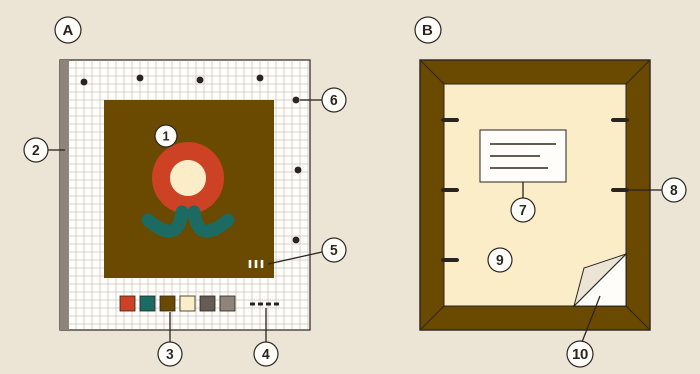
A number in brackets is the number in the picture.
- Look at the stitches (1). Is it needlepoint at all? Stitches over an open grid of canvas say yes. Needlepoint and tapestry tells it from woven cloth, and "Is it needlepoint at all?" below does the rest.
- Compare the colors, back and front, if the back is open. The back shows what they were. Note any bright purple, magenta or harsh green.
- Match the canvas to the next picture, wherever bare canvas already shows. Lay a ruler on it and count its threads in one inch (2.5 cm). That number is its mesh.
- Look at the thread through a magnifier. Wool is matte and a little hairy. Silk shines and is smooth. Rayon shines more, and is slippery and limp. Acrylic is fuzzy, light and even. You cannot be sure by eye, and burning a thread to find out destroys it.
- Name the stitch. A tent stitch is one small slant, a cross stitch two that cross. Note whether each covers one crossing of threads or two each way. Note loops, beads, and pile, which is loops cut to make a tuft like velvet.
- Find the subject in the table of clues.
- Read the margin: the woven edge (2), a row of color squares (3), a name or number (4).
- Look for initials or a date in the stitching (5), and note whether the stitch and thread are the same as the rest.
- Look at the mount: old tack holes (6), a label (7), nails, tacks or staples (8), paper (9), a lining or a zipper. Look in where it is open already (10), and open nothing more.
The canvas
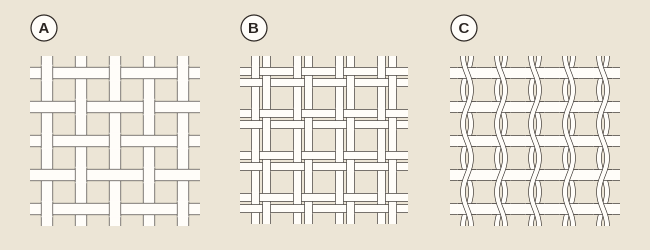
| Canvas | What it says |
|---|---|
| Linen, hand woven and uneven, 20 threads to the inch (8 to the cm) or finer | Common before the 19th century. Fine linen was also used later |
| Single canvas, even | Any date. Linen canvas was still in use in the 1930s |
| Penelope, in pairs | Ordinary by 1858, and still made |
| Silk gauze, a very fine canvas of silk | Any date, from Chinese badges of about 1800 to now |
| Interlock | The early 1970s or later. Silk gauze, also woven with twisted threads, is far older and much finer |
| Card with punched holes | 1820s to about 1910, at its height in the 1870s, and sold again today. It is not canvas, but the stitches are the same |
A design printed or painted on the canvas does not by itself mean modern: patterns were drawn and painted on canvas in the 1850s, and long before. A crisp many-colored print, with squares of the colors on the margin, points to a kit of the 20th century or later.
Dated clues
Each row rests on a dated museum record, book or study. Only a row that begins with "From" is a limit. The others are looks: they tell you when a thing is known to have been made or was in fashion, and it may have been made earlier or copied later.
| Clue | Date |
|---|---|
| Berlin work: wool in cross or tent stitch, copied from a colored chart on squared paper. It is sure only if the chart or its maker's name is with the piece | From 1804; at its height 1830 to the 1870s; in the United States mainly from the 1840s; falling away in the late 1880s |
| The wool sold for it, Berlin wool | Made until the 1930s |
| Bright mauve, then other harsh bright colors | From 1856; mauve in fashion 1859 to 1861 |
| Full-blown roses in many shades | 1830 to the 1870s at its height; a bag of about 1900 has them too |
| Parrots and cockatoos, plumage in cut loops | A panel of the 1850s; a manual of 1858 gives the method |
| Wool and silk together with beads and cut pile, flowers | A picture of about 1850 |
| Glass and metal beads for the background or the lightest parts | A handbook of 1858 teaches both |
| Royal children, dogs, scenes after paintings | A prince with a dog, about 1860 |
| Bible scenes in wool, beads and pile | As late as 1885 |
| Geometric repeats in darker wools, on chairs | A child's chair of about 1845 has one. Others may be older |
| Faces in fine silk stitches, clothes in larger wool ones | 19th century, on double canvas |
| Faces painted on silk laid over the canvas | Taught in 1858 |
| Mottoes and bookmarks on punched card | From the 1820s, at their height in the 1870s, out of fashion by about 1910 |
| Covers for chair backs, woven by machine to look like petit point | About 1900 to 1925 |
| Wool with metallic thread on a seat | A stool cover of about 1938 |
| Country cottages, gardens and villages | Common in British magazines from the 1930s to 1960 |
| A regiment's or a service's badge | Badge patterns were given away and sold from 1940 through the war |
| A picture on very coarse canvas | One was offered in 1939 for dim evenings in the blackout. Coarse canvas alone proves nothing |
| A flower center already stitched, ground left to fill | Advertised in 1955 and in 1965, and still sold |
Materials and labels: the earliest date they allow
| What you find | Not before |
|---|---|
| Machine-cut nails: flat-sided, not round, with a blunt tip | About 1800; common to about 1914. Cut tacks for upholstery went on much longer |
| Wire nails, with a round shank | About 1860; the usual nail from the 1890s |
| "Made in Germany" in English | 1887 |
| Rayon thread | 1905 |
| A postal zone of one or two figures after the city in a maker's address | 1943, and mostly before 1963 |
| Acrylic yarn | The 1940s |
| "Made in West Germany" | 1949, and before 1991 |
| A five-figure ZIP code | July 1963 |
| Interlock canvas | Early 1970s |
| A bar code on a wrapper | 1974 |
| A nine-figure ZIP code | 1983 |
A label on the back may be the framer's and not the stitcher's. A zipper, a velvet back or staples may have been put on when a pillow was covered again. Write them down, and do not let them date the stitching.
Numbers, letters and initials
- A number on the margin is usually a design number, put there by the maker of the canvas so that a shop could order it. A second number such as 10, 12, 13 or 18 is often the mesh. Neither is a date.
- A name on the margin is the maker of the canvas or of the design. Look for the years in which that firm traded.
- Letters on the squares of color are a key to the wools.
- Initials in the stitching are the stitcher's, or the person it was for. Initials or a name painted on the canvas belong to whoever painted the design.
- A date in the stitching is the best clue there is, as long as it is in the same thread and stitch as the rest. It may be the date of an event, a birth or a wedding, and it may be copied from an older piece.
- Alphabets and rows of patterns are a sampler.
- A selvage, the firm woven edge, was usually kept at the left or the right, so it hints which way is up. It gives no date.
Is it needlepoint at all?
| What you see | What it is |
|---|---|
| Tent or cross stitch covering an open grid | Needlepoint, also called canvas work |
| Tiny slanted stitches on fine canvas or gauze | Petit point, which is needlepoint: see petit point and gros point |
| Tent stitch on silk gauze, with dragons, birds or clouds | Chinese canvas work, as on an official's badge of about 1800 |
| Long glossy stitches on silk cloth, the cloth showing | Silk embroidery, not needlepoint |
| Fine black or brown lines like pen drawing on silk | Often hair worked with silk. A museum has one of 1800 to 1825. Not needlepoint |
| Crosses on linen, with the linen showing | Counted cross stitch |
| Ridges one way, no canvas | Woven tapestry |
| The same motif again and again, no separate stitches | Machine-woven cloth |
| Thread on solid cloth, locked behind with a second, finer thread | Factory embroidery, as on patches and panels |
Putting the clues together
A pillow front, as an exercise: cotton Penelope canvas, roses in tent stitch, yarn that is partly hairy and partly even and light, a back brighter than the front, a printed row of squares on the hidden margin that a torn lining shows.
- Penelope canvas, a limit, though not a sure one: ordinary by 1858, so probably the middle of the 19th century or later.
- Roses, a look: no help. They were stitched for a century and more.
- Color squares, a limit, though not a sure one: they point to a printed kit of the 20th century or later.
- Light, even yarn that may be acrylic, a limit if it is: 1940s or later. The bright back says only that the front has faded.
- The latest limit: a printed kit, perhaps with acrylic. Say: "a kit, probably of the middle 20th century or later, in the style of the 1850s."
That is how to word it: what is certain, then "probably", then the style.
What cannot be told
- The year, from a style. Roses were copied for a hundred years, and a pattern could be bought in one decade and stitched in the next.
- Who made it, from its quality. Workshops and homes used the same patterns.
- Where, from the stitch. The same stitches were worked all over Europe and America.
- Hand or machine, from neatness. Look at the structure and not at the evenness.
- The fiber, for certain, without a microscope.
- That it is old because it is faded. A sunny window fades a new piece in a few summers: see faded colors.
Where to ask
- A museum with textiles, by letter or email, with your pictures and measurements. Ask what it is and when that kind was made. Museums do not give values.
- A local history society or historic house, if you know the family or the town.
- A needlework guild. Members know kits and canvases of their own lifetime.
- A textile conservator, a person trained to clean and mend old cloth, if it is weak, dirty, moldy or torn. Old needlepoint says how to find one.
- A library, for a firm's name on the margin: city directories and old magazines list them.
Send the pictures, not the piece.
What goes wrong
| Mistake | Instead |
|---|---|
| Dating it by its subject alone | Date it by the newest material or mark that belongs to it |
| Pulling a thread to test it | Look through a magnifier at what already shows |
| Opening the frame to see the back | Leave it. A frame that must be opened goes to a conservator |
| Trusting a family story whole | Write it down with the name of who told it. Then see whether the materials agree |
| Cleaning it to see better | Never. Dirt and old labels are evidence too |
| Calling it tapestry, and looking in the wrong books | Look under canvas work, Berlin work, needlework and petit point |
Questions people ask
How old does it have to be to be antique? People usually say a hundred years, and vintage for less. Neither word tells you the date.
Is an unfinished piece older? No. It may be useful, though: bare canvas shows the weave, the drawing and the margin.
Was mine a kit? Printed canvas, color squares on its margin and wool cut to equal lengths say so. Kits are not only modern: patterns were sold with their wools in the 19th century. Preworked canvases, whose middle is stitched before they are sold, are a kind of kit.
What do I do with it now? See what to do with old needlepoint, and the history of needlepoint for the fashions in order.