Old silkwork pictures: embroidery or needlepoint?
Most old silk pictures that families call needlepoint are embroidery on silk cloth, often with the face and the sky painted. It is needlepoint only if there is canvas under the stitches. Look at the surface through a magnifier, and open nothing.
On this page
Look in this order
Leave the picture closed in its frame. If it hangs, look at it where it hangs. If it is down, lay it flat on a table, glass upward, near a window but out of the sun. Old silk may be too weak to be tilted or stood up, so move your own head and not the picture. Use a magnifier. Each step names the row of the table below that fits, or sends you on.
- Look for canvas. At a worn spot or along the edge, is there an open grid of threads with holes? Then it is needlepoint. If all the thread is silk, it is row F. If most of it is wool, it is row G. Stop here. If there is no grid, go on.
- Follow one thread. If the threads only run straight across, side by side, and none goes down into the cloth, the picture is woven: row E. Stop here. If threads go down at each end, they are stitches: go on.
- Look at the cloth between the stitches. If it is smooth, close and shiny, it is silk or satin, and the picture is silk embroidery. One of rows A to D will fit.
- Note the colors. Only black, brown and cream, in lines like a pen drawing: print work, row B. More colors: go on.
- Look at the faces, the hands and the sky. If no thread crosses them, and they stay dull when you move your head while the silk shines, they are painted: row A. With a tomb, an urn and a willow, it is the second row A.
- Look for fuzzy cord lying on top, like a thin pipe cleaner. That is chenille. Keep row A, and read row C for its dates.
- If no face is painted, look at the petals and feathers. Flat, glossy silk with a clean edge to each petal, a blank sky, a poem, a scroll or a long panel: probably Chinese, row D. People and a landscape filled in with long and short stitches: row A again. A stitched face is rare there, but it is known.
- Read the glass, the mat and the back for names, titles, numbers and labels, as far as they already show.
Small rings like seeds are knots. They do not decide between A and D: Chinese pictures have them in the centers of flowers, and British ones have them in a sheep's fleece and in leaves.
What the surface tells you
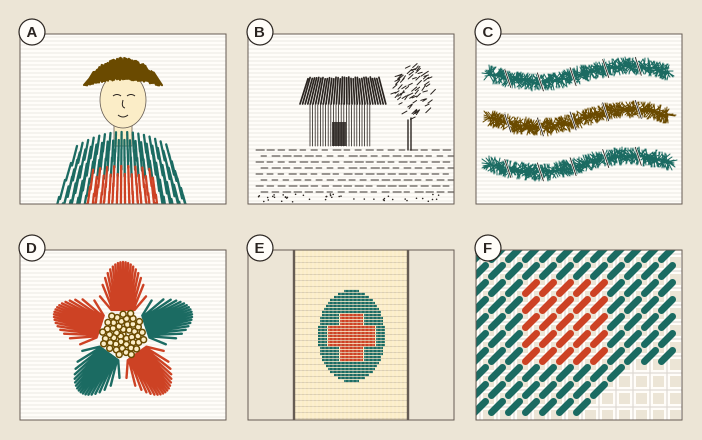
| What you see | What it is | Dated pieces in museums | Is it needlepoint? | |
|---|---|---|---|---|
| A | Long and short stitches on silk or satin, perhaps small knots for a fleece; face, hands and often sky painted | Silk embroidery, much of it schoolroom work, in Britain and America | About 1770 to 1840 | No |
| A | The same, with a tomb, an urn and a willow | A mourning or memorial picture | 1803, about 1815, 1824 | No |
| B | Fine black lines and specks on white or cream silk | Print work: black silk made to look like a printed engraving | 1787, 1796, early 1800s | No |
| B | The same in brown or fair lines finer than silk | Hair, alone or with silk | 19th century | No |
| C | Thick, fuzzy cord on trees, fleece or ground | Chenille, beside silk stitches | America, 1803 to 1840. Britain, 1780 to 1810 | No |
| D | Glossy flat petals, birds or figures, flower centers of close-set knots, a blank sky, a poem | Chinese silk embroidery | 18th century to now | No |
| E | A strip or small card, the picture in the cloth itself | Woven silk, from a ribbon loom | From 1862; souvenirs of 1893 and 1904 | No |
| F | Small slanted silk stitches, one over each crossing of the canvas: tent stitch | Canvas work. If the stitches are very fine, it is called petit point | Middle of the 17th century | Yes |
| G | The same or small crosses, mostly in wool, with silk where something shines | Berlin work, pictures stitched on canvas from a painted chart, and its like | 1840s to 1870s | Yes |
The dates are those of pieces in museum records. They show when a kind is known to have been worked, and later copies of every kind exist. How to identify and date old needlepoint says how to use such a date, and old needlepoint has a shorter list with what to do first.
A short history of silkwork pictures
The 1600s. English pictures of this century are silk on linen canvas, or silk, metal thread and raised figures on satin. Those on canvas in tent or cross stitch, such as one of 1636, are needlepoint. Kings, queens, Bible scenes, and lions and leopards out of scale are common subjects.
About 1770 to 1840: the silk picture. White or cream satin was stretched, a scene from an engraving was sketched on it, and the clothes, trees and ground were filled in colored silks. Most faces are painted; a stitched face is rare. Some were painted on card or parchment, laid on the silk and stitched round. American ones were mostly no more than 18 to 20 inches (46 to 51 cm) across. Where stitches have worn, the drawn outline may show.
The same years: print work. A pale silk was shaded with thin brown wash, then covered with black silk: close satin stitches in the darkest parts, separate lines in the middle tones, nothing in the sky. It looks like an engraving from a step away. By 1882 it was called etching embroidery, and by then it was mostly outline.
The Victorian years. A dictionary of 1882 says how fine silk work went out of date and Berlin patterns, stitched on canvas in tent or cross stitch, took its place. Silk stayed on in them where something shines: a cheek, a pearl, a sleeve. What else was made then is in what Victorian fancywork was. So a Victorian "silkwork" lady may be needlepoint with silk in it.
From the 1870s: art needlework. Shaded silk in long and short stitches came back, often in soft, plant-dyed colors. Societies sold designs and part-worked pieces. A painted and embroidered figure of about 1886 to 1890 shows that painting and silk were still put together.
After 1900. Woven silk souvenirs went on (one is of 1904), and kits and magazines brought the old subjects back. A crisp printed outline under the stitches points to a kit.
Ladies, shepherds and peasants
The subject tells you what was liked, and the dress sets the scene. Neither dates the stitching by itself.
| What is in the picture | Dated example or fact | What to be careful of |
|---|---|---|
| A lady in a wide straw hat and a white dress, with grain in her apron | About 1790, face and sky painted | The grain makes her a gleaner, but the dress is a fashionable one |
| A lady or shepherdess in a high-waisted dress with sheep | About 1800; a shepherd with pipes, 1816 | 20th century kits copy it |
| Peasants hauling wood; a man with a scythe going home to a cottage | 1800 and the early 1800s; the wood haulers are in black silk | A peasant with a pretty, smooth face: the face is probably painted. Move your head from side to side: paint does not shine |
| A lady in a bonnet, seen from the side | Bonnets with a brim deep enough to hide the face from the side: about 1817 to 1845. Smaller bonnets: to the end of the century | A lady in profile shows off the bonnet, and was drawn long after it was worn |
| A lady walking in a large shawl and a full gown | Kashmir and Paisley shawls: early to middle 19th century, going out from the 1860s and 1870s | Embroidered shawls came back in the 1920s |
| A lady in a very wide skirt in a cottage garden | A favorite of magazines from about 1930 to 1950 | It looks Victorian and is not: see old picture subjects |
To put a lady in order, ask three things. Is her face painted or stitched? Is there silk cloth or canvas behind her? What is the latest thing she wears? A painted face on satin with a dress of 1800 fits the silk pictures of about 1770 to 1840. A bonnet and shawl in tent stitch on canvas belongs with Berlin work or a later kit.
Chinese silk pictures and hangings
Chinese embroidery is a tradition of many centuries, with four regional styles, and it is practiced now. On a hanging look for these:
- Flat silk, with little or no twist, laid in satin stitch so close that it shines like the ground. The direction of the stitch changes with each petal or feather.
- Knots set one against the next, for flower centers, fruit or fur.
- A scroll or a long panel. One scroll of 1860 to 1880 has birds, a willow and a poem. Such scrolls were brought out for a season, not hung all year.
- Figures in a pavilion, peaches, and the sign for long life. These suit birthday gifts. A hanging of 1850 to 1900 has small parts painted.
- The same on both sides, with no ends to see: a special kind of work from Suzhou.
Style alone does not date one: the same birds and peonies are worked today. A country's name on a label helps: marks and frames has the years. Chinese work in tent stitch on silk gauze exists too, such as a badge of about 1800 for an official's robe. That is needlepoint.
The colors of old silk
Until 1856 silk was dyed with plants, insects and minerals. This table is from a dyer's handbook of 1853, the end of that time, so an older picture may differ in part. How the dyes hold is from a conservation institute.
Four words in it are a dyer's. A dyewood is a colored wood, such as logwood, boiled for its color. A lichen dye is a paste or powder from a lichen, which grows on rocks and bark: alone it gives ruby, a little of it makes blue brighter, and with logwood it gives purple. Indigo extract is indigo, a blue from the leaves of a plant, dissolved in acid. Drab is dull light brown.
| Color in the picture | What it was dyed with | How it lasts |
|---|---|---|
| Crimson | Cochineal, a dye from an insect. The silk was first steeped in a tin salt | Fades easily |
| Scarlet | Annatto, an orange seed dye, then cochineal | Fades easily |
| Cheaper crimson, claret, ruby | Dyewoods or lichen dyes | Fades easily, as most plant dyes do |
| Dark and middle blue | Indigo, with a lichen dye under it to make it brighter; or Prussian blue, made with iron | Indigo is among the steadiest on wool. On silk there is no figure to give |
| Sky blue, lavender | Indigo extract. For lavender a red dye was added | Fades easily, as most plant dyes do, and a pale shade has little to lose |
| Violet, purple, maroon | Logwood, dyewoods, lichen dyes | Fades easily, as most plant dyes do |
| Yellow | Weld, oak bark, turmeric | The dyer called weld very fast and turmeric very fugitive. Most plant yellows fade easily |
| Green | A yellow dyewood called fustic, then indigo | Where the yellow goes first, blue is left |
| Brown, drab, fawn | Annatto, fustic, lichen dye, logwood and iron | The dyer found browns with iron more lasting than those without. Iron weakens the silk |
| Black | Iron and logwood | Iron weakens the silk, so a black part may break first |
| Flesh, buff, salmon | Annatto | Faces were more often painted |
| Harsh purple, magenta, bright green | Dyes made from coal tar, from 1856 | Fades easily. The thread is of 1856 or later |
Antique: before 1856. The whole range, from crimson to sky blue, on cream. Most of what you see now is softer than it was.
Victorian: from 1856 on. The same dyes and the new bright ones beside them. A picture from the first Victorian years, 1837 to 1855, has the older colors only. From the 1870s, soft plant-dyed shades again, by choice.
Red, blue and earth colors only. Three things give that look. Greens may have lost their yellow and turned blue. Purples and pinks may have faded away. Or the picture was planned in browns and blacks on fawn silk, as a landscape of 1770 to 1799 was. Look under the edge of the mat, if a gap already shows it, for color the light has not reached. Faded colors explains the fading.
Frame, glass, mat and label
- Black glass with a gold line, painted on the back, round an oval or square opening: pictures of 1770 to about 1800 have it, and so do mourning pictures. The title may be lettered on it.
- A carved or gilded wood frame fits about 1770 to 1840, and was copied later.
- A fire screen on a pole may hold one: look for rings or a fitting on the back.
- A printed title on a card mount, with a weaver's name, and a printed label behind: woven silk, later 19th century. The word "registered" may stand on either.
- A framer's label dates the framing. The frame may be older or younger than the picture.
Keep it, and leave it closed
Silk is the natural fiber that light harms most, and the harm cannot be undone.
- Take it out of the sun, and away from lamps and the wall above a fire.
- Do not open it. Silk that looks whole may be held up only by the glass and the mat.
- Do not clean it, not with a brush, a vacuum or a damp cloth. Ink and watercolor run.
- Carry it flat, glass upward, on a board, level all the way.
- Photograph it straight on, with a ruler beside it, and the back as it is.
- Ask a textile conservator if you see splits, powder at the bottom of the frame, stains, or silk touching the glass.
Silk that splits in long cracks is called shattered. From the later 19th century silk was often weighted: metal salts, iron and tin among them, were put in to make it hang well. They make it turn acid, weak and brittle, and light then breaks it up fast. Silk dress linings of 1890 to 1915 are known for it, and the silk behind a picture can be the same. It cannot be ironed, glued or stitched back at home.
What goes wrong
| Mistake | Instead |
|---|---|
| Looking it up as needlepoint | Look under silk embroidery, silk picture, needlework picture or print work |
| Dating it by the dress | Use the dress as the earliest date of the scene, then look at cloth, stitch and frame |
| Taking a painted face for damage | It was meant: the face was never stitched |
| Taking a woven picture for fine stitches | Follow one thread to see whether it goes down |
| Opening the frame to see the edge | Photograph what shows, and ask |
Questions people ask
Is silkwork the same as needlepoint? No. Silkwork is any stitching in silk, mostly on cloth. Needlepoint is stitching on canvas. Silk on canvas is both.
Was it done by a child? Many were the work of girls at school, and the painted parts often of a painter. A name and an age on the glass are the only good evidence.
What is it worth? No page can say. Old needlepoint says whom to ask.
Can I stitch something like it on canvas? Yes: silk or stranded cotton in satin stitch for dresses and petals, tent stitch on fine canvas for a face, as in petit point, and French knots for a fleece. Victorian ladies has patterns.