Needlepoint rugs and others, and how to tell them apart
A needlepoint rug is stitched with a needle over canvas. An Aubusson and a kilim are woven on a loom, and have no canvas. Fold back one corner and look at the back, and you will know which you have.
On this page
Turn back a corner
- Choose a corner that is not worn or torn. Fold it back gently, with the fold a little way in from the edge. If the rug is brittle, stop.
- See if there is a lining. If cloth covers the back, do not cut it. Look for a place where its edge has come loose. If there is none, look in front for a worn spot: bare canvas, a grid with square holes, means needlepoint, and bare strings lying side by side mean weaving.
- Feel the front. Flat all over: go to step 4. Loops or tufts that stand up: go to step 6.
- Flat: look for canvas. If the back is a grid of threads with square holes, and every stitch goes down through a hole, it is needlepoint. Now look at the front to tell A from B. Plain slants, or small crosses side by side, are A. Thick rows like a plait are B. If there is no grid, go to step 5.
- Flat, with no canvas: look at the edges between colors. Fine ribs that run one way, with a slit or a line of sewing where two colors meet, mean tapestry weave. With yarn ends behind, or flowers and scrolls, it is C. With the same clean face on both sides, and steps and diamonds, it is D. If threads of every color run straight across the whole back, it is H.
- Loops or tufts: look at the back. Loops in front and lines of short dashes on cloth behind: F. Cut tufts knotted on open canvas, with pairs of short bars behind: G. Cut tufts with rows of small bumps behind, in the colors of the front: E. Cut tufts with threads of every color, or a stiff coated cloth, behind: H.
- Look at the ends. Strings that run out of the rug itself as a fringe are the warp, the threads stretched on a loom. That rug was woven: C, D, E or H. A fringe that was sewn on, or no fringe, settles nothing, because needlepoint, hooked, latch hook and many woven rugs have the same.
- Compare the back with the picture.
The back of needlepoint is not always like A or B in the picture. Tent stitch may show long slants, a basket weave or short uprights, and cross stitch worked in rows shows uprights. The page on the back of needlepoint draws the three of tent stitch. Any of them on a grid is needlepoint, and the front gives the stitch.
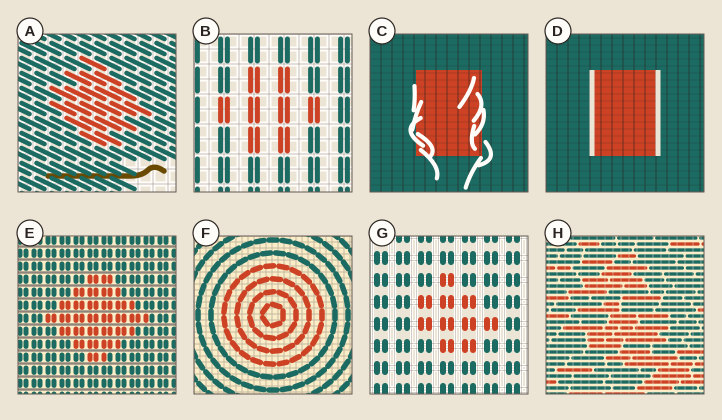
| Rug | How it is built | The back | The edge | Feel | Usual date and place | |
|---|---|---|---|---|---|---|
| A | Needlepoint in tent stitch or cross stitch | Wool through canvas | Slants, a basket weave or uprights on a grid, or a lining | Canvas folded under, and sewn over and over with yarn or covered with tape | Flat, firm, a little stiff | England from the 1500s, first for tables; made in many countries now |
| B | Needlepoint in long-armed cross stitch, and Portuguese wool rugs, whose stitch is much like it | Wool through canvas, or through linen, hemp, jute or cotton cloth | Rows of short stitches on a grid | Sewn over and over, often with a fringe added | Flat, thick, plaited rows | Portugal, late 16th century to now. An English table rug, 1600 to 1629 |
| C | Aubusson | Tapestry weave on a level loom | The picture again, with yarn ends, or a lining | Woven, often turned under | Thin and flexible | France, 17th century to now. Floral carpets mostly 19th century |
| D | Kilim | Tapestry weave, often with slits | The same as the front | Fringe of the warp at both ends | Thin, limp, both sides usable | Anatolia, the Balkans and wider. Very old ones are rare |
| E | Knotted pile: a surface of cut tufts | Tufts knotted on the threads of a loom | Rows of bumps in the colors of the front | Warp fringe; sides sewn over and over | Soft on top, ribbed behind | Asia and Europe, many centuries |
| F | Hooked | Loops pulled through burlap or linen | Lines of short dashes on cloth | Cloth turned under | Soft, loopy | North America and Britain. Burlap after 1850 |
| G | Latch hook | Cut yarn knotted to open canvas | Pairs of short bars on wide canvas | Canvas folded under | Shaggy | Popular from the 1930s |
| H | Machine woven | A power loom | Both colors everywhere, or a coated cloth | Even, machine stitched | Regular | 19th century to now |
In this table A is also the place for Berlin work carpets, Victorian rugs in squares and most modern rugs sold as needlepoint. A Portuguese rug is B wherever its stitch is the plaited one.
Needlepoint or Aubusson?
Aubusson is a town in France, and an Aubusson is woven: the weaver passes colored yarn over and under the warp, the strings of a loom that lies level, working from the back. The name has become a common word for that look, which is why shops sell "Aubusson needlepoint". Such a rug is needlepoint in an Aubusson design: flower bouquets, ribbons, a medallion, scrolls in a wide border, soft rose, cream and green. Both kinds may be called French.
| Needlepoint rug in Aubusson style | Aubusson carpet | |
|---|---|---|
| Surface | Small slanted stitches or crosses, in rows both ways | Fine ribs, all one way |
| Canvas | Yes | None |
| Between two colors | Stepped, stitch by stitch | A straight edge along the ribs, sometimes a slit sewn up |
| Back, if it is open | A grid, with stitches of another shape | The same picture, ends of yarn |
| Worn places | Canvas shows | Bare warp, like strings, shows |
| Dated pieces | English rugs with flowers: the 1830s; 1840 to 1860 | 1814 to 1830; 1820 to 1829; 1850 to 1900 |
Which wears better? Short wool stitches on good canvas stand feet well. A tapestry weave is thinner and lies like cloth. Both are flat, so both need a pad.
What about "Savonnerie"? A true one is knotted pile, as the one of about 1803 in a London museum is. The design, too, is often copied in needlepoint.
How to date a needlepoint rug
A rug is no older than the newest thing in it.
- Look at the canvas. Hand-woven, uneven linen suits the 18th century and before. Double canvas, whose threads lie in pairs, suits the 19th and later. Interlock, whose threads twist round each other, is 1970s or later. How to date old pieces has pictures.
- Look at the yarn and the dyes. Harsh purple or magenta: 1856 or later. Light, even, fuzzy yarn may be acrylic: 1940s or later.
- Look at the stitch. Cross stitch with bouquets fits the 1830s to 1860s. Tent stitch fits any date.
- See how it is put together. Feel for seams. An English rug of 1840 to 1860 is of thirty-five stitched squares joined. Squares may also be only drawn: one of 1830 to 1840 has nine, parted by bands of satin stitch. Rugs in squares were made later too.
- Look at the lining and its sewing. A lining may be newer than the rug. One of 1830 to 1840 has linen.
- Read any label. A country of origin in English, a fiber label or a washing mark belongs to the late 19th century or after, and mostly to the 20th.
- Compare front and back. If the pale colors go right through to the back, they were dyed pale. That is often a newer rug colored to look old. If the back is bright, light has faded the front.
What cannot be told: the year, the hand, or whether it is French. Aubusson designs have long been copied, and a design is not a place.
How to date an Aubusson rug
First see which it is. A needlepoint rug in an Aubusson design, stitched on canvas, is dated by the seven steps above. An Aubusson is woven, and the name dates nothing, for in 1918 tapestry-woven rugs were already called so wherever they came from. It has no canvas to go by, but steps 2, 5, 6 and 7 above serve for it too: yarn and dyes, lining, label, front against back. They can show that it is newer than it looks. Its design gives only the earliest date, because designs were copied:
| What one dated museum carpet shows | Its date |
|---|---|
| Leaves, and rosettes, which are round open flowers, on red | 1800 to 1829 |
| Two swans and a medallion in the middle, wreaths in the corners, swags, which are ropes of flowers, between them, on rust red | 1820 to 1829 |
| Flat bands laced together, curling frames, flowers in pinks, browns and greens, a coat of arms | 1850 to 1900 |
Yours need not have everything in a row. Look at the back where it is open. Every Aubusson shows its picture there as well: it is the color that tells. Yarn that is bright behind and faded in front has had years of light: on the carpet of 1820 to 1829 a deep pink has gone to lilac and a golden yellow to tan. Soft, even colors, as pale behind as in front, are often a copy: new ones in French designs were woven in the United States by 1918. A border missing on one side most likely means that the rug was cut down. A lining is often newer, and slits are only how it was woven.
Where it was made, and whether its wool and dyes are of that time, can be said only with the rug in hand, by a textile conservator who works on carpets or by the textile department of a museum: how to find one.
Table rugs
For a long time a "carpet" lay on a table. An English one of about 1530 to 1570 was made in tent stitch as a costly cover, with a border that hung down over the edge. It was taken off when the table was used. Others are of about 1600, one of them in long-armed cross stitch.
| How to know a table rug | Why |
|---|---|
| A border wide enough to hang down on all four sides | It was meant to show below the edge of the table |
| A good deal of silk beside the wool | Too fine for feet. A little silk is found in floor rugs too |
| Coats of arms, small figures and beasts | Meant to be looked at close by |
| Little wear in the middle, for all its age | Probably never walked on |
In the 19th century the fashion was for smaller things: table covers with worked borders, and urn rugs, mats to stand the tea urn on, with a raised border of cut wool. A book of 1842 speaks of them as well known. So a small square of Berlin work with a thick tufted edge is probably an urn rug, and not a sample of a larger carpet.
Portuguese wool rugs
The town of Arraiolos, in the south of Portugal, has given its name to a rug that is stitched, not woven. Heavy wool is worked over counted threads of linen, hemp, jute or cotton cloth, in a slanting cross stitch that covers everything. A rug is named in a list of household goods there in 1598, and another, unfinished, with its balls of colored wool, in 1608. The women of the town are still its makers, and in 2021 the craft was placed on Portugal's national list of living heritage.
| Period | What the rugs look like |
|---|---|
| 17th century | Many colors; designs after Persian rugs; outlines first in stem stitch, a line of overlapping stitches, later in the same cross stitch as the ground |
| 18th century | Softer colors, then flowers, vases, figures with high hair and bows, then small repeats on plain grounds |
| 19th century | Few were made. Copies of older ones, with much ground |
| 20th century | A revival, from museum pieces. Old ones were copied in the faded colors of their fronts. Their backs had kept the first colors |
Two lines of symmetry, a border in another ground color, and often a center in a third, come from the layout of Persian rugs. To try a stitch of that kind on canvas, work long-armed cross stitch in rows. It makes the same thick plait.
"Hand-woven Portuguese needlepoint" on a label mixes two things. Turn the corner back: if there is a grid, it was stitched.
Kilim, Bessarabian, Moroccan
- Kilim is tapestry weave with no tufts. The ribs run one way, the pattern is made of steps and diamonds, and where two colors meet in an upright line there is often a slit. A needlepoint "kilim" is canvas work in such a pattern, and has no slits. Kilim patterns are of that kind.
- Bessarabian rugs, from a country that now lies in Moldova and Ukraine, are kilims. Two in pictures are of the middle of the 19th century. The design too is copied in needlepoint: look for canvas.
- Moroccan rugs of the Berber people are woven and knotted. "Moroccan needlepoint" means the pattern: lattices and tiles.
- Soumak and other flat weaves are made on looms as well. No canvas, no needlepoint.
A worn or damaged one
Cutting it up. A needlepoint rug past use can become pillow fronts or a seat, if it is modern and nobody wants it whole. Stitch two rows by machine, or run two rows of small stitches by hand, round each piece before you cut, because canvas ravels. What to do with old needlepoint has the steps, and how to upholster covers a seat. Do not cut one that may be over a hundred years old. Ask a museum first.
Care in three sentences. Vacuum it gently with no beating brush, and turn it end for end every year or two. Blot spills and never rub them. Washing is for someone who washes hand-made rugs: how to clean needlepoint and old needlepoint rugs say why.
Mending. No glue and no tape, and no latex on the back. The edges go first, and they can be sewn over again with yarn.
What goes wrong
| Mistake | Instead |
|---|---|
| Believing the name on the label | Turn back a corner |
| Taking bargello or Gobelin stitch for weaving | Each upright stitch goes down into a hole at both ends. In weaving the yarn runs on across the rug, over and under |
| Taking a lined rug for machine made | Look for a gap in the lining, or a worn spot in front |
| Dating by design alone | Date by canvas, yarn, dye and label. A design gives only the earliest date |
| Unpicking the lining to look | Wait, and ask a conservator if the rug is old |
Questions people ask
What is the difference between a kilim and a needlepoint rug? A kilim is woven, and is the same on both sides. A needlepoint rug is stitched on canvas, and its back looks different.
Is an Aubusson a kind of needlepoint? No. It is tapestry. Needlepoint and tapestry sets the two side by side.
Is mine hand stitched? If each stitch goes through canvas, and here and there on the back one yarn ends and the next begins, yes: the ends are run under other stitches, as the brown one is in A of the picture, at no regular places. A copy woven or stitched by a factory has the same motif again to the thread.
Can I make one? Yes: how to make a needlepoint rug, with rug patterns for a first one.
What is it worth? An appraiser of rugs can say. A page cannot.