Needlepoint guide
Needlepoint and tapestry: what is the difference?
Tapestry is woven on a loom, and the picture and the cloth are made together. Needlepoint is stitched with a needle onto canvas that is already woven. In everyday speech, above all in Britain, both are called tapestry.
On this page 9 parts
The difference at a glance
| Woven tapestry | Needlepoint | |
|---|---|---|
| Tool | A loom, a frame that holds threads tight, and bobbins, small spools, of yarn | A needle |
| What it starts from | Bare upright threads, the warp | A finished cloth, the canvas |
| How color goes in | Colored yarn, the weft, is passed over and under the warp and packed down | One stitch at a time, over the places where canvas threads cross |
| What you see | The weft only. The warp is covered | The stitches only, as a rule. The canvas is covered |
| The surface | Ridges that run one way | Small points or slants in rows, both ways |
| The back | Much like the front, with loose ends, and often under a lining | Stitches of another shape, on a canvas grid |
| A straight edge between two colors, along the ridges | May leave a slit, which is sewn up | No slit |
| Other names | Arras, Gobelin | Canvas work, tapestry, petit point (fine needlepoint) |
What to do next. If you have a piece in front of you, go to Which one do I have? If you have a kit called a tapestry kit, it is almost certainly needlepoint: see What is in a tapestry kit. To begin, go to how to needlepoint.
How each is built
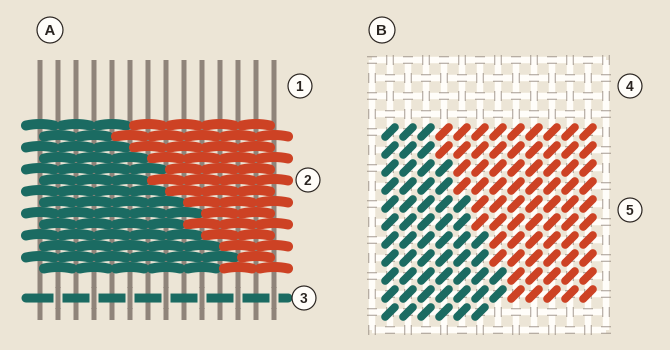
In tapestry there is no cloth until it is woven. Each color of yarn goes back and forth only in its own patch, so a weaver has many bobbins hanging at once. That is the feature weavers use to define the word: hand woven, the weft covering the warp, and each color kept to its own place.
In needlepoint the cloth is there first. The stitcher can start in the middle, do the face last, or change the stitch from part to part. A weaver cannot, because the picture grows row by row from one end.
Which one do I have?
Pull no thread, cut nothing, and do not take a piece out of a frame or off a chair to look. Use a magnifier and what already shows.
- Look at the surface. Tilt it to the light. Ridges that run one way, like fine corduroy, say woven tapestry. Small slanted or upright stitches in rows, each a thread of its own, say needlepoint.
- Find which way the ridges run, if there are any. On a tapestry they may run up and down the picture or straight across it, because many were woven sideways. Either way says tapestry. Remember the way for step 4.
- Look for canvas. At a worn spot or a bare edge, an open grid of threads with holes is canvas, and the piece is needlepoint. Where a tapestry has worn, you see bare parallel threads, all one way.
- Look for slits. Follow the straight edges between two colors that run the same way as the ridges: up and down if the ridges do, across if they run across. A slit there, or a line of sewing that closes one, says tapestry. Finding none proves nothing.
- Look at the back, if it is open. Compare it with the picture below.
- Count. Lay a ruler on it and count along one inch (2.5 cm), first across and then up and down. Nearly the same number both ways says needlepoint in small stitches. A few ridges one way and many more fine rows of yarn the other way says tapestry.
- Look for the repeat. A motif that comes again exactly, every few inches (10 cm or so), with no separate stitches, says a machine loom. See machine-made "tapestry".
What the clues say together. Canvas with stitches over it settles it: needlepoint. Ridges with no canvas and no stitches: woven tapestry, or machine-woven cloth if it repeats or if colors are mixed in every part. If you can see neither a back nor a worn spot, the surface and the count are the best you have.
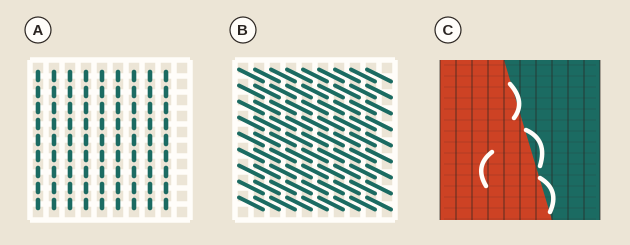
Tent stitch worked in slanting rows, which is basketweave, has a third back, like a woven basket; basketweave shows it.
Two things that mislead. Needlepoint in upright stitches, such as upright Gobelin, makes ridges of its own. And much machine-woven cloth is made of small square points with lines both ways, so that it looks like petit point from a step away. In both, look for the thread and not the squares: a stitch goes down into a hole at each end.
If the piece is old, read old needlepoint before you handle it, and how to date old pieces for what else to look at.
What each word means
| Word | Strictly | In everyday use |
|---|---|---|
| Tapestry | A picture cloth woven on a loom with a covered warp. Also any large pictured wall hanging | In Britain, needlepoint. In shops, machine-woven furnishing cloth |
| Needlepoint | Stitching on canvas | The American name. Also an older name for a lace made with a needle |
| Canvas work | Any embroidery on stiff, open canvas | The name museums use, and British teachers |
| Tapestry wool | A wool in one thick strand, sold for canvas | Needlepoint wool. It is too thick for most embroidery |
| Tapestry needle | A needle with a blunt point and a long eye | Used for needlepoint, cross stitch, knitting and weaving alike |
| Tapestry canvas | Needlepoint canvas | The same |
| Tapestry stitch | No one stitch | Usually half cross or tent stitch |
| Tapestry kit | A needlepoint kit | The same |
| Gobelin | From a family of dyers in Paris, where a famous tapestry works was set up | In German and several other languages, a tapestry, or canvas work. In English, a long stitch that imitates weaving |
| Arras | An old English name for tapestry, from a town that wove it | Out of use. Arazzo is still the Italian word |
| Tapisserie | The French word | Covers the woven kind and needlepoint both |
| Petit point | Fine tent stitch, in silk or thin wool | Sometimes any fine needlepoint: see petit point and gros point |
| Jacquard tapestry | Cloth woven on a machine loom that a pattern controls | Pillow covers, throws and wall pieces sold as tapestry |
Why the names got mixed
- The word was always wide. The first English meaning took in any decorated cloth for walls, curtains and seats, and it did not matter whether the picture was woven, stitched or painted. The narrow sense, loom work only, is later.
- One copied the other. Woven tapestry was slow and costly. Canvas could be stitched at home to look much like it, and pieces of it, for chairs and screens, took the name.
- French uses one word. Tapisserie is both, and a chair covered in it may be either.
- The tools kept the name. Wool and needles sold for canvas are still labeled tapestry.
- A famous "tapestry" is neither. The Bayeux Tapestry was not woven on a loom as a picture, and it is not on canvas. It is wool embroidery on linen. It carries the name because large pictured hangings of every kind were called tapestries.
What museums write. One museum has two cushion covers that make the point. One, of 1600 to 1610, is recorded as tapestry in silk and wool, with 22 to 23 warp threads to the inch (about 9 to the cm). The other, of about 1540, is recorded as linen canvas embroidered with silk in tent stitch. Houses of the time had both kinds. Museum labels keep tapestry for the woven one; the material line, "canvas, embroidered", tells you when it is needlepoint.
Machine-made "tapestry"
Most pillow covers, throws and wall pictures sold as tapestry now are machine-woven cloth. So were the upholstery "tapestries" of a hundred years ago. They are neither hand-woven tapestry nor needlepoint.
| Clue | Machine-woven cloth | Needlepoint |
|---|---|---|
| Worn place | Cloth all the way through | Canvas grid with holes |
| Colors | Two or more yarns mixed in every part | Each stitch one color |
| Back | The same picture with its colors changed about, or long threads lying loose | Stitches on a grid |
| Two pieces side by side | Identical to the thread | Never quite identical |
What is in a tapestry kit
A tapestry kit, sold under that name, holds a printed canvas, wool in each color, a blunt needle and a page of instructions. It is worked in tent stitch, often the half cross kind. That is a needlepoint kit. Needlepoint kits says what else to look for. A kit for weaving has a small frame with warp threads, and says weaving or loom on the box.
| You want | Look for |
|---|---|
| To stitch a picture with a needle | A needlepoint, canvas work or tapestry kit |
| To weave one | A tapestry loom or frame loom, with warp and a fork or comb to pack the yarn down |
| A picture in the style of old tapestries, stitched | A needlepoint design of that kind, on 10 to 14 mesh |
Can a tapestry design be stitched?
Yes. People have stitched big wall pieces in the manner of woven ones for centuries, mostly in tent stitch or cross stitch.
- Choose a part, not the whole: a rabbit, a tree, a border. A whole scene is hundreds of thousands of stitches.
- Put it on squared paper, one square to a stitch. How to design your own has the steps, and the graph paper prints at canvas scale.
- Keep the flat shapes and the dark outlines. They suit stitches as well as they suited yarn.
- Shade in bands. Weavers pass from one color to the next in fine teeth, like two combs pushed together. Chart the edge between two shades as teeth one stitch wide.
- Choose the mesh, the number of canvas threads to the inch (2.5 cm). 10 or 12 for a pillow or a hanging, 14 or 18 for faces. How to make a wall hanging has sizes.
- Or copy the ridges. Upright Gobelin and encroaching Gobelin give a ribbed ground. The ribs run across. For ribs that run up and down, turn the canvas a quarter while you stitch it.
Questions people ask
Is needlepoint a kind of tapestry? In the strict sense, no: it is a kind of embroidery. In everyday British use the two words mean the same thing.
Is tapestry harder? It is a different skill. A weaver sets up a loom, works every row in order and sees the picture sideways or from behind. A stitcher needs a canvas and a needle.
Which lasts better on a chair? Both were used for seats. Wool needlepoint in short stitches is the one you can make at home: how to cover a chair seat.
What about crochet or hook "tapestry"? Tapestry crochet is crochet with a second color carried inside the stitches. It shares the word and nothing else. Crafts like needlepoint sets ten crafts side by side.
Is needlepoint the same as embroidery? It is one kind of it: needlepoint and related terms.