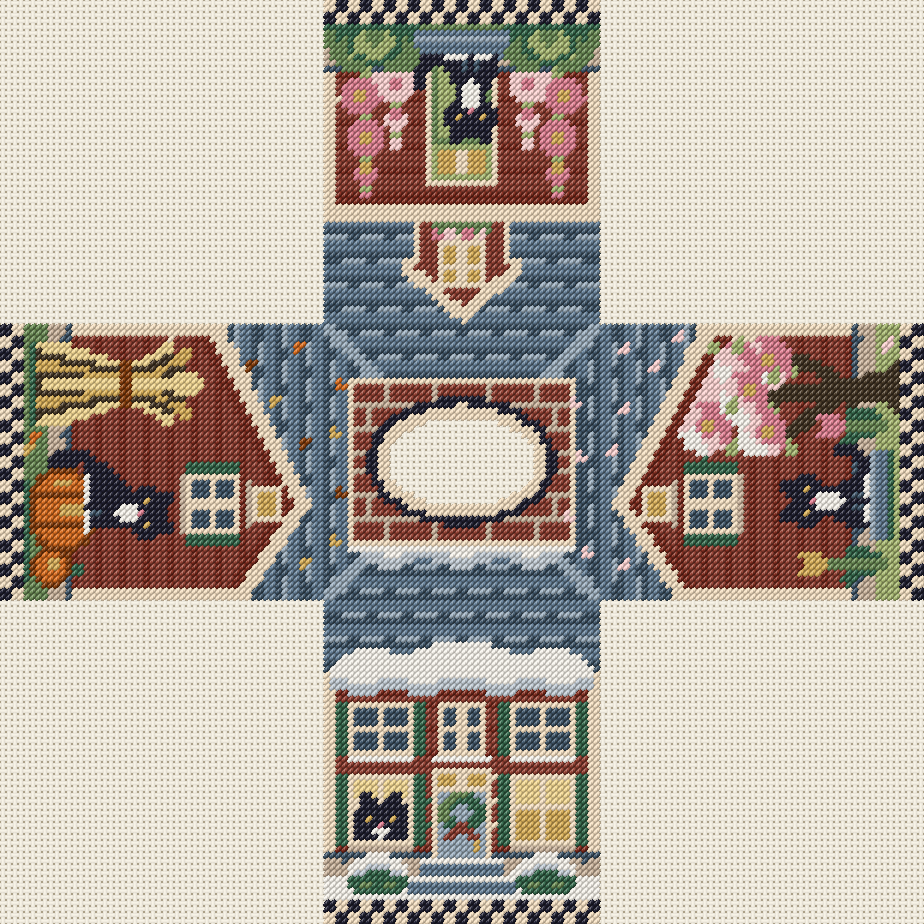
Tissue box cover, four seasons house needlepoint pattern
Advanced · 20 colors · 15.4 × 15.4 in · 10 mesh · 11,768 stitches
Download free PDFPDF, US Letter · 91 KBFor your own stitching, gifts and handmade pieces you sell. Do not resell or share this PDF or copies of it. Selling, classes and kits: the rules
You will need
- Canvas: 10 mesh, cut 19.4 × 19.4 in
- Needle: tapestry, size 16 or 18
- Thread: 20 colors of six-strand floss, 8 to 10 strands in the needle, about 38 skeins in all (an estimate)
- Thread: 20 colors of pearl cotton size 3, 2 strands in the needle, about 29 skeins in all (an estimate)
- Thread: 20 colors of tapestry wool, 1 strand in the needle, about 27 skeins in all (an estimate)
- Thread: 20 colors of Persian wool, 3 strands in the needle, about 30 skeins in all (an estimate)
When it is stitched. A finisher, or the fabric and cord to make it up yourself. Ask before you stitch the edge: some finishes take two extra rows all round, carrying the colors of the edge on. They are in neither the chart nor the counts of thread. Ways to finish needlepoint
Another thread. Stitch it in six-strand floss, tapestry wool or Persian wool: the skeins follow
A brick red house wraps a tissue box, one season on each wall and a black cat on every one. There are hollyhocks, a blossom tree, pumpkins and snow. The top is blue slate round a brick chimney, over a black and cream checked foot.
Size and details
The chart is 154 × 154 stitches at its widest and tallest: a tissue box cover on 10 mesh canvas, with 11,768 stitches inside its outline.
Worked in tent stitch throughout.
Advanced. Many colors, or changes every few stitches: best with a canvas or two behind you.
How the level is set
Advanced: 20 colors. Over the whole chart, changes of color are about 3 stitches apart. With 10 colors or more, closer than 4.5 apart is Advanced, 4.5 or more is Intermediate, and a design with this many colors is never Beginner.
| Mesh | Stitched size | Canvas to cut |
|---|---|---|
| 10 | 15.4 × 15.4 in 39.1 × 39.1 cm | 19.4 × 19.4 in 49.3 × 49.3 cm |
| 12 | 12.8 × 12.8 in 32.6 × 32.6 cm | 16.8 × 16.8 in 42.8 × 42.8 cm |
| 13 | 11.8 × 11.8 in 30.1 × 30.1 cm | 15.8 × 15.8 in 40.2 × 40.2 cm |
| 14 | 11 × 11 in 27.9 × 27.9 cm | 15 × 15 in 38.1 × 38.1 cm |
| 18 | 8.6 × 8.6 in 21.7 × 21.7 cm | 12.6 × 12.6 in 31.9 × 31.9 cm |
Mesh is the number of canvas threads to the inch; the row in bold is the mesh this chart is sized for. Canvas to cut includes a margin of 2 in (5.1 cm) of bare canvas on every side. Leave at least that much.
Paper for the PDF
Threads and canvas
Pearl cotton size 3: 2 strands in the needle on 10 mesh, and a skein is 16.4 yd. DMC pearl cotton goes by the same numbers, for the shades it is made in.
- DMC 739 Ultra Very Light Tan 2,086 stitches about 26 yards 4 skeins
- DMC 355 Dark Terra Cotta 1,671 stitches about 21 yards 3 skeins
- DMC 931 Medium Antique Blue 1,364 stitches about 17 yards 3 skeins
- DMC 930 Dark Antique Blue 1,200 stitches about 15 yards 2 skeins
- DMC 310 Black 867 stitches about 11 yards 2 skeins
- DMC 3777 Very Dark Terra Cotta 659 stitches about 9 yards 1 skein
- DMC 3865 Winter White 570 stitches about 8 yards 1 skein
- DMC 932 Light Antique Blue 559 stitches about 7 yards 1 skein
- DMC 501 Dark Blue Green 486 stitches about 6 yards 1 skein
- DMC 3782 Light Mocha Brown 285 stitches about 4 yards 1 skein
- DMC 3820 Dark Straw 284 stitches about 4 yards 1 skein
- DMC 3733 Dusty Rose 281 stitches about 4 yards 1 skein
- DMC 3347 Medium Yellow Green 275 stitches about 4 yards 1 skein
- DMC 471 Very Light Avocado Green 253 stitches about 4 yards 1 skein
- DMC 3031 Very Dark Mocha Brown 212 stitches about 3 yards 1 skein
- DMC 963 Ultra Very Light Dusty Rose 196 stitches about 3 yards 1 skein
- DMC 3822 Light Straw 182 stitches about 3 yards 1 skein
- DMC 3752 Very Light Antique Blue 166 stitches about 3 yards 1 skein
- DMC 922 Light Copper 87 stitches about 2 yards 1 skein
- DMC 400 Dark Mahogany 85 stitches about 2 yards 1 skein
11,768 stitches inside the outline, about 156 yards in all. The yards are estimates for 10 mesh. The skeins are estimates too, about 29 in all.
Thread colors are approximate screen matches to DMC numbers. Check against real thread before you buy.
The numbers are DMC color numbers, which its six-strand cotton and its pearl cotton share. Wool and silk are numbered differently: match those by eye. For how many strands and which needle, see which thread suits which mesh.
You also need blank needlepoint canvas (mono canvas) in the mesh you choose (see mesh sizes), cut to the size in the table above, and a tapestry needle.
About the yards and skeins
The yards are of thread as it is threaded in the needle: stitched with several strands together, a thread takes that many yards of single strand for every yard listed. For six-strand cotton on 10 mesh, the thread and needle chart gives 8 to 10 strands.
An estimate. The length of thread one stitch uses on the front and back of the canvas, times the number of stitches, plus 30 percent for starting, ending and the tail left in the needle. Each count is estimated as basketweave or continental and rounded up to a whole yard, so the yards in all are a little more than the thread calculator gives for every stitch at once. The 30 percent is this site's own choice. The thread calculator works the same estimate for any count and mesh.
Getting it onto your canvas
This is a counted chart: one square of the chart is one stitch. Find the center of your canvas and the center of the chart (the red arrows above and to the left of the chart), and count out from there, a color at a time.
Nothing is printed on the canvas, so no transfer is needed. How to needlepoint covers the first stitches.
See the chart on this page
The chart is drawn when this is opened.
It opens in the pattern maker, with your colors and your name on it.
Downloads
- Chart for US Letter paper PDF · 4 pages
- Chart for A4 paper PDF · 5 pages
The same chart in squares of about 6 mm, on more pages.
Each file has the thread key, with an estimate of the yards and skeins of each color, and the sizes on its first page, then the chart with a symbol in every square and a heavier line every ten. A chart too large for one page is divided over several, with two rows or columns repeated in gray where the pages join; a page may be turned on its side for a part that is wider than it is tall.
More patterns like this
Advanced 12.5 × 8.1 in · 20 colors
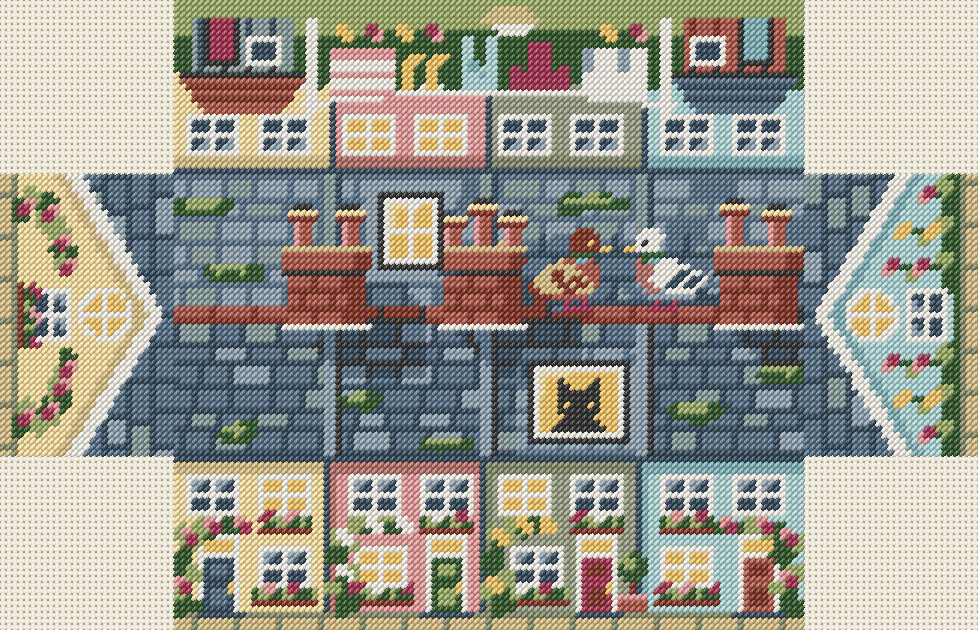
Row of cottages brick doorstop
Advanced 9,072 stitches 7 × 4 in · 18 colors
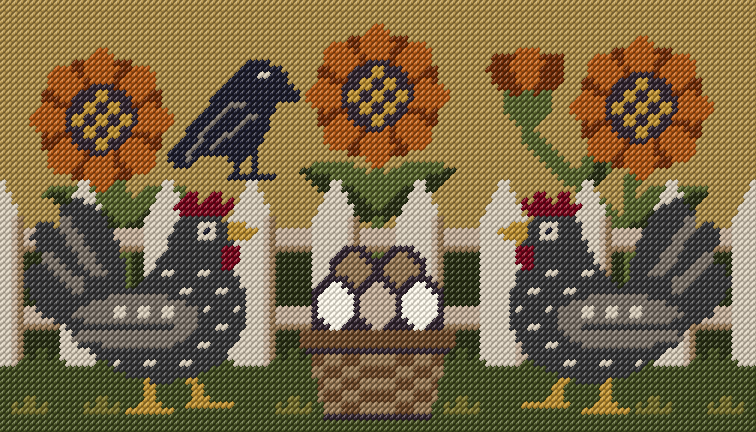
Folk art picket fence with hens
Advanced 9,072 stitches 7 × 4 in · 17 colors
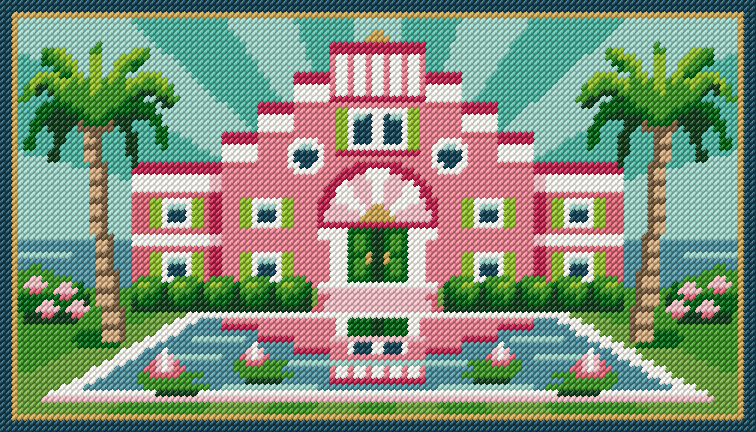
Preppy pink house with palm trees
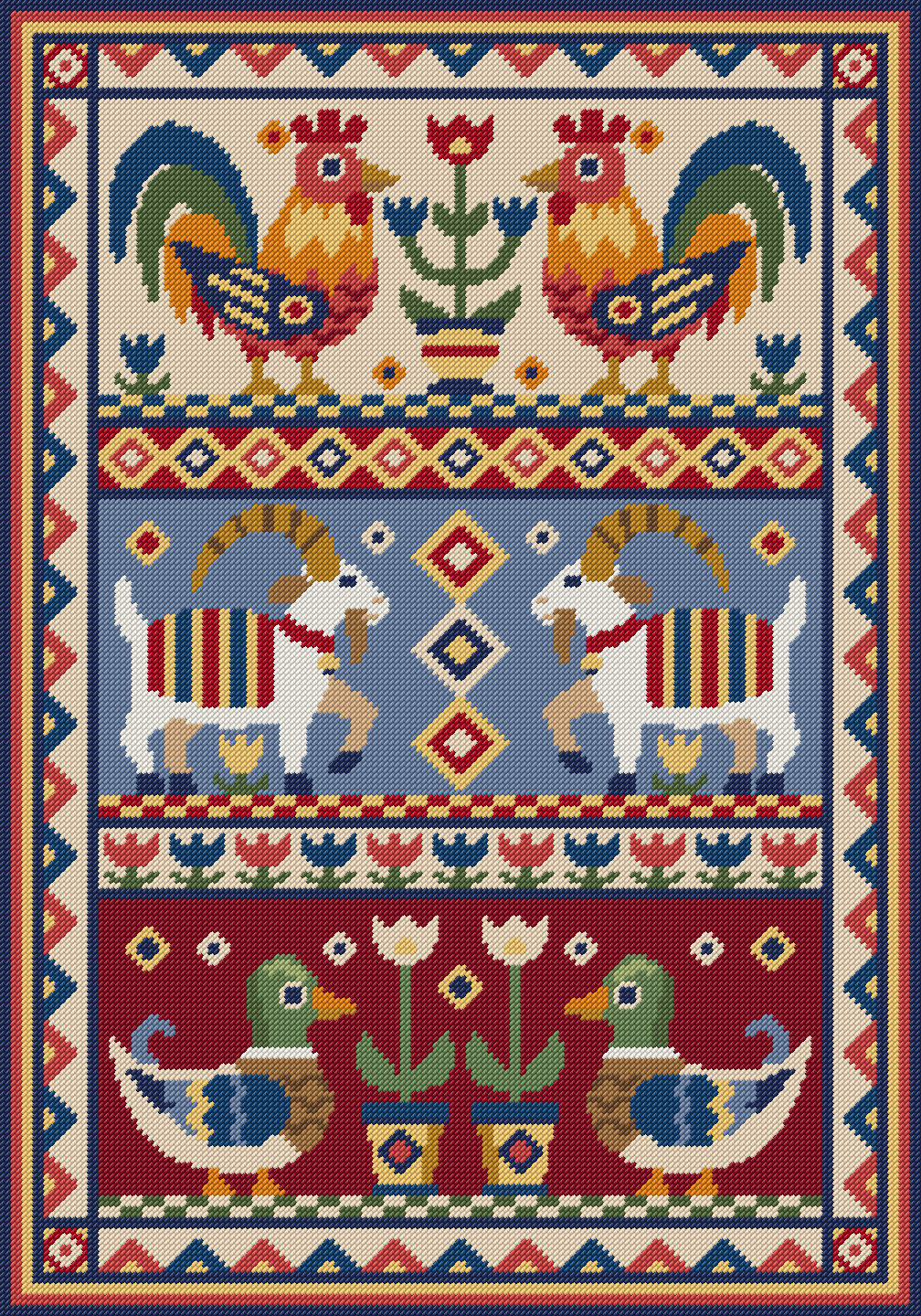
Intermediate 40,320 stitches 16.8 × 24 in · 17 colors
Folk art kilim rug
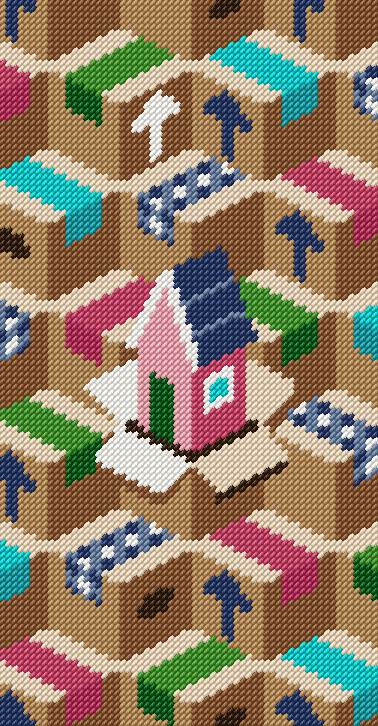
Advanced 7,623 stitches 3.5 × 6.7 in · 14 colors
Preppy moving boxes
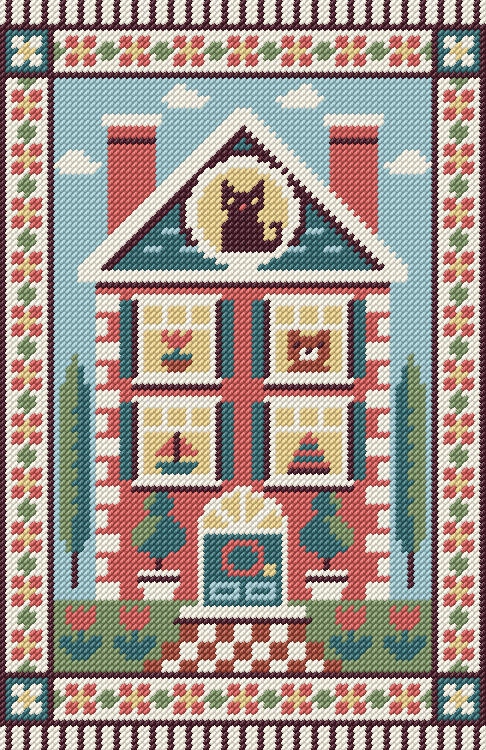
Intermediate 10,125 stitches 4.5 × 6.9 in · 8 colors
Dollhouse nursery rug with a house
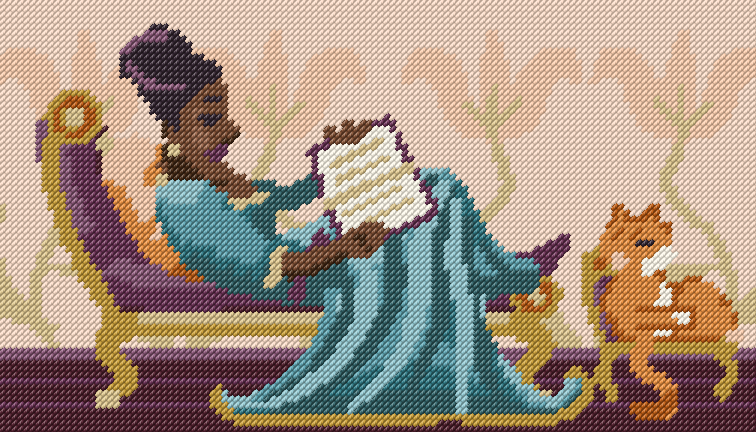
Advanced 9,072 stitches 7 × 4 in · 18 colors
Whimsical woman on a chaise
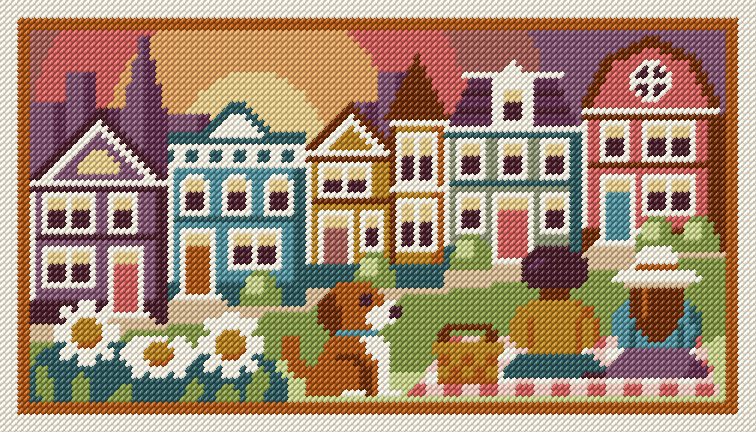
Advanced 9,072 stitches 7 × 4 in · 18 colors
San Francisco postcard row houses
New to needlepoint? How to needlepoint