Crochet guide
How to crochet a messy bun hat
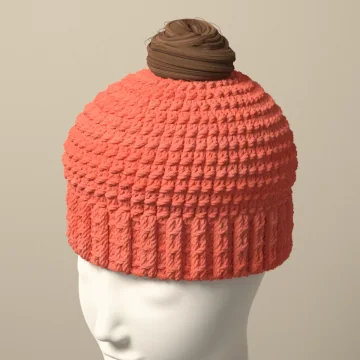
A messy bun hat is a beanie that begins around an open ring in place of a closed one, so that a bun or a ponytail comes through the top. The ring is a short circle of chains, or a hair elastic that you crochet over. After round 1 it is a plain hat from the top down: increases, sides and a brim.
On this page 14 parts
- Before you start
- 1. Choose the opening
- 2. Make the ring of chains and begin round 1
- 3. Or begin over an elastic
- 4. Count and join round 1
- 5. Work rounds 2 to 4: the crown
- 6. Work the sides
- 7. Work the brim
- 8. Finish
- Messy bun hat diagram
- A gap for a ponytail in a plain beanie
- Change the hat
- If it goes wrong
- Where to go next

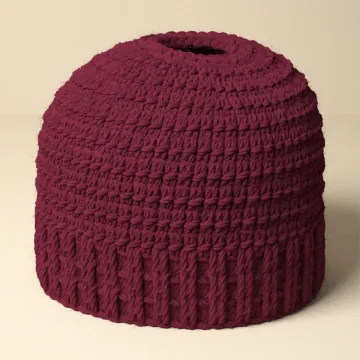
In the picture A is the opening for the hair, B the crown, 4 rounds that grow, C the sides, 6 rounds with no more stitches, and D the brim, 3 rounds of ribs.
Before you start
You need: medium yarn (weight 4), a 5.5 mm (I-9) hook, a soft tape measure, a yarn needle and scissors. A hair elastic about 2 in (5 cm) across is needed only for the stretchy start.
Know first: the chain, the slip stitch and double crochet (UK treble). A beanie with a closed top is in how to crochet a simple hat.
Choose a size. Put the tape around the widest part of the head, across the forehead and above the ears.
| For a head of | Hat, about | Stitches after the increases | Rounds: crown, sides, brim | Yarn to buy, an estimate |
|---|---|---|---|---|
| Child, 19½ in (49.5 cm) | 18½ in (47 cm) around, 6¼ in (16 cm) deep | 60 | 3, 5, 3 | 95 yd (87 m) |
| Teen, 21 in (53.5 cm) | 19¾ in (50 cm) around, 6¾ in (17 cm) deep | 64 | 4, 5, 3 | 110 yd (101 m) |
| Woman, 22 in (56 cm) | 21 in (53.5 cm) around, 7½ in (19 cm) deep | 68 | 4, 6, 3 | 125 yd (114 m) |
| Man, 23 in (58.5 cm) | 22¼ in (56.5 cm) around, 8 in (20.5 cm) deep | 72 | 4, 7, 3 | 140 yd (128 m) |
| Man, large, 24 in (61 cm) | 22¾ in (58 cm) around, 8 in (20.5 cm) deep | 74 | 5, 6, 3 | 145 yd (133 m) |
The depth is measured from the edge of the opening. From the middle of the head there are about 1¼ in (3 cm) more. If you cannot measure, the hat size chart has heads by age.
The steps make the woman's size, and steps 5 to 7 say where another size differs. It is that of our double stitch messy bun hat, whose page has all five sizes to print. The outside faces you in every round. In the lines Rnd is round, ch chain, sl st slip stitch, dc double crochet, RS the right side, and [ ] 12 times means that what is in the brackets is worked twelve times in all.
1. Choose the opening
A ring of chains keeps its size. An elastic stretches over the hair and closes again. Bun hats begin with about 16 to 24 chains. This one takes 24, for a bun. For a ponytail alone take 20 or 16.
| Chains in the ring | Opening across, about | Round 1 |
|---|---|---|
| 16 | 1½ in (4 cm) | 24 double crochet. Then one more round before round 2, [dc in next st, 2 dc in next st] 12 times: 36 |
| 20 | 2 in (5 cm) | 36, a little crowded |
| 24 | 2¼ in (6 cm) | 36 |
| 28 | 2¾ in (7 cm) | 36, a little spread |
The figures are for the hat's yarn and hook: 13 stitches to 4 in (10 cm). From 36 stitches on, the hat is the same.
2. Make the ring of chains and begin round 1
Leave a tail of 6 in (15 cm). Chain 24 and close them into a ring with a slip stitch in the first chain, with no twist. Chain 3, which is not a stitch. Work every double crochet with the hook in the open middle of the ring, over the chains, and not into the chains.

3. Or begin over an elastic
Put a slip knot on the hook. Hold the elastic so that the yarn is behind it. Put the hook through the middle of the elastic from front to back, catch the yarn, and draw it back through the middle and through the loop on the hook. That is a slip stitch around the elastic, and the yarn is joined. Chain 3 and work the same 36 double crochet over the elastic. They crowd. Push them along with your thumb, so that they lie side by side and the elastic is covered all the way round.

Working over a ring shows the stitch close. Round 1 is now the same for both, and so is all that follows.
4. Count and join round 1
Count 36. Close the round with a slip stitch in the top of the first double crochet, the one to the left of the chain 3. The chain is passed over in every round.
Foundation: Ch 24, sl st in first ch to form a ring.
Rnd 1 (RS): Ch 3, 36 dc in ring, sl st in first dc to join (36 dc).
5. Work rounds 2 to 4: the crown
Where to stop. Rounds 2 and 3 are the same in every size. Round 4 below is the woman's: for another size stop after round 3 and go to the table under the lines.
Chain 3, and put the first stitch in the stitch you joined in. An increase is two stitches in one place. In round 2 it is every third stitch.

Rnd 2: Ch 3, [dc in next 2 sts, 2 dc in next st] 12 times, sl st in first dc to join (48 dc).
Rnd 3: Ch 3, [2 dc in next st, dc in next 3 sts] 12 times, sl st in first dc to join (60 dc).
Rnd 4: Ch 3, [2 dc in next st, dc in next 7 sts] 4 times, [2 dc in next st, dc in next 6 sts] 4 times, sl st in first dc to join (68 dc).
After round 3 lay the crown flat and measure across it: about 5¾ in (14.5 cm). If it is larger, begin again with a smaller hook. If it is smaller, use a larger one.
The size is set by the round that stops the increases. After round 3 every size has 60 stitches. Then:
| Size | After round 3, between the chain 3 and the slip stitch | Stitches |
|---|---|---|
| Child | none: go on to the sides | 60 |
| Teen | [dc in next 14 sts, 2 dc in next st] 4 times | 64 |
| Woman | [2 dc in next st, dc in next 7 sts] 4 times, [2 dc in next st, dc in next 6 sts] 4 times | 68 |
| Man | [dc in next 4 sts, 2 dc in next st] 12 times | 72 |
| Man, large | Round 4: [dc in next 4 sts, 2 dc in next st] 12 times. Round 5: [2 dc in next st, dc in next 35 sts] 2 times | 74 |
6. Work the sides
Work 1 double crochet in each stitch. After round 7 put the tape around the outside of the hat, along that round: about 21 in (53.5 cm). If it is more, begin again with a smaller hook. If it is less, use a larger one.
Rnds 5 to 7: Ch 3, dc in each st around, sl st in first dc to join (68 dc).
Rnds 8 to 10: Ch 3, dc in each st around, sl st in first dc to join (68 dc).
The two lines are the same work. They are parted only because you measure between them.
Another size has its own numbers of rounds, and every round has that size's number of stitches:
| Size | Rounds of the sides | Measure after | It should be, about | Rounds of the brim | Times the bracket of the brim is worked |
|---|---|---|---|---|---|
| Child | 4 to 8 | Round 6 | 18½ in (47 cm) | 9 to 11 | 30 |
| Teen | 5 to 9 | Round 7 | 19¾ in (50 cm) | 10 to 12 | 32 |
| Woman | 5 to 10 | Round 7 | 21 in (53.5 cm) | 11 to 13 | 34 |
| Man | 5 to 11 | Round 7 | 22¼ in (56.5 cm) | 12 to 14 | 36 |
| Man, large | 6 to 11 | Round 8 | 22¾ in (58 cm) | 12 to 14 | 37 |
Try it on with your hair up. Pull the bun through, and see where the edge comes. The brim adds about 1¾ in (4.4 cm). Add a round, or leave one out.
7. Work the brim
The ribs are post stitches: a double crochet whose hook goes around the upright post of the stitch below, and not into its top. FPdc is a front post double crochet. The hook comes from the front and passes behind the post.

BPdc is a back post double crochet. The hook comes from the back and passes in front of the post.

Chain 3, not counted, as before. The first front post stitch goes around the stitch that holds the slip stitch. Work one of each in turn, and from the second rib round on put front posts on front posts and back posts on back posts. The number of stitches must be even.
Rnds 11 to 13: Ch 3, [FPdc around next st, BPdc around next st] 34 times, sl st in first FPdc to join (34 FPdc, 34 BPdc).
Post stitches shows the whole stitch. For a plainer edge work three rounds of single crochet (double crochet in United Kingdom patterns) in place of the ribs.
8. Finish
Fasten off. Weave the starting tail around the ring of chains on the inside, so that the ring is firm, and weave in the other tail.
Messy bun hat diagram
Rounds 1 to 3 as chart symbols. Begin at the ring and go counterclockwise.

A T with a bar is a double crochet, and two red T on one T are an increase. Three ovals in a line are the chain 3, not counted, and the dot closes the round.
A gap for a ponytail in a plain beanie
- A slit at any height. In a round of the sides chain 8 and skip 8 stitches, for a slit of about 2½ in (6 cm). In the next round work 1 stitch in each of the 8 chains, so that the count is the same. For a high ponytail make it in the first or second round of the sides, and for a low one near the brim. It is a large buttonhole.
- A hat that opens. Work the hat in increasing rows and not in rounds, so that a slit runs up the back from the brim, and close the brim with one or two buttons. The hair comes out of the slit where you like.
- A gap in a seam. A hat worked sideways has a seam down the back. Leave about 2½ in (6 cm) of it unsewn where the ponytail sits, and fasten the yarn well above and below. See the third way in how a crochet hat is made.
- Or the open top. The lacy ponytail hat has an opening of about 2 in (5 cm), and the striped ponytail hat and the cable ponytail hat have the opening of 24 chains.
Change the hat
- Chunky yarn: the chunky messy bun hat begins with 16 chains, about 1¾ in (4.5 cm) across.
- Half double crochet (UK half treble), closer and warmer: the half double messy bun hat. Puffs: the puff stitch messy bun hat.
- A flower or a bow: made apart and sewn to the side: decorating a hat.
- A longer hat: add rounds before the brim.
- A closed top after all: begin with 12 double crochet in a magic ring and add 12 more each round, up to your size, as in how a crochet hat is made.
If it goes wrong
| What you see | Why | What to do |
|---|---|---|
| The elastic shows | Too few stitches on it | Push them together, or work round 1 again with more and begin the increases from that count |
| The stitches bunch on the elastic | They are crowded, as they should be | Spread them evenly. They lie flat when the elastic is stretched by the hair |
| The opening is too tight | A small ring, or tight chains | More chains, made with a larger hook, or an elastic |
| The opening gapes | The ring is larger than the bun | Thread an elastic through the tops of round 1 from the inside |
| The crown is a cone | An increase round was left out | Count: 36, 48, 60 |
| The crown ripples | Too many stitches, or loose ones | Count, then try a smaller hook |
| The hat is too short | The bun takes up height | Add rounds above the brim |
| The ribs do not line up | A front post was put on a back post | Read the stitch below: a post that stands out gets a front post |
Why a crochet hat comes out wavy, pointy or too big has more.
Where to go next
Work the double stitch messy bun hat from its page, or choose among the messy bun hats and all hats.