Cool things to crochet
Some crochet makes people ask how it was done: scales that overlap, a scarf that coils like a spring, cubes that seem to stand up from a flat blanket. The table has fifteen to start with, each with a free pattern. Below it are the odd techniques, how each works and which need a special tool.
On this page
- Fifteen cool things with a free pattern
- Fabric that curls, ruffles or stands up
- Color and pictures that look like a trick
- Lace made in odd ways
- Very big, very small and a longer hook
- Things you would not expect to crochet with
- No pattern, or no wrong side
- Dragons, dinosaurs, tails and odd hats
- Useful odd things
- When you are bored: pick by what you have
- Cool and easy
- Which of these need a special tool
- Questions people ask
Fifteen cool things with a free pattern
The level is the one printed on the pattern. The yarn is an estimate for all the colors together, and it runs from the smallest size to the largest.
| Thing | What is unusual about it | Level | Yarn, an estimate |
|---|---|---|---|
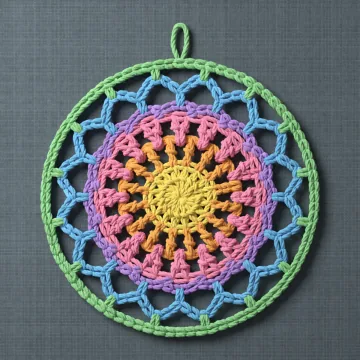
| Rainbow suncatcher | The last round is worked over a metal ring | Easy | 30 yd (27 m) |
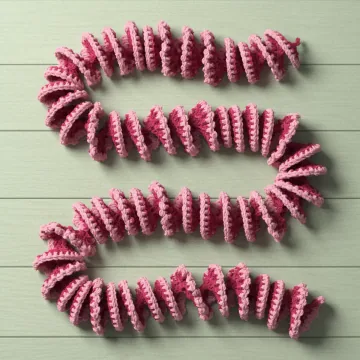
| Curly spiral scarf | A crowded strip that coils by itself | Easy | 220 to 310 yd (201 to 283 m) |
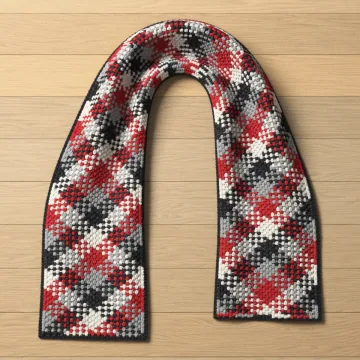
| Planned pooling scarf | A multicolored yarn falls into diamonds | Easy | 545 yd (498 m) |
| Tunisian honeycomb scarf | A whole row of loops waits on a long hook | Easy | 265 to 345 yd (242 to 315 m) |
| Cat café curtain | Three cats drawn in open and solid squares | Easy | 390 to 670 yd (357 to 613 m) |
| Giant round rug | Yarn as thick as a thumb on a 25 mm hook | Easy | 250 to 550 yd (229 to 503 m) |
| Plastic bag beach bag | The yarn is old shopping bags | Easy | 245 to 350 yd (224 to 320 m) |
| Dachshund draft stopper | A dog as long as a door is wide | Easy | 940 to 1,115 yd (860 to 1,020 m) |
| Lace covered stones | Thread lace that closes under a flat stone | Intermediate | 55 yd (50 m) of thread |
| Beaded amulet purse | Bead diamonds, strung before the first stitch | Intermediate | 35 yd (32 m) |
| Celtic knot | One long cord woven over and under itself | Intermediate | 27 yd (25 m) |
| Dragon scale bucket bag | Scales that lie over each other | Intermediate | 400 yd (366 m) |
| Greek key mosaic basket | Two colors, but only one to a round | Intermediate | 545 to 775 yd (498 to 709 m) |
| Dragon tail to wear | Spikes, a gold belly and belt loops | Intermediate | 285 yd (261 m) |
| 3D cubes blanket | Flat diamonds that look like stacked boxes | Intermediate | 1,675 to 3,875 yd (1,532 to 3,543 m) |
New to the hook? Begin with how to crochet, then the suncatcher: it is six short rounds.
Fabric that curls, ruffles or stands up
- Hyperbolic pieces. Add stitches at a steady rate in every row, and the fabric runs out of room and ruffles like coral. Hyperbolic crochet.
- Corkscrews. Work three stitches into each chain of a long chain, and the strip winds into a spiral. Curlicues.
- Dragon scales. A post is the upright part of a tall stitch. Each scale is a fan of stitches worked down one post and up the next. Crocodile stitch.
- Wiggly crochet. Make a flat mesh (an open net of squares), then work stitches back and forth over it to stand up in wavy ridges. Wiggly crochet.
- Shaggy fur. Wrap the yarn over a raised finger in each stitch, and a loop stays behind. Loop stitch.
Color and pictures that look like a trick
- Mosaic. Each row has one color. Tall stitches reach down over the rows below and draw the pattern. Mosaic crochet.
- Color pooling. A run is all the colors of the yarn once, and it must repeat the same way all along the ball. Work row 1 in moss stitch (single crochet, chain 1, skip 1, over and over) until one run is used up. Then undo the last single crochet and its chain. Go on at that width, and the colors move one stitch over in each row and cross in diamonds. Color pooling.
- Interlocking meshes. Two open nets, each in its own color, are worked through each other's gaps until the pair is one fabric. Interlocking crochet.
- Hidden pictures. Shadow crochet shows stripes from the front and a picture from an angle. Illusion crochet.
- 3D blankets. Diamonds in a light, a middle and a dark color read as cubes, though the 3D cubes blanket is flat.
- A picture of your own. Picture to crochet pattern turns a photo into a chart on your own device. Pick a picture of one thing on a plain ground, and begin with four to six colors. Then see how to read a graph.
Lace made in odd ways
- Broomstick lace. Lift a long loop from every stitch onto a thick rod or a fat knitting needle, then take the loops off in groups. Broomstick lace.
- Hairpin lace. Wrap yarn on a frame with two prongs, crochet a line up the middle, and join the strips that come off. Hairpin lace.
- Bruges lace. Make a narrow tape with chain loops along both edges. Bend it and join it through the loops. Bruges lace.
- Filet pictures and lace curtains. A net of squares, some left open and some filled in, makes the picture. Filet crochet, or make your own chart with the filet chart maker.
Very big, very small and a longer hook
- Giant yarn. The usual stitches, made with a huge hook or your hands. Which kinds shed and how heavy they get: giant yarn.
- Micro crochet. Miniature animals in thread, with hooks of about half a millimeter, some of them finer. Micro crochet.
- Tunisian. A long hook picks up a whole row of loops, then works them off again without turning. Tunisian crochet.
Things you would not expect to crochet with
- Wire. Thin wire takes the place of yarn, often for jewelry. Wire.
- Plastic bags. Cut bags into strips about 1 in (2.5 cm) wide and loop them into one long strand. The beach bag in the table takes wider strips, about 1½ in (4 cm). Plastic bag yarn.
- Rope. Work the stitches around a rope that lies along the round below. It coils into mats and the bottoms of baskets. Rope and cord.
- Beads. String them on the yarn first, then slide each one up as you need it. Beads.
- A hoop or a ring. Work stitches all around the rim and it disappears inside them. Around objects.
- Stones. The lace for stones starts in the middle of the top, reaches the edge and draws in underneath. The three covers fit flat stones of about 2, 3 and 4 in (5, 8 and 10 cm).
No pattern, or no wrong side
- Freeform. With no pattern, small patches grow in any stitch and any odd bit of yarn. Freeform crochet.
- Two good sides. Some stitches, moss stitch among them, look as good from the back. Reversible stitches.
Dragons, dinosaurs, tails and odd hats
- Friendly dragon: wings, ear frills and horns in 18 pieces. Intermediate, about 210 yd (192 m).
- Little green dinosaur and long-necked dinosaur: intermediate, about 175 yd (160 m) each.
- Shell scale mermaid tail: a blanket to slip the legs into, in three sizes. Easy, about 610 to 1,370 yd (558 to 1,253 m).
- One-eyed monster hat: shaggy, with an eye on a stalk. Intermediate, about 140 to 205 yd (128 to 187 m).
More: dragons, dinosaurs, mermaid tails, costumes and funny hats.
Useful odd things
- Fidget lap blanket, also called a twiddle mat: a blanket for anyone who likes busy hands, with nine blocks to pull, button, zip and count. Intermediate, about 1,540 yd (1,408 m).
- Jar vase cover: bobble stripes for a pint or a quart jar. Easy, about 80 to 105 yd (73 to 96 m).
- Hanging basket: for fruit or a plant, on three cords. Easy, about 105 to 140 yd (96 to 128 m).
- Snail tape measure cover: the tape pulls out above the tail. Easy, about 65 yd (59 m).
When you are bored: pick by what you have
| You have | Make this | Look here for more |
|---|---|---|
| A hook and 10 yd (9 m) of yarn | Small heart, about 5 yd (5 m), in one color | Under 100 yards |
| Two scraps | Interlocking hearts, about 30 yd (27 m) in all | Scrap yarn |
| One large ball | One ball granny shawl, the small size, about 250 yd (229 m) | One-skein projects |
| Thread and a steel hook | Lacy masquerade mask, about 35 yd (32 m), or sunflower earrings, about 8 yd (7 m) in two colors, with ear wires | Thread patterns |
| Thick yarn | Jumbo layered flower, about 80 yd (73 m) in four colors | Super bulky yarn |
| A multicolored ball | A test strip of color pooling | Variegated yarn |
| Old T-shirts | T-shirt yarn basket, about 65 to 150 yd (59 to 137 m) of strips | Fabric strips |
| Yarn and no hook | A chain made on a finger | Finger crochet |
Cool and easy
- The curly spiral scarf looks hard, but it is three long rows that coil.
- The giant round rug in its smaller size is 14 rounds of single crochet (UK double crochet), 40 in (102 cm) across.
- The bacon scarf is one stitch, with increases that make it curl: about 310 to 370 yd (283 to 338 m).
Which of these need a special tool
| To make this | You need |
|---|---|
| Tunisian | A long hook with a stopper |
| Hairpin lace | A frame with two prongs, and a hook |
| Broomstick lace | A thick rod or a fat knitting needle, and a hook |
| Giant yarn | A huge hook (25 mm for the rug), or your hands |
| Micro crochet | A hook of about half a millimeter, or finer |
| Lace for stones | Thread and a 1.75 mm hook |
| Wire | A metal hook you do not mind scratching |
| Beads strung first | A needle thin enough for the beads, to string them |
The rest, from mosaic and interlocking to filet, scales and corkscrews, need only a hook to suit the yarn, and the rope or ring if you work around one.
Questions people ask
Why does my circle ruffle? It has more stitches than it has room for, which is what a hyperbolic piece does on purpose. Flat circle gives the count for each round.