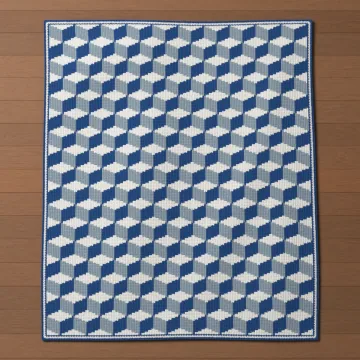
Illusion crochet
The words illusion crochet are used for more than one thing. One is a flat blanket that looks three-dimensional: diamonds in a light, a middle and a dark shade that read as blocks. Another is shadow crochet, which hides a picture in stripes. Here is which is which, and how to make the blocks.
On this page
Which kind of illusion do you mean?
| The name | What you see | How it is done | Where the color changes |
|---|---|---|---|
| Tumbling blocks, baby blocks, 3D cubes | Solid blocks on a flat blanket | Diamonds in three shades | Between diamonds, or inside a row |
| Optical illusion blanket | Plain shapes that seem to spin or shift | Squares, triangles or strips, arranged by color | Between pieces, or on a graph |
| Shadow crochet | Stripes from the front, a picture from the side | Some stitches stand up and some lie flat | At the edge, never inside a row |
| Old shadow crochet | Lace: a net with solid figures | Open and solid stitches, close to filet | Not a matter of color |
The first is the one to start with, and the rest of this page begins there. A blanket called 3D may also have real relief, from stitches that stand up. Those are textured stitches and no illusion.
Stitch names are United States terms, with the United Kingdom name in brackets.
How tumbling blocks work
A block is three diamonds that meet at a point: one for the top and two for the sides. One is light, one is middle and one is dark. That contrast is what makes the eye see three faces of a solid thing.
- Keep each shade in its place. If the top is light on one block, it is light on every block. The left side keeps its shade and the right side keeps its own.
- Choose by light and dark, not by name. Pale blue, mid blue and navy work. So do cream, rust and brown. Two colors that are equally light melt into one face. Color combinations explains light against dark.
- Many colors are allowed, as long as each is sorted as light, middle or dark.
- The blocks can flip. Look long enough and the tops turn into undersides. That is in the pattern, and no mistake.
The pattern is an old patchwork one. It goes by tumbling blocks and baby blocks, and sometimes by illusion.
Ways to make it in crochet
| Way | Pieces | Suits |
|---|---|---|
| Diamonds, joined | Three to a block | Scraps, carrying it about, choosing colors as you go |
| One piece in rows, with the diamonds in the fabric | None | A blanket with no seams, and several colors in a row |
| A graph, a square for each stitch | None | A drawing of blocks of any size |
Our 3D cubes blanket is made the second way, in single crochet in three colors, with every row counted. A graph is read as in how to read a crochet graph. To turn a drawing into one, see picture to graph.
How to crochet a diamond
A diamond is a triangle that grows by one stitch a row and then shrinks by one stitch a row. For blocks its sides must all be as long as it is wide across the middle. Single crochet (UK double crochet) makes that shape. Taller stitches change the angles.
- Chain 2. Work 2 single crochet in the 2nd chain from the hook. Chain 1, turn: 2 stitches.
- Single crochet across, with 2 in the last stitch. Chain 1, turn: 3 stitches.
- Do step 2 again until there are 14 stitches, at the end of row 13.
- Row 14: 14 stitches, with no increase. Chain 1, turn.
- Row 15: single crochet across and work the last 2 stitches together. Chain 1, turn: 13 stitches.
- Do step 5 again until 1 stitch is left, at the end of row 27. Fasten off.
That is 209 stitches. The chain 1 at a turn is not counted as a stitch. For another size, stop growing at any number.
Measure the first one. Lay a ruler across the middle, then along a side. The two should be the same. If not, make one change from the table and crochet the diamond again. The widest part stays 14 stitches, with its one plain row. Only the number of rows changes.
| A side is | On the way up | On the way down | Half a diamond | Rows in all |
|---|---|---|---|---|
| As long as the middle is wide | No change | No change | Rows 1 to 14 | 27 |
| Longer: too thin | Row 7: 2 in the first stitch and 2 in the last | Row 19: work 2 together at both ends | Rows 1 to 13 | 25 |
| Shorter: too fat | After row 7, one row with no increase | After row 21, one row with no decrease | Rows 1 to 15 | 29 |
Row numbers in the table count the rows as you now make them. If one change is not enough, make a second in another row, up and down. Settle it before you make the rest, because six sharp corners have to meet in one spot.
Our guides to increases and decreases show both stitches.
How to join the blocks
Work from the top strip of the blanket downward.
- Sides. Put a left and a right diamond together along one edge, right sides facing. Sew it, or single crochet through both edges. At the foot of this seam two sharp corners meet, and at its head two wide ones.
- Top. Set the top diamond into the notch above. Its sharp corners point left and right and one wide corner goes into the notch. Join one edge to the middle, turn, and join the other.
- Strips. Join blocks side by side.
- Rows. Lay the second strip below the first and half a block to the side. Its tops go up into the notches between the feet of the first strip. Join along the zigzag. Lay each strip below the last in the same way.
- Ends. The second strip, and every second one after it, has a half block at each end. At its left end: a right-side diamond, with half a top above it. At its right end: a left-side diamond, with half a top above it. Each keeps the shade it has in a whole block.
- Half tops. Half a top is a triangle: rows 1 to 14 of the diamond (or the rows on your line of the table), ending with the plain row, fastened off. Its long last row lies along the side edge of the blanket and its point looks inward.
Wide corners meet in threes and sharp corners in sixes. Joining and seaming compares the seams.
How many diamonds for a blanket
These counts are for straight sides, with strips of whole blocks first and last. The sizes are for a diamond 4 in (10 cm) across the middle and 4 in along each side. The top and bottom edges run in points.
| Blocks across and strips | Top diamonds | Side diamonds | Half tops | Size about |
|---|---|---|---|---|
| 4 and 5 | 18 | 20 left, 20 right | 4 | 28 by 32 in (70 by 81 cm) |
| 6 and 7 | 39 | 42 left, 42 right | 6 | 42 by 44 in (106 by 112 cm) |
| 8 and 9 | 68 | 72 left, 72 right | 8 | 55 by 56 in (141 by 142 cm) |
For any size: a block is about 1.7 times the side of its diamond in width, and each strip adds 1.5 times the side in height, plus half a side for the points.
Optical illusions with plain shapes
Optical illusion is a looser name. It is given to any flat pattern that fools the eye: squares turned and colored so that they seem to spin, strips, triangles. The stitches are ordinary. The order of the colors does the work. Plan them on paper first, then make them as squares and join them, or work from a graph.
Shadow crochet: a picture hidden in stripes
Shadow crochet is also called illusion crochet. It is the crochet form of a technique that is better known in knitting. This part tells how it works, so that you can judge a pattern. It is not a lesson in it.
How it works. The fabric is striped in two colors. Most stitches lie flat and some are made to stand up. From straight on they look much the same, and you see stripes. From a low angle only the raised stitches are seen, and they show as a shape.
The colors. Two that contrast. They change at the side of the work and not inside a row, after every two rows. See stripes.
The rows. Within the picture each stripe has one plain row and one row that carries the picture, where some stitches are raised.
The chart. A square stands for a stitch, marked plain or raised. Row 1 is at the bottom.
What the pattern must tell you. There is no sample row here: the raised stitch is for the pattern to name. Choose a pattern that names its raised stitch, says which loop it goes into and prints a key to the chart. Work a small piece of it first and look at it from the side. Back loop and front loop and how to read a crochet graph are the two things to know before you start.
Looking at it. Hang it or lay it so that it is seen from the side. Face on, the picture is hard to make out.
In older needlework books shadow crochet is something else: a fine net with solid figures in it, close to filet crochet. It is a lace, and nothing is hidden in stripes.
Questions people ask
What colors make a 3D blanket? One light, one middle and one dark. They may be three shades of one color.
Is tumbling blocks made of hexagons? Three diamonds make one hexagon, so a block has a hexagon's outline. A hexagon in one color shows no block. Your first hexagon teaches that shape, and hexagon patterns are listed by themselves.
Is interlocking crochet an illusion technique? No. It is two meshes woven through each other: see interlocking crochet.
Is shadow crochet the same as mosaic crochet? No. A mosaic picture is seen from the front. A shadow picture is seen from the side.