Crochet guide
How to crochet a cardigan
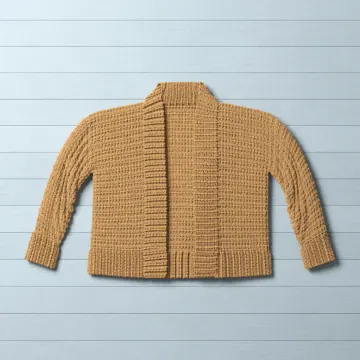
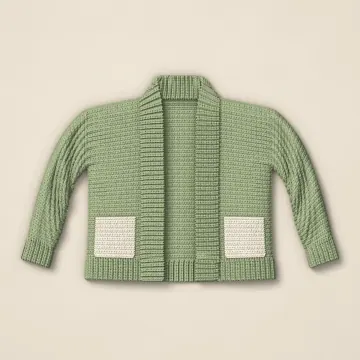
A first crochet cardigan can be one that hangs open. It is a back, two narrow fronts and two sleeves, all in rows of one stitch, with a ribbed band sewn round the opening at the end. Below it is worked step by step, with counts in nine sizes. After it comes the plainest one of all, a cocoon folded from a single rectangle.
On this page 18 parts
- Before you start
- 1. Choose your size
- 2. Make a swatch
- 3. Make the hem ribs
- 4. Work the back
- 5. Work two fronts
- 6. Check the three pieces
- 7. Work two sleeves
- 8. Block, then sew the shoulders
- 9. Sew on the sleeves
- 10. Sew the sides and sleeves
- 11. Make the front band
- 12. Pin it and sew it
- A cocoon from one rectangle
- Change it
- If it goes wrong
- Questions people ask
- Where to go next

A is the back, B a front, C a sleeve and N the neck. Each front is as wide as one shoulder, so there is nothing to shape: the gap between the fronts is the neck, all the way down, and the band fills part of it.
Before you start
You need: bulky yarn (weight 5), an 8 mm (L-11) hook, a yarn needle, scissors, a tape measure, stitch markers and pins.
Know first: the half double crochet (UK half treble) and the single crochet (UK double crochet; United Kingdom patterns use the other name). The seams here are whip stitch, with the right sides together. If sewing up is new to you, a first sweater shows the same seams.
The rows are those of our chunky open cardigan, size M; its page has nine sizes to print. In the lines ch is chain, sc single crochet, hdc half double crochet, st stitch and RS the right side.
1. Choose your size
Take the row nearest to your bust. The third column is the whole way around with the two bands pulled together until they touch: 5½ to 7 in (14 to 18 cm) more than the body. Left alone it hangs open. The lines in the steps are for size M: put the numbers of your own row in their place.
| Size | For a bust of | Finished, with the bands | Back: stitches | Each front: stitches |
|---|---|---|---|---|
| XS | 29 in (73.5 cm) | 35¼ in (89.5 cm) | 48, 40 rows | 13, 40 rows |
| S | 33 in (84 cm) | 40 in (101.5 cm) | 54, 40 rows | 16, 40 rows |
| M | 37 in (94 cm) | 43¼ in (110 cm) | 58, 42 rows | 18, 42 rows |
| L | 41 in (104 cm) | 47¼ in (120 cm) | 64, 42 rows | 20, 42 rows |
| 1X | 45 in (114.5 cm) | 50½ in (128.5 cm) | 68, 42 rows | 22, 42 rows |
| 2X | 49 in (124.5 cm) | 55¼ in (140.5 cm) | 74, 44 rows | 25, 44 rows |
| 3X | 53 in (134.5 cm) | 58½ in (148.5 cm) | 78, 44 rows | 27, 44 rows |
| 4X | 57 in (145 cm) | 63¼ in (160.5 cm) | 84, 44 rows | 30, 44 rows |
| 5X | 61 in (155 cm) | 66½ in (169 cm) | 88, 44 rows | 32, 44 rows |
| Size | Shoulder, neck, shoulder | Sleeve, cuff to top; marker below the shoulder | Front band | Yarn, an estimate |
|---|---|---|---|---|
| XS | 13, 22, 13 | 20 to 36, 30 rows; 7¼ in (18.5 cm) | 138 rows, 52½ in (133.5 cm) | 875 yd (800 m) |
| S | 16, 22, 16 | 20 to 38, 30 rows; 7½ in (19 cm) | 138 rows, 52½ in (133.5 cm) | 950 yd (869 m) |
| M | 18, 22, 18 | 20 to 40, 30 rows; 8 in (20.5 cm) | 144 rows, 54¾ in (139 cm) | 1,050 yd (960 m) |
| L | 20, 24, 20 | 22 to 42, 30 rows; 8½ in (21.5 cm) | 146 rows, 55½ in (141 cm) | 1,150 yd (1,052 m) |
| 1X | 22, 24, 22 | 22 to 44, 28 rows; 8¾ in (22 cm) | 146 rows, 55½ in (141 cm) | 1,175 yd (1,074 m) |
| 2X | 25, 24, 25 | 24 to 48, 28 rows; 9½ in (24 cm) | 150 rows, 57¼ in (145.5 cm) | 1,325 yd (1,212 m) |
| 3X | 27, 24, 27 | 24 to 50, 28 rows; 10 in (25.5 cm) | 150 rows, 57¼ in (145.5 cm) | 1,425 yd (1,303 m) |
| 4X | 30, 24, 30 | 24 to 52, 26 rows; 10½ in (26.5 cm) | 150 rows, 57¼ in (145.5 cm) | 1,475 yd (1,349 m) |
| 5X | 32, 24, 32 | 24 to 56, 26 rows; 11¼ in (28.5 cm) | 150 rows, 57¼ in (145.5 cm) | 1,550 yd (1,417 m) |
The length with the rib is 22 in (56 cm) in XS and S, 22¾ in (58 cm) from M to 1X, and 23¾ in (60.5 cm) from 2X on. All the yarn amounts are estimates.
2. Make a swatch
Chain 16, begin in the second chain from the hook and work 13 rows of 15 half double crochet. You want 10 stitches and 8½ rows in 4 in (10 cm), counted in the middle. More than that: take a larger hook. Fewer: a smaller one. Wash it, let it dry, and pull it lengthwise. If it stays longer, plan a row or two fewer in the body.
3. Make the hem ribs
Chain 9 and work back along it: 8 single crochet. From row 2 on, work in the back loop only, the strand farther from you.
- Row 1 (RS): Sc in 2nd ch from hook and in each ch across (8 sc).
- Rows 2 to 58: Ch 1, turn; sc in back loop only of each st across (8 sc).
That is the rib for the back. For each front make one of 18 rows. In another size a rib has as many rows as its piece has stitches.
4. Work the back
Turn the long rib on its side. Join the yarn at the right-hand end of the long edge, chain 1, and work one single crochet in the end of each rib row: 58. That is row 1. Then:
Rows 2 to 42: Ch 1, turn; hdc in each st across (58 hdc).
It measures about 23¼ in (59 cm) across and 22¾ in (58 cm) long. For a longer cardigan add rows here and as many in both fronts. Every 2 rows are nearly 1 in (2.5 cm). Fasten off.
5. Work two fronts
Work row 1 along a short rib, 18 single crochet, and then:
Rows 2 to 42: Ch 1, turn; hdc in each st across (18 hdc).
The two fronts are the same piece. When the second one is done, turn it over: that makes a left front and a right one. Mark the outside of each.
6. Check the three pieces
Lay both fronts on the back, side edges level. Three things must be true:
- All three have 42 rows. Count along the edges.
- Each front covers 18 stitches of the back, so 22 show in the middle: 18 + 22 + 18 = 58.
- The two fronts are the same width. If one is wider, count the stitches of its rows from the hem up until you find the extra one.
7. Work two sleeves
Make a cuff rib of 20 rows, turn it, and work 20 single crochet along its edge. Then work rows of half double crochet. An increase row has two in the first stitch and two in the last, and in size M every second row is one:
Row 2: Ch 1, turn; hdc in each st across (20 hdc).
Row 3: Ch 1, turn; 2 hdc in first st, hdc in each st across to last st, 2 hdc in last st (22 hdc).
Row 4: Ch 1, turn; hdc in each st across (22 hdc).
Row 5: Ch 1, turn; 2 hdc in first st, hdc in each st across to last st, 2 hdc in last st (24 hdc).
Row 6: Ch 1, turn; hdc in each st across (24 hdc).
Go on like this, row 7 to 26, row 9 to 28, until row 21 brings you to 40. Work nine more rows.
Rows 22 to 30: Ch 1, turn; hdc in each st across (40 hdc).
The sleeve is about 16 in (40.5 cm) across the top and 17¼ in (44 cm) long. The other sizes:
| Size | Increase in | You then have | Work even |
|---|---|---|---|
| XS | every third row, rows 3 to 24 | 36 | rows 25 to 30 |
| S | every third row, rows 3 to 27 | 38 | rows 28 to 30 |
| M | every second row, rows 3 to 21 | 40 | rows 22 to 30 |
| L | every second row, rows 3 to 21 | 42 | rows 22 to 30 |
| 1X | every second row, rows 3 to 23 | 44 | rows 24 to 28 |
| 2X | every second row, rows 3 to 25 | 48 | rows 26 to 28 |
| 3X | every row, rows 3 to 15 | 50 | rows 16 to 28 |
| 4X | every row, rows 3 to 16 | 52 | rows 17 to 26 |
| 5X | every row, rows 3 to 18 | 56 | rows 19 to 26 |
XS to M begin with 20 stitches, L and 1X with 22, the rest with 24. All the rows not named are even.
8. Block, then sew the shoulders
Block the pieces and let them dry. Lay the fronts on the back with right sides together and sew the 18 stitches of each shoulder, firmly: the cardigan hangs from these two seams. They are the seams 1 in the picture.

9. Sew on the sleeves
Mark each side edge 8 in (20.5 cm) below the shoulder seam, about 17 rows, on the fronts and on the back. Pin the middle of the sleeve top to the seam and its ends to the markers, right sides together. Sew from marker to marker. These are the seams 2.
10. Sew the sides and sleeves
Fold at the shoulders. Sew from the cuff to the underarm and on down to the hem, in one line: the edges 4, then the edges 3. Pin row to row. Leave the same room for both arms.
11. Make the front band
Chain 8 and work the same rib, 7 stitches wide, for 144 rows.
- Row 1 (RS): Sc in 2nd ch from hook and in each ch across (7 sc).
- Rows 2 to 144: Ch 1, turn; sc in back loop only of each st across (7 sc).
Why 144? The band runs up one front, across the back of the neck and down the other: 22¾ + 8¾ + 22¾ = 54¼ in (138 cm). At 10½ rib rows to 4 in that is about 142. The pattern has 144, about ½ in (1.5 cm) more, which is eased in as you sew. Before you fasten off, lay the band round the opening. Take out rows or add some until it fits with no pull.
12. Pin it and sew it
Pin the middle of the band to the middle of the back neck, and its ends to the lower corners: in the picture P is the middle and Q the corners. Pin between, so that it neither stretches nor buckles. Sew it on, edge to edge.

Or crochet a band along the edge. Rows of single crochet stand in the row ends: about 7 stitches to every 6 rows at this gauge. Picking up stitches shows where the hook goes. Give both fronts the same number.
A cocoon from one rectangle
A cocoon is a rectangle, folded once, with two short seams. Nothing is shaped, and it fits loosely.

- Measure the width, A. Hold your arms out and measure across the back from elbow to elbow, or to where the sleeves should end. Say 36 in (91 cm).
- Measure the length, B. From the back of the neck to where it should end, with some for the collar that folds back. Say 40 in (102 cm).
- Count. At 10 stitches and 8½ rows to 4 in: 36 × 2.5 = 90 stitches, and 40 × 2.125 = 85 rows. In half double crochet chain 91. That is 7,650 stitches, about 1,100 yd (1,006 m) of this yarn, an estimate.
- Fold it in half, so that the chain edge meets the last row. It is now 20 in (51 cm) high.
- Sew each side, the row ends, from the open edge toward the fold, and stop 8 in (20 cm) short of it: a seam of 12 in (30 cm), S in the picture. The gap that is left, H, goes around the arm, 16 in (41 cm).
- Put it on with an arm through each gap. One of the open edges goes round the neck and the other hangs at the hip. It is done. A rib at the armholes or along the opening is made as in step 11, as long as the edge, and sewn on: cuffs and bands.
Change it
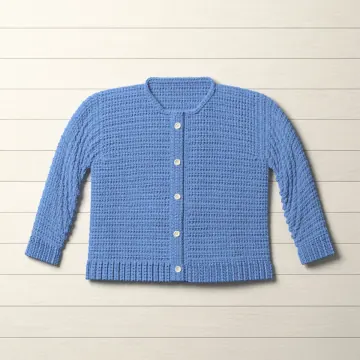
- Buttons. For buttons the fronts must be wider, because one band lies on the other. How a cardigan is built has the sum, buttonholes the two rows, and the button cardigan is one worked out.
- Ties or a clasp. Closures has them.
- Longer, or with pockets. A long open front grows as it is worn, and full pockets pull it down. Keep the side seams, and work a row of slip stitch up each front edge before the band. Pockets are sewn on last.
- A hood. Hoods are worked up from the back of the neck.
- Lighter. The open front cardigan is the same shape in medium yarn and single crochet, and the granny stitch cardigan is more open.
If it goes wrong
| What you see | Why | What to do |
|---|---|---|
| The fronts flare or wave at the band | The band is too long for the edge | Take rows out of it and pin it again |
| The fronts pull up | The band is too short | Add rows |
| The hem rides up at the front | The band or the fronts have fewer rows than the back | Count the rows: all three need 42 |
| One front hangs lower | A row too many in it | Open the shoulder and take the row out |
| It grows with wear | A heavy yarn in a long piece | Firm shoulders, a slip stitch row up the fronts, fewer rows next time |
| The fronts will not stay closed | It is made to hang open; the bands meet only when you pull them together | A clasp or a tie, or wider fronts |
| The back of the neck stands off | The band was not eased there | Pull that part out and pin it again |
Questions people ask
Is a cardigan harder than a sweater? This one has no neck to shape. It has one more piece and a long seam for the band.
How much yarn does it take? From 875 yd (800 m) in XS to 1,550 yd (1,417 m) in 5X, in bulky yarn; those are estimates.
Where to go next
Print the chunky open cardigan in your size, or see all the cardigans. How a sweater is put together has the other ways to build one.