Crochet guide
How to crochet a doily
A doily is a flat round of crochet worked from the middle out, solid at the center and open toward the edge. Make the first one in cotton yarn and not in thread: the same seven rounds come out larger and are far easier to see.
On this page 14 parts
- 1. Make the ring
- 2. Round 1: fill the ring
- 3. Round 2: two in every stitch
- 4. Round 3: open it
- 5. Step into the space
- 6. Rounds 4 to 6: loops on loops
- 7. Round 7: a picot in each loop
- 8. Wet it and pin it out
- How to read a doily chart
- Keep it flat
- Make it larger, or another shape
- A mandala is the same in colors
- Questions people ask
- Where to go next
| Worked in | Hook | Comes out about | After round 3, about | To buy, an estimate |
|---|---|---|---|---|
| Light cotton yarn (weight 3) | 4 mm (G-6) | 6¼ in (16 cm) | 2¾ in (7 cm) | 25 yd (23 m) |
| Medium cotton yarn (weight 4) | 5 mm (H-8) | 7¾ in (19.5 cm) | 3½ in (9 cm) | 30 yd (27 m) |
| Size 10 cotton thread | 1.5 mm (steel 8) | 2¾ in (7 cm) | 1¼ in (3 cm) | 15 yd (14 m) |
The rounds are those of our easy first doily, which has them to print. Work it once in yarn and once in finer yarn before you take up thread and a steel hook.
Have: the yarn and hook of one line of the table, a stitch marker, a yarn needle, scissors. For the end: rust-proof pins, paper, clear plastic, and a flat board or mat that pins go into and that may get damp.
Know first: the chain, single crochet (double crochet in United Kingdom patterns), double crochet (UK treble) and the slip stitch. If you have worked a granny square, you know how a ring and a space are worked into.
In the lines rnd is round, ch is chain, sc is single crochet, dc is double crochet, sl st is slip stitch, st is stitch, sp is space and beg is beginning: the beg ch is the chain that begins the round. What stands in square brackets is worked as many times as the number after them says. "Counts as dc" in round brackets says that a chain stands for a stitch.
In the charts an oval is a chain, a T with one slash is a double crochet, a plus is a single crochet and a dot is a slip stitch. Start at the middle: each ring of signs is a round. Its number stands where it begins, and it runs counterclockwise, to the left along the top. Orange dots are the slip stitches where a round ends or begins. Green only sets stitches apart.
1. Make the ring
Make a magic ring, or chain 4 and join with a slip stitch in the first chain.
2. Round 1: fill the ring
Chain 3: it counts as the first double crochet. Work 11 more into the ring and close with a slip stitch in the third of the 3 chains. If you made a magic ring, pull its tail to shut the hole.
Keep the marker in the first stitch of the round, so that you see where to join: in the third chain in rounds 1 to 3, and from round 4 on in the first single crochet. Move it up as you begin each round.
Rnd 1: Ch 3 (counts as dc), 11 dc in ring, join with sl st in top of beg ch-3 (12 dc).
3. Round 2: two in every stitch
Chain 3 and put 1 double crochet in the same place, the stitch you joined in. Then two in each stitch to the end.
Rnd 2: Ch 3 (counts as dc), dc in same st, [2 dc in next dc] 11 times, join with sl st in top of beg ch-3 (24 dc).
4. Round 3: open it
The doily opens here: one chain between stitches. Chain 4, three for the stitch and one for the first space. At the end, join in the third chain, not the fourth.
In the chart the second stitch of each pair of round 2 is green.
Rnd 3: Ch 4 (counts as dc, ch 1), [dc in next dc, ch 1] 23 times, join with sl st in 3rd ch of beg ch-4 (24 dc, 24 ch-1 sps).

Count after every round, before you go on: 12, 24, 24. A missed stitch does not show for another round or two, and by then it has to be pulled back.
Then measure across. If it is larger than the table says after round 3, take a smaller hook and start again from the ring; if it is smaller, take a larger one and start again.
5. Step into the space
Every round from here begins in a space and not over a stitch. You have joined in the third chain. Slip stitch into the next space, the one on the left of the join, under the fourth chain (left-handed: on the right). Chain 1, which is not a stitch, and work a single crochet in that space.
These are the first words of round 4: the line in step 6 begins with them. Do them once, and go on there from "ch 2". Rounds 5 to 7 begin the same way.
In the picture 1 to 4 are the chains that began round 3. The first orange dot is the slip stitch that joins, beside the third chain; the second is the one into the space. The orange plus is the first single crochet of round 4.

6. Rounds 4 to 6: loops on loops
Single crochet in a space, then chains, all the way round. Each single crochet goes in the next space of the round below, with the hook in the hole and not in a chain. A loop is a space of chains. There are always 24 loops. Round 6 makes them longer.
Rnd 4: Sl st in next ch-1 sp, ch 1, sc in same sp, ch 2, [sc in next ch-1 sp, ch 2] 23 times, join with sl st in first sc (24 sc, 24 ch-2 sps).
Rnd 5: Sl st in next ch-2 sp, ch 1, sc in same sp, ch 2, [sc in next ch-2 sp, ch 2] 23 times, join with sl st in first sc (24 sc, 24 ch-2 sps).
Rnd 6: Sl st in next ch-2 sp, ch 1, sc in same sp, ch 3, [sc in next ch-2 sp, ch 3] 23 times, join with sl st in first sc (24 sc, 24 ch-3 sps).
7. Round 7: a picot in each loop
Chain 3, make a picot, chain 3, and single crochet in the next loop. The picot is chain 3 and a slip stitch in the third chain from the hook. A loop with its picot is a picot loop.
Rnd 7: Sl st in next ch-3 sp, ch 1, sc in same sp, ch 3, picot, ch 3, [sc in next ch-3 sp, ch 3, picot, ch 3] 23 times, join with sl st in first sc (24 sc, 24 picot loops).

In the chart one repeat of each round, a single crochet and its chains, is green.
Fasten off and weave in both ends.
8. Wet it and pin it out
A doily looks limp until it is blocked.
- Draw a circle on paper as wide as the table's "Comes out about". For the light cotton one that is a compass set to 3⅛ in (8 cm), half of 6¼ in (16 cm), or a plate of that size to draw round. Mark its middle, and fold the paper in quarters to mark four places on the circle.
- Lay the paper on the board, with clear plastic over it.
- Wet the doily, press the water out without wringing, and lay it on the circle with its right side up and its middle on the mark.
- Pin four picots at the four marks. They are every sixth picot.
- Pin the picot halfway between each two, then all 24, each drawn out to the circle.
- Leave it until it is dry, and take the pins out.
Blocking has more, and stiffening is for one that must stand.
How to read a doily chart
- Learn its signs first. The four of this page are told before step 1.
- Start at the middle. Each ring of symbols is one round, and its number stands where it begins.
- Go counterclockwise, to the left along the top. Left-handed makers work the same symbols clockwise.
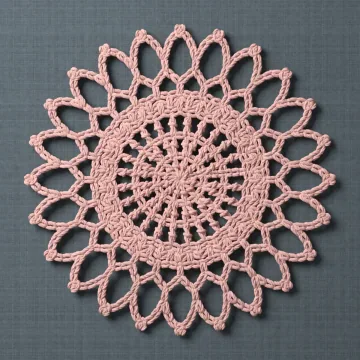
- A large chart may show one wedge. Work the wedge again and again until the round is full. The doily above has 24 wedges in its outer rounds.
Reading charts has the symbols.
Keep it flat
A round that is a step farther out is longer, so it needs more in it. In solid double crochet that is 12 more stitches every round. In open rounds the count can stand still if the loops get longer, as rounds 4 to 7 show.
| What you see | Why | What to do |
|---|---|---|
| It cups like a bowl | Too few stitches, or tight ones | Count back to a round that is right; try a larger hook |
| The edge waves | Too many stitches, or loose ones | Count back; try a smaller hook |
| It waves a little, and the counts are right | The loops are long for their round | Finish, wet it and pin it out; if it still waves, use one chain fewer in each loop |
| 23 loops | One space was passed over | Pull back to the round before and count |
| The join climbs like a seam | Each round begins over the last one | Begin in the next space, as in step 5 |
| The middle has a hole | A ring of chains | Begin with a magic ring |
Make it larger, or another shape
- Larger by the yarn. Thicker yarn and its hook make the same rounds larger: see the table.
- Larger by rounds. Before round 7 work more rounds like round 6. When the edge begins to draw in, put one chain more in each loop, and the same in both halves of round 7. Lay it down after every round.
- Oval. An oval begins on a chain and not a ring: see oval shapes and the oval lace doily.
- Pineapples. They are lace shapes, broad at the foot and narrowing to a point, set round the doily: the pineapple is taught alone first.
A mandala is the same in colors
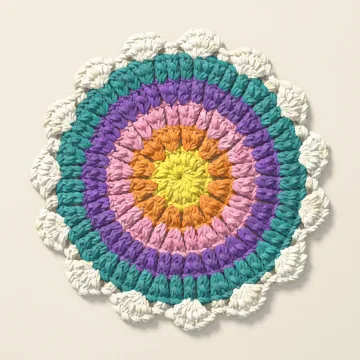
A mandala is a round worked from the middle out, in yarn, with a new color for most rounds. Plan three things: how many rounds, which colors meet, and how many stitches each round adds. The simple mandala is six rounds, about 7 in (18 cm) across in medium yarn:
| Round | Double crochet | How |
|---|---|---|
| 1 | 12 | In a ring |
| 2 | 24 | Two in each stitch |
| 3 | 36 | Two in every second stitch |
| 4 | 48 | Two in every third stitch |
| 5 | 60 | Two in every fourth stitch |
| 6 | 75, and 15 single crochet | 15 shells of 5: single crochet, pass over one, five in the next, pass over one |
Each of rounds 2 to 5 is 12 more than the one before. Round 6 takes 4 stitches for a shell and its single crochet, and 60 ÷ 4 is 15.
Questions people ask
How much thread does a doily take? The amounts in the table are estimates worked out from the stitches and chains of this one, the picots among them. For another doily, weigh the ball before and after a round near the edge and multiply by the rounds left.
Which thread is for doilies? Size 10 is the common one to learn on. Kinds of thread and the thread size chart compare them.
Do I turn the work? No. The right side faces you in every round.
How do I wash one? As the label of its yarn says, and then pin it out again as in step 8. An old one needs care: see old pieces. To show one, see displaying doilies.
Where to go next
Print the easy first doily, try the mini doily, or choose among the doilies and the mandalas. A coaster is a doily with no holes.