Crochet guide
How to crochet a hexagon
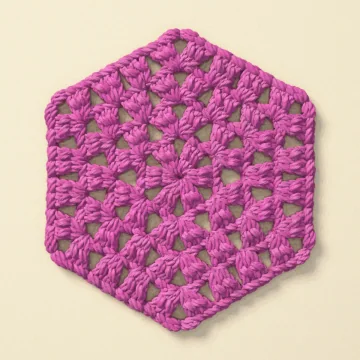
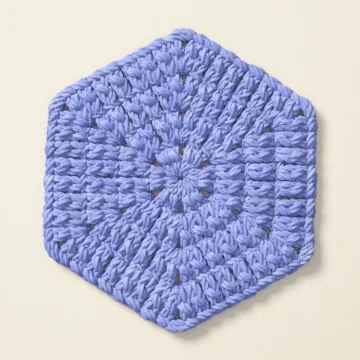
A crochet hexagon is worked from the middle outward, with six corners in every round. The granny hexagon is made of pairs of stitches and has open corners. The solid hexagon has a stitch in every stitch. Either one adds 12 double crochet (UK treble) a round, two for each side. Begin with the granny hexagon, in the six steps below.
On this page 14 parts

| Kind | Each corner | Along a side | When to choose it | Where below |
|---|---|---|---|---|
| Granny | 2 stitches, chain 2, 2 stitches | A pair in each gap between pairs | A first one, scraps, soft blankets | Steps 1 to 6 |
| Solid | 1 stitch, chain 1, 1 stitch | One stitch in each stitch | Close fabric, coasters, bags | "A solid hexagon" |
| Solid, no chains | 1 stitch, a taller one, 1 stitch | One stitch in each stitch | No holes at all | The end of "A solid hexagon" |
| Half, in rows | As the solid one, two of them | One stitch in each stitch | A straight edge on a blanket | "A half hexagon" |
Before you start
You need: medium yarn (weight 4), about 20 yd (18 m) for four rounds as an estimate, a 5.5 mm (I-9) hook, a yarn needle, scissors, and pins for blocking.
Know first: the chain (ch), the double crochet (dc, UK treble) and the slip stitch (sl st). Names here are United States terms, with the United Kingdom name in brackets.
These are the rounds of our granny hexagon pattern. The front faces you in every round. In the lines Rnd is a round, RS the right side or front, st a stitch, sp a space and sk means skip. A granny square has groups of three; a hexagon has two more corners, so pairs are enough to keep it flat.
- (dc, ch 2, 2 dc) in same sp means that everything in the brackets goes into that one space.
- [ ] 5 times means: work what is in the square brackets five times in all, after what came before them. Where one pair of square brackets stands inside another, the inner one is repeated first.
1. Work six pairs in a ring
Chain 4 and join them with a slip stitch, or begin with a magic ring. Chain 3, which counts as the first stitch, and work 1 double crochet in the ring. Then chain 2. Work 2 more in the ring and chain 2, five times. Join to the top of the chain 3.
Foundation: Ch 4, sl st in first ch to form a ring.
Rnd 1 (RS): Ch 3 (counts as dc), dc in ring, ch 2, [2 dc in ring, ch 2] 5 times, sl st in top of ch-3 to join (12 dc, 6 ch-2 sps).
Count: six pairs and six spaces. Count the spaces now: with five you are making a pentagon.
2. Slip to a corner
Slip stitch in the next stitch and in the next chain-2 space. You stand in a corner, and every round begins in one.
3. Make the corner
Chain 3, which counts as a double crochet. Work 1 double crochet in the space, chain 2, and work 2 double crochet in the same space.

4. Make five more corners
Work 2 double crochet, chain 2, 2 double crochet in each of the next five spaces. There is no chain between one corner and the next. Join.
Rnd 2: Sl st in next st, sl st in next ch-2 sp, ch 3 (counts as dc), (dc, ch 2, 2 dc) in same sp, [(2 dc, ch 2, 2 dc) in next ch-2 sp] 5 times, sl st in top of ch-3 to join (24 dc, 6 ch-2 sps).
Count: two pairs on each side, 24 stitches.
5. Put a pair in each gap
In round 3 each side has a gap between its two pairs. After a corner, skip the next 2 stitches of round 2 and work 2 double crochet in the gap itself, down between the pairs. Then skip 2 more stitches and make the next corner. In the lines this gap is the sp before next st. The last gap of the round lies just before the chain 3 that round 2 began with. A pair goes in there too, and then you join.

Rnd 3: Sl st in next st, sl st in next ch-2 sp, ch 3 (counts as dc), (dc, ch 2, 2 dc) in same sp, [sk next 2 sts, 2 dc in sp before next st, sk next 2 sts, (2 dc, ch 2, 2 dc) in next ch-2 sp] 5 times, sk next 2 sts, 2 dc in sp before next st, sl st in top of ch-3 to join (36 dc, 6 ch-2 sps).
6. One more pair on every side
Slip to a corner, as in step 2, at the start of every round. Each round has the same corners and one pair more along each side, in the gaps between the pairs below.
Rnd 4: Sl st in next st, sl st in next ch-2 sp, ch 3 (counts as dc), (dc, ch 2, 2 dc) in same sp, [[sk next 2 sts, 2 dc in sp before next st] 2 times, sk next 2 sts, (2 dc, ch 2, 2 dc) in next ch-2 sp] 5 times, [sk next 2 sts, 2 dc in sp before next st] 2 times, sl st in top of ch-3 to join (48 dc, 6 ch-2 sps).
Rnd 5: Sl st in next st, sl st in next ch-2 sp, ch 3 (counts as dc), (dc, ch 2, 2 dc) in same sp, [[sk next 2 sts, 2 dc in sp before next st] 3 times, sk next 2 sts, (2 dc, ch 2, 2 dc) in next ch-2 sp] 5 times, [sk next 2 sts, 2 dc in sp before next st] 3 times, sl st in top of ch-3 to join (60 dc, 6 ch-2 sps).
Stop at any round and fasten off. Weave in both tails, then pin the six corners out, dampen it and let it dry.

Read it counterclockwise; left-handed, clockwise. Reading charts explains the symbols.
A solid hexagon
Our hexagon pattern, also in three sizes. There is nothing to slip to: each round begins on the join, on a side, and the last stitches of the round finish that side.
Foundation: Make a magic ring.
Rnd 1 (RS): Ch 3 (counts as dc), dc in ring, ch 1, [2 dc in ring, ch 1] 5 times, sl st in top of ch-3 to join (12 dc, 6 ch-1 sps).
Rnd 2: Ch 3 (counts as dc), dc in next st, (dc, ch 1, dc) in next ch-1 sp, [dc in next 2 sts, (dc, ch 1, dc) in next ch-1 sp] 5 times, sl st in top of ch-3 to join (24 dc, 6 ch-1 sps).
Rnd 3: Ch 3 (counts as dc), dc in next 2 sts, (dc, ch 1, dc) in next ch-1 sp, [dc in next 4 sts, (dc, ch 1, dc) in next ch-1 sp] 5 times, dc in next st, sl st in top of ch-3 to join (36 dc, 6 ch-1 sps).
Rnd 4: Ch 3 (counts as dc), dc in next 3 sts, (dc, ch 1, dc) in next ch-1 sp, [dc in next 6 sts, (dc, ch 1, dc) in next ch-1 sp] 5 times, dc in next 2 sts, sl st in top of ch-3 to join (48 dc, 6 ch-1 sps).
Rnd 5: Ch 3 (counts as dc), dc in next 4 sts, (dc, ch 1, dc) in next ch-1 sp, [dc in next 8 sts, (dc, ch 1, dc) in next ch-1 sp] 5 times, dc in next 3 sts, sl st in top of ch-3 to join (60 dc, 6 ch-1 sps).

Look for the first stitch after each corner. It sits close behind the corner and is easy to miss.
The rule for any round: one more stitch before the first corner, two more between corners, and one more at the end than in the round before.
With no chain corners: put 1 treble crochet (tr, UK double treble) in the place of the chain. Round 1 is 2 double crochet and 1 treble, six times. After that, work 1 double, 1 treble and 1 double crochet in each corner treble. The rounds have 18, 30, 42 and 54 stitches.
In single crochet (sc, UK double crochet): work 6 stitches in a ring, then 2 into each of them: 12. Round 3 is 1 stitch in the next one and 2 stitches in the one after, six times: 18. Round 4 is 1 stitch in each of the next two and 2 stitches in the one after, six times: 24. Every later round has one more plain stitch before each increase. Increases that stand above each other make the corners. They are what a flat circle has to avoid.
Counts and sizes
| Round | Stitches on a side | In all | Granny, point to point and side to side | Solid, point to point and side to side |
|---|---|---|---|---|
| 1 | 2 | 12 | ||
| 2 | 4 | 24 | ||
| 3 | 6 | 36 | 5 x 4½ in (13 x 11 cm) | 4¼ x 3¾ in (11 x 9.5 cm) |
| 4 | 8 | 48 | 6 x 5½ in (15 x 14 cm) | 5½ x 4¾ in (14 x 12 cm) |
| 5 | 10 | 60 | 7½ x 6½ in (19 x 17 cm) | 6¾ x 5¾ in (17 x 15 cm) |
Sizes are about right at the patterns' gauge, 13 double crochet and 7 rounds to 4 in (10 cm). From a side to the width: point to point is twice one side, and side to side is about 1¾ times one side. A side of 3 in (7.5 cm) gives 6 in (15 cm) and 5¼ in (13 cm).
A half hexagon
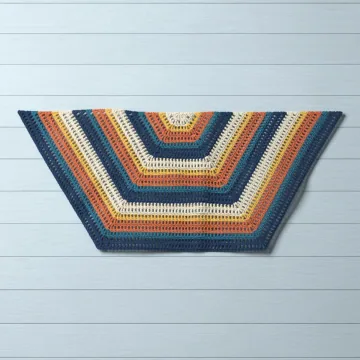
It is cut from point to point and worked in rows that turn: a ring, two corners, and an increase at both ends. The rows are the first five of our half hexagon shawl, and each has half the stitches of the solid round of its number. So five rows fit a solid hexagon of five rounds. Beside granny hexagons chain 2, not 1, at both corners: four rows then come to the side of a granny hexagon of four rounds. In the lines turning ch is the chain 3 at the start of the row before, and you work into its top.
Foundation: Ch 4, sl st in first ch to form a ring.
Row 1 (RS): Ch 3 (counts as dc), dc in ring, ch 1, 2 dc in ring, ch 1, 2 dc in ring (6 dc, 2 ch-1 sps).
Row 2: Ch 3 (counts as dc), turn; dc in same st, dc in next st, (dc, ch 1, dc) in next ch-1 sp, dc in next 2 sts, (dc, ch 1, dc) in next ch-1 sp, dc in next st, 2 dc in top of turning ch (12 dc, 2 ch-1 sps).
Row 3: Ch 3 (counts as dc), turn; dc in same st, dc in next 3 sts, (dc, ch 1, dc) in next ch-1 sp, dc in next 4 sts, (dc, ch 1, dc) in next ch-1 sp, dc in next 3 sts, 2 dc in top of turning ch (18 dc, 2 ch-1 sps).
Row 4: Ch 3 (counts as dc), turn; dc in same st, dc in next 5 sts, (dc, ch 1, dc) in next ch-1 sp, dc in next 6 sts, (dc, ch 1, dc) in next ch-1 sp, dc in next 5 sts, 2 dc in top of turning ch (24 dc, 2 ch-1 sps).
Row 5: Ch 3 (counts as dc), turn; dc in same st, dc in next 7 sts, (dc, ch 1, dc) in next ch-1 sp, dc in next 8 sts, (dc, ch 1, dc) in next ch-1 sp, dc in next 7 sts, 2 dc in top of turning ch (30 dc, 2 ch-1 sps).

Turned rows show both faces of the stitches, and the rounds show one. To match them, do not turn: cut the yarn after each row and join it again at the end where the row before began, with the front facing. The first stitch of the row below is then its chain 3, and the last is a double crochet. The counts stay the same.
Lay them out and join
Hexagons fit together with no gaps. Set every second row along by half a hexagon. Wherever two in one row meet (B and C), a corner of one in the next row (D) comes in, so three corners share one point. The gaps at the sides take a half hexagon each (A). The zigzag at the top and bottom stays, or a border fills it.

- Join the hexagons of one row, side to side. Sew them, or join them as their last round is worked.
- Join the next row to it. Each hexagon of it meets two above, so its two upper sides are joined.
- Join each half into its gap along its three short sides. Its long side is the blanket's edge.
Joining squares has the seams and join as you go the other way.
How many for a blanket
With points up, divide the width by the size from side to side: that is how many go across. For the rows, take a quarter of the point-to-point size from the length, and divide by three quarters of that size. Every second row has one hexagon fewer, and a half at each end.
Example, for granny hexagons of four rounds, 5⅓ in (13.5 cm) by 6⅛ in (15.5 cm), and 48 in (122 cm) by 60 in (152 cm): 48 divided by 5⅓ is 9. And a quarter of 6⅛ is about 1½, and three quarters of it about 4⅝. 60 less 1½ is 58½, which divided by 4⅝ is nearly 13 rows. An odd number of rows makes the top and the bottom alike.
| Granny hexagons of 4 rounds | Across | Rows | Whole ones | Halves |
|---|---|---|---|---|
| 32 in (81 cm) by 34 in (86 cm) | 6 | 7 | 39 | 6 |
| 37 in (94 cm) by 52 in (132 cm) | 7 | 11 | 72 | 10 |
| 48 in (122 cm) by 61 in (155 cm) | 9 | 13 | 111 | 12 |
| 59 in (149 cm) by 71 in (180 cm) | 11 | 15 | 158 | 14 |
The hexagon blanket has its own plan, and the hexagon throw is one hexagon that goes on growing.
If it goes wrong
| What you see | Why | What to do |
|---|---|---|
| It waves | Threes in place of pairs, or loose stitches | Count each side; a smaller hook |
| It cups | Too few stitches, or tight ones | Look for a missed stitch after a corner; a larger hook |
| A side is 1 short | The first stitch after a corner was missed | Open the corner with a finger and look |
| Gaps spread along the sides | Chains between the pairs | Chain only at the corners |
| Round corners, wavy sides | Not yet blocked | Block every hexagon of a set to one size |
Questions people ask
How do I change color? Fasten off after a round and join the next color in any corner space, in place of step 2. Then go on with step 3.
Does it need a border? Not to lie flat. A round of single crochet, two in each corner, gives an even edge.
Is a flower hexagon the same thing? It ends as one. The African flower hexagon and the puff flower hexagon have their own rounds in the middle.
More: hexagon patterns, crochet shapes, and polygons for other numbers of sides.