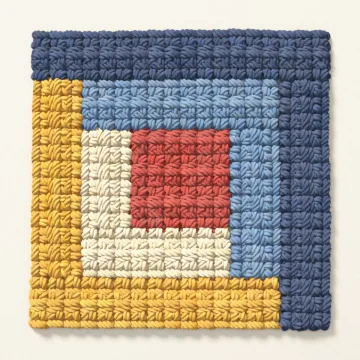
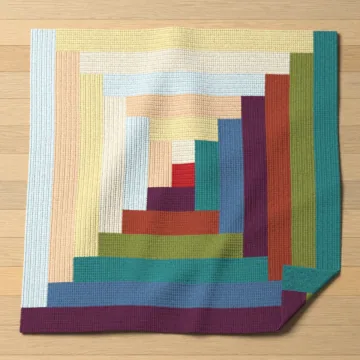
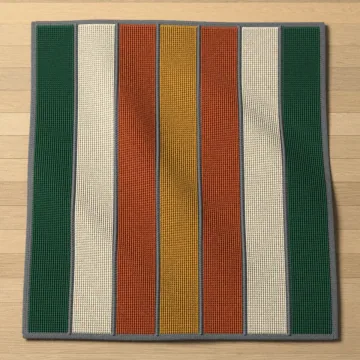
A ten stitch strip, worked round and round
This is a square or a blanket made of one strip, ten stitches wide. The strip begins in the middle, turns a corner, and is joined to its own side as it goes round, so there is nothing to sew. Begin with a trial of four blocks, about 5½ in (14 cm) square: steps 1 to 7.
On this page
- Before you start
- 1. Make the first strip
- 2. Slip stitch across the end
- 3. Turn the corner
- 4. Work strip 2
- 5. Begin strip 3
- 6. Join to the side
- 7. Go out and come back
- 8. Go past the corner
- 9. Stop on a straight edge
- Tunisian: the strip that is never turned
- The other corner, by short rows
- Change it
- If it goes wrong
- Questions people ask

In the plan, 1 to 5 are five lengths of one strip and A to D its first corners. A block is ten stitches wide and ten rows tall. The yarn is never cut. At each corner you work ten stitches along the side of the last block, and the strip goes off in a new direction.
| Form | What a row is | How it is joined | Where below |
|---|---|---|---|
| Single crochet (double crochet in the United Kingdom) | Ten stitches, turned every row | Two slip stitches at the end of every second row | Steps 1 to 9 |
| Tunisian | Ten loops out, then back, never turned | One loop at the end of every row | "Tunisian: the strip that is never turned" |
Before you start
You need: medium yarn (weight 4), a 5 mm (H-8) hook, a stitch marker, scissors and a yarn needle. The trial needs about 25 yd (23 m) as an estimate.
Know first: the chain (ch), the single crochet (sc, UK double crochet) and the slip stitch (sl st). For the Tunisian way, Tunisian simple stitch as well.
Gauge: ten stitches and ten rows should measure the same, here 2¾ in (7 cm). That they match is what keeps the piece flat. RS is the right side, st a stitch.
1. Make the first strip
Chain 11 and work 20 rows of 10 single crochet: two blocks. Hang the marker on the front of row 1. The side it hangs on is the right side.
Foundation: Ch 11.
Row 1 (RS): Sc in 2nd ch from hook and in each ch across (10 sc).
Rows 2 to 20: Ch 1, turn; sc in each st across (10 sc).
2. Slip stitch across the end
Turn, so that the right side faces you. Slip stitch loosely in each of the 10 stitches, with no chain first. This is not counted as a row. It brings the yarn to the other corner, where the next strip begins, and it leaves an edge to join to later. If it is tight, that edge will pucker.
Count: 10 slip stitches, and the loop is at the left end.
3. Turn the corner
Do not turn the piece over. Turn it a quarter to the right, so that the side of the last ten rows lies along the top. Chain 1. Work 1 single crochet in the end of each of those ten rows. That is row 1 of strip 2.

Count: 10 stitches. In the picture, 1 to 10 are the ten row ends. Put the hook under two strands of each row end. Picking up stitches shows the place.
4. Work strip 2
Chain 1, turn, and work nine more rows of 10. Nothing lies beside this strip yet, so there is nothing to join. At its end, turn and slip stitch across as in step 2.
- Row 1 (RS): Ch 1, sc in end of each of next 10 rows (10 sc).
- Rows 2 to 10: Ch 1, turn; sc in each st across (10 sc).
5. Begin strip 3
Turn the corner again: a quarter turn, chain 1, and 10 single crochet along the side of strip 2. After the tenth stitch you stand in the inner corner, with the long side of strip 1 straight ahead.
6. Join to the side
At the end of that row slip stitch in each of the next 2 places on the side of strip 1. A place is a row end, a stitch or a foundation chain, whichever the side has there.

In the picture P is the piece and S the strip. The first slip stitch joins the row just made, and the second makes room for the next.
7. Go out and come back
Turn. Do not chain. Skip the 2 slip stitches and work 10 single crochet back to the outer edge. Chain 1, turn, work 10 single crochet to the inner edge, and join as in step 6. Two rows use two places. Go on until the ten places are used up: ten rows, five joins.
Count: 10 stitches in every row. The slip stitches are never counted.
You have four blocks, a square of 5½ in (14 cm). For a trial, fasten off here.

In the chart the first and last rows of each strip are numbered, and the chain 1 at each turn is left out.
8. Go past the corner
To make it larger, do not stop. Work ten more rows that are joined to nothing: after the last join there are no more slip stitches, and you chain 1 and turn at both ends. Those ten rows are the corner block. Slip stitch across its end, turn the corner, and begin the next strip.
Every strip after this is the same: joined rows as long as there is an edge beside you, then ten free rows, then the slip stitches.
| Strip | Joined rows | Free rows | What it is joined to |
|---|---|---|---|
| 1 | 0 | 20 | Nothing |
| 2 | 0 | 10 | Nothing |
| 3 | 10 | 10 | Row ends of strip 1 |
| 4 | 10 | 10 | The foundation chain |
| 5 | 20 | 10 | The other side of strip 1 |
| 6 | 20 | 10 | The end of strip 1, then the side of strip 2 |
| 7 | 30 | 10 | The end of strip 2, then the side of strip 3 |
| 8 | 30 | 10 | The end of strip 3, then the side of strip 4 |
The joined rows grow by ten every second strip. Where you come to a slip-stitched end, work each join under both strands of the slip stitch.
9. Stop on a straight edge
A square is whole when a strip with an odd number has been joined all along and has no free rows. Fasten off there and weave in the two tails.
| Blocks on a side | Last strip | Rows in all | Each side, about |
|---|---|---|---|
| 2 | 3 | 40 | 5½ in (14 cm) |
| 3 | 5 | 90 | 8¼ in (21 cm) |
| 4 | 7 | 160 | 11 in (28 cm) |
| 6 | 11 | 360 | 16½ in (42 cm), a cushion |
| 13 | 25 | 1,690 | 35¾ in (91 cm), a baby blanket |
| 16 | 31 | 2,560 | 44 in (112 cm) |
| 18 | 35 | 3,240 | 49½ in (126 cm), a throw |
Sums at 2¾ in (7 cm) a block, before any border. At another gauge, multiply the side of your own block by the first figure. The blanket size chart gives the size to aim for, and yarn for a blanket an estimate of the yarn.
A round of single crochet with three in each corner evens the edge: see adding a border.
Tunisian: the strip that is never turned
The plan, the table of strips and the sizes are the same. Every row is a row of Tunisian simple stitch, worked from the front and never turned. Ten or eleven loops fit on an ordinary hook with a plain handle. Use one two sizes larger than you would otherwise.

In this chart 1 to 10 are the loops of the strip, and 11 comes from the piece.
In the forward pass you draw up loops from right to left and keep them all on the hook. To draw up a loop, put the hook under a strand, take the yarn over the hook and pull it through. In the return pass you work the loops off from left to right, through two at a time, until one is left. The two together are one row.
- First strip. Chain 10 and work 20 rows of 10, the first of them in the chain. Then bind off: skip the edge bar, and work one loose slip stitch under each bar that is left. That is 9 slip stitches, and the loop is at the left end. The bind off takes the place of step 2.
- The corner. Turn the piece a quarter to the right. The loop on the hook is the first stitch. Draw up 9 more loops along the ends of the last ten rows, beginning with the second, one to a row: 10 loops. This is the forward pass of row 1. In strip 2 finish the row as in item 3. From strip 3 on it has an edge beside it, so finish it as in item 4, with an eleventh loop from the very first place.
- A row with nothing beside it. Draw up ten loops, the last through both strands of the edge stitch. Begin the return pass by drawing through one loop.
- A row with an edge beside it. Draw up ten loops, the tenth under its front bar only, like the others. Then draw up one loop from the next place on the piece: 11 loops. Begin the return pass by drawing through two loops at once, which takes the joining loop in. Ten stitches are left.
- The end of a strip. Bind off as in item 1, then turn the corner as in item 2.
Every joined row uses one place, row 1 too, so ten rows use ten, as in the table. Along a bound-off end the places are its 9 slip stitches and then the corner after them, where the next strip goes off.
After the last row of all, bind off: 9 slip stitches, then one in the corner of the piece beside you, where its places end.
The other corner, by short rows
In some pieces a line runs across each corner block on the slant. That corner is made of rows that are turned before their end, and nothing is bound off. The steps above do not need it. This is how to know it when you see it.

In the picture X is the strip as it comes and Y as it goes on. First come ten rows, each one stitch shorter at the inner side: 10 stitches, 9, 8 and so on, down to 1. Then come nine rows across their stepped ends, which grow from 1 stitch to 9, each tied to the end of a short row. The next row, of 10, is the first of Y. The two halves are 55 and 45 stitches, 100 together, as in ten rows of ten, so the block is the same size. Short rows shows how such a row is turned and how its step is closed.
Change it
- Another width. Any even number works. Count that many rows to a block. Six stitches make a block of about 1⅝ in (4 cm), eight 2¼ in (5.5 cm), fourteen 3⅞ in (10 cm) and twenty 5½ in (14 cm).
- A rectangle. Work more rows before the first corner: ten for each block the long side has beyond the short one. Fourteen blocks by eighteen begin with 60 rows, not 20. The strips with an odd number, from strip 3 on, then have as many joined rows more: here 40, so strip 3 has 50 and strip 5 has 60. The strips with an even number stay as in the table. The last strip is the one the short side asks for, twice its blocks less one: strip 27. Rows in all are ten for each block: 2,520.
- A taller stitch. Work enough rows for a square block, an even number, and put ten stitches along their ends. In half double crochet (UK half treble) that is about eight rows, with 2 stitches in every fourth row end. Where the edge beside you is ten stitches, not eight row ends, skip every fifth stitch as you join.
- Colors. Change at a corner, on the last pull of the slip stitches, and every strip has its own color. A change of color at each corner leaves two ends. A yarn that changes color slowly leaves none.
- Left-handed. Turn the piece to the left at each corner. The strip runs round clockwise.
If it goes wrong
| What you see | Why | What to do |
|---|---|---|
| The middle cups | Strips pulled short by tight joins | Looser slip stitches, or a larger hook for the joins |
| The edge waves | Ten rows are taller than ten stitches are wide | A smaller hook, or shorter loops |
| The block is wider than tall | Rows too short | Draw the loops up higher, or a larger hook |
| The strip gets wider | Slip stitches counted as stitches | Skip both, then work ten |
| The strip gets narrower | The last stitch missed at the outer edge | Count ten in every row |
| A hole at the inner corner | The first join is too far along | Use the very first place after the corner |
| Places left when the rows are done | A join took one place only | Two places for every two rows |
| The strip turned the wrong way | The corner was begun at the outer side | Slip stitch across first; begin at the inner side |
Questions people ask
What is a ten stitch blanket? A blanket of one strip ten stitches wide that runs round and round from the middle. It is known from knitting too. This page has it in crochet and in Tunisian crochet.
Is it entrelac? No. Entrelac is many small blocks, and this is one long strip. Both are joined as they are worked.
Can I make it round? Not by this plan. Its corners are square.
More: strips joined side by side, first blankets and the log cabin square, which turns its corners the same way with strips that grow.