Joined African flower mat crochet pattern
Crochet, 13½ in across, 9 colors, intermediate
PDF. Prints on US Letter and A4.
What you need
Each amount is an estimate.
- Yarn A marigoldabout 20 yd (18 m)round 1
- Yarn B raspberryabout 10 yd (9 m)rounds 2 and 3
- Yarn C tangerineabout 8 yd (7 m)some of the pieces
- Yarn D leaf greenabout 8 yd (7 m)some of the pieces
- Yarn E turquoiseabout 8 yd (7 m)some of the pieces
- Yarn F violetabout 8 yd (7 m)some of the pieces
- Yarn G rose pinkabout 8 yd (7 m)some of the pieces
- Yarn H creamabout 40 yd (37 m)round 4
- Yarn I navyabout 60 yd (55 m)round 5
- Yarn in all
- About 170 yd (155 m) or 70 g
- Weight
- Light weight, 3 on the label (UK DK)
- Hook
- 4 mm (US G-6), or the size that gives you the gauge
- Also
- A yarn needle, scissors, pins for blocking and a spray bottle
- Gauge
- 18 stitches and 19 rows to 4 in (10 cm) in single crochet (UK double crochet). How to check it
Instructions
How to read these rounds
US terms · Show UK terms
- ch chain, sl st slip stitch, sc single crochet (UK double crochet), dc double crochet (UK treble).
- sk skip, RS right side, the one that shows.
- 3 dc in next st: all in one stitch. sc in next 6 sts: one in each. ch-1 sp: the gap under the one chain; the hook goes in the gap.
- [ ] 5 times: work what is inside 5 times in all. ( ): all of it goes into the one place.
- (12 dc, 6 ch-1 sps): the stitches you have when the round is done. How to read a pattern.
- Working in the round. Joining squares. Changing colors.
- A chain that counts as a stitch is marked so in its line and is included in the count.
- A chain 1 at the start of a round does not count as a stitch.
- In Rnd 4 every spike sc is worked in front of Rnd 3: put the hook down between two petals into the ch-1 sp of Rnd 2 that lies straight below and draw the loop up to the height of the round. The first one lies after the first petal. The first dc of Rnd 3 is the ch-3 that counts as a dc.
Special stitches
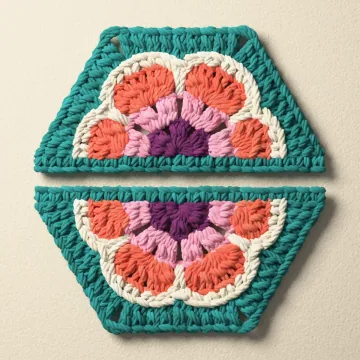
Hexagon make 7
Yarns in order of use: A, marigold; B, raspberry; H, cream; I, navy.
- Hexagon 1, the middle one: read B for A and A for B, so that it has a raspberry center and marigold petals. Hexagons 2 to 7 have a center of A; for the petals, Rnds 2 and 3, use B, C, D, E, F and G in this order. H and I are the same in all seven. Work Rnds 1 to 4 of all seven hexagons and weave in their ends; then work Rnd 5 of hexagon 1 as written. Rnd 5 of hexagons 2 to 7 joins them: see FINISHING.
- StartWith A, make a magic ring.
- Rnd 1RSCh 3 (counts as dc), dc in ring, ch 1, repeat: 2 dc in ring, ch 1 5 times, pull the tail to close the ring, sl st in top of ch-3 to joinleaves (12 dc, 6 ch-1 sps)
Fasten off A.
- Rnd 2Join B with sl st in any ch-1 sp, ch 3 (counts as dc), (dc, ch 2, 2 dc) in same sp, ch 1, repeat: (2 dc, ch 2, 2 dc) in next ch-1 sp, ch 1 5 times, sl st in top of ch-3 to joinleaves (24 dc, 6 ch-2 sps, 6 ch-1 sps)
- Rnd 3Sl st in next ch-2 sp, ch 3 (counts as dc), 6 dc in same sp, repeat: 7 dc in next ch-2 sp 5 times, sl st in top of ch-3 to joinleaves (42 dc)
Fasten off B.
- Rnd 4Join H with sl st in first dc, ch 1, sc in same st, sc in next 6 sts, spike sc in next ch-1 sp of Rnd 2, repeat: sc in next 7 sts, spike sc in next ch-1 sp of Rnd 2 5 times, sl st in first sc to joinleaves (42 sc, 6 spike sc)
Fasten off H.
- Rnd 5Join I with sl st in 4th sc, ch 3 (counts as dc), (dc, ch 2, 2 dc) in same st, ch 1, sk next 3 sts, 3 dc in next st, repeat: ch 1, sk next 3 sts, (2 dc, ch 2, 2 dc) in next st, ch 1, sk next 3 sts, 3 dc in next st 5 times, ch 1, sl st in top of ch-3 to joinleaves (42 dc, 6 ch-2 sps, 12 ch-1 sps)
- EndFasten off, leaving a 6 in (15 cm) tail.
Finishing
- The joins, in general: all hexagons lie with the right side up and the hexagon you work on is held beside the finished ones. A joined corner is (2 dc, ch 1, sl st in the corner space of the finished hexagon, ch 1, 2 dc) in the one sc, instead of (2 dc, ch 2, 2 dc). Where the corner meets two finished hexagons it is (2 dc, ch 1, sl st in the corner space of the one hexagon, sl st in the corner space of the other, ch 1, 2 dc). On a joined side each of its two ch 1 is left out, and a sl st in the ch-1 space of the finished hexagon that lies opposite is worked in its place; the 3 sc before and the 3 sc after the spike sc are skipped as before. For every sl st put the hook down into the space of the finished hexagon from its right side. The sides of a finished hexagon are followed clockwise, against the direction of its own round. At a place where three hexagons meet, the corner spaces there are used a second time. A corner space of hexagon 1 is always whole: the new sl st goes into it beside the sl st that is there already. A corner of any other hexagon that was itself joined to hexagon 1 is in two halves, two ch-1 spaces with a sl st between them: put the hook into the half that lies beside the side you are about to join or have just joined, as each line says, never into the sl st. A ch-1 space along a side is used only once.
- Hexagon 2: work Rnd 5 as written up to the second ch 1 of side 3: work that ch 1 and stop before any dc of corner 4. Corner 4: join to any corner space of hexagon 1. Side 4: sl st in the next ch-1 space of hexagon 1, 3 dc in the spike sc, sl st in the next ch-1 space of hexagon 1. Corner 5: join to the next corner space of hexagon 1. Then go on as written from the first ch 1 of side 5.
- Hexagons 3, 4, 5 and 6: each takes the next free side of hexagon 1, going round hexagon 1 counterclockwise, and is joined to the hexagon before it as well. Work as written up to the second ch 1 of side 3: work that ch 1 and stop before any dc of corner 4. Corner 4: join to the corner space of hexagon 1 at the far end of its free side, the end away from the hexagon before. Side 4: sl st in the next ch-1 space of hexagon 1, 3 dc in the spike sc, sl st in the next ch-1 space of hexagon 1. Corner 5: join to two, first the next corner space of hexagon 1, then corner 4 of the hexagon before, which is already joined there: take the half of it that lies beside side 3 of that hexagon, the half before its sl st. Side 5 is joined to side 3 of the hexagon before: sl st in the next ch-1 space of the hexagon before, 3 dc in the spike sc, sl st in its next ch-1 space. Corner 6: join to the next corner space of the hexagon before, its corner 3, which is whole. Then go on as written from the first ch 1 of side 6.
- Hexagon 7 fills the last side of hexagon 1 and meets hexagon 2, hexagon 1 and hexagon 6. Work as written up to the second ch 1 of side 2: work that ch 1 and stop before any dc of corner 3. Corner 3: join to the corner space of hexagon 2 at the outer end, away from hexagon 1, of the free side of hexagon 2 that faces the gap: its corner 6, which is whole. Side 3 is joined to side 5 of hexagon 2: sl st in the next ch-1 space of hexagon 2, 3 dc in the spike sc, sl st in its next ch-1 space. Corner 4: join to two, first corner 5 of hexagon 2, the half of it that lies beside side 5 of hexagon 2, after its sl st, then the corner space of hexagon 1 that is joined to it there. Side 4: sl st in the next ch-1 space of hexagon 1, 3 dc in the spike sc, sl st in the next ch-1 space of hexagon 1. Corner 5: join to two, first the next corner space of hexagon 1, then corner 4 of hexagon 6, the half of it that lies beside side 3 of hexagon 6, before its sl st. Side 5 is joined to side 3 of hexagon 6: sl st in the next ch-1 space of hexagon 6, 3 dc in the spike sc, sl st in its next ch-1 space. Corner 6: join to the next corner space of hexagon 6, its corner 3, which is whole. Then go on as written from the first ch 1 of side 6.
- After each hexagon slip stitch in the top of the ch 3 to join and fasten off.
- Border, round 1: the edge now has 18 free sides, each of 7 dc and 2 ch-1 spaces between its two corner spaces (the 2 dc of the corner at each end and the 3 dc of the side), 12 corner spaces that stand out and 6 dips, where two hexagons are joined at a corner. At a dip the corner space of the later hexagon is in two halves, with the sl st of the join between them; take the half on the outer side. With H and the right side facing, join with a slip stitch in the two corner spaces of any dip, taken together, and ch 1, which does not count as a stitch. To work a dip, insert the hook in the corner space before it and pull up a loop, insert it in the corner space after it and pull up a loop, yarn over and pull through all 3 loops, which counts as 1 sc. Work the first dip, then 1 sc in each dc and in each ch-1 space (9 sc on a side), 4 sc in every corner space that stands out, and 1 sc in every dip. Slip stitch in the first sc to join (216 sc). Fasten off.
- Border, round 2: join I with a slip stitch in the sc of any dip, ch 1, sc in the same sc; [skip 2 sc, 5 dc in the next sc, skip 2 sc, sc in the next sc] 35 times, skip 2 sc, 5 dc in the next sc, skip the last 2 sc and slip stitch in the first sc to join (36 sc and 180 dc: 36 scallops, 6 on each outer hexagon). An sc falls in every dip. Fasten off.
- Weave in all the ends that are left with the yarn needle. Block: pin the mat to shape on a flat surface, right side up, each hexagon with its sides straight and each scallop pulled out round, spray it with water and let it dry.
About
Seven African flowers joined into a mat with nothing to sew: each hexagon is joined to the ones before it while its last round is worked, and every join is said stitch by stitch. Bright petals with cream lines and spikes lie on navy, and the mat has a round of cream and a navy scalloped border.