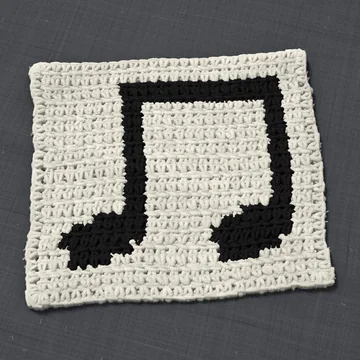
Bass clef graph crochet pattern
Easy · 2 colors
PDF · US Letter · 5 pages · Change paper
- Size
- About 8¾ × 7½ in (22 × 19 cm)With its border. The panel alone: about 8¼ × 7 in (21 × 18 cm)
- Skill
- EasySingle crochet throughout, 2 yarns, a graph of 27 by 26 units, at most 6 color changes in a row, 6 ends to weave in
Paper for the PDF
A bass clef in black on a cream ground, worked in single crochet from the bottom row up, one stitch for each square of the graph. The yarn not in use is carried along the row inside the stitches, so the piece has 6 ends to weave in.
Graph
27 squares wide and 26 tall. One square is 1 single crochet in 1 row. Row 1 is the bottom row. Right-side rows are read right to left, wrong-side rows left to right: each row's number stands at the end it begins from.
- A cream, no symbol 507 squares
- B black, cross 195 squares
Drag the graph to move around it. The whole graph is printed in the PDF.
Gauge
13 stitches and 15 rows to 4 in (10 cm) in single crochet, with the idle yarn carried.
How to measure it
The pattern also stops you to measure after row 12.
Work a test square first (23 rows)
A test piece to measure and pull out. It is not the start of the pattern.
Gauge is counted over 4 in (10 cm), so make the swatch bigger than that: about 6 in (15 cm) each way, and count in the middle of it. Work it as the piece is worked: in yarn A, with one of the other yarns carried along the row and worked over.
- Swatch foundationCh 21.
- Swatch row 1 (RS)Sc in 2nd ch from hook and in each ch across(20 sc)
- Swatch rows 2 to 23Ch 1, turn; sc in each st across(20 sc)
The same graph in other yarn weights
The picture fixes the number of stitches, so a graph is resized by yarn and hook, not by counting. Each line is the same graph at a single crochet gauge inside the standard range for that yarn weight; the height follows the same proportion of stitch to row. Every size is about. The yarn amounts of this pattern are for its own gauge only. Each size is the panel without its border.
| Yarn | Single crochet to 4 in (10 cm) | Hook | Panel alone, about |
|---|---|---|---|
| Light (3) | 15 | 4.5 to 5.5 mm | 7¼ × 6 in (18 × 15 cm) |
| Bulky (5) | 10 | 6.5 to 9 mm | 10¾ × 9 in (27 × 23 cm) |
No yarn amount has been worked out for these, so they are not a choice on this page.
Before you start
- Each square of the graph is one single crochet. Every row is 27 stitches.
- Row 1 is the bottom row of the graph and is a right-side row. The colors of every row are written in the order you work them. The direction in a row's label says where that row lies on the graph: a right-side row lies on the graph from right to left, a wrong-side row from left to right.
- Ch 1 and turn at the end of every row but the last. The chain 1 does not count as a stitch.
- To change color, work the last yarn-over of the stitch before in the new color.
- Carry the yarn you are not using along the top of the row below and work over it, so that it is hidden inside the stitches. Carry each yarn across every whole row, edge to edge, from the first row it appears in to the last row it appears in: join it at the start of that first row, and cut it at the end of that last row.
- Work firmly. A carried yarn can show between loose stitches, a dark yarn inside light stitches most of all. If it shows in your swatch, change to a smaller hook and measure again: the piece will then be smaller than the size given.
- Rows 1 to 2 and 25 to 26 have nothing carried inside, so they are a little thinner than the rows between.
- Worked flat only. In joined or spiral rounds the picture slants.
- In a row, "21 A" is 1 single crochet in each of the next 21 stitches with yarn A.
- The border is part of the piece: the first size given is with the border, the second is the panel alone.
- Leave a tail of about 6 in (15 cm) when you begin a yarn, and weave it in at the end with the others.
- Left-handed. Worked left-handed, these rows give a mirror image of the picture. To get the picture as drawn, read each row's runs in reverse order.
Instructions
- A row lists its colors in the order you work them, each with its number of stitches.
- The count at the end is what the row leaves.
- Tick a row when it is done. Your place is kept in this browser.
How to read these rows
Never read a row’s list backwards. On the graph a right-side (RS) row runs right to left and a wrong-side (WS) row left to right. In UK terms sc is double crochet and sl st is slip stitch.
Panel
- FoundationWith A, ch 28. Work row 1 beginning in the 2nd ch from hook.
- Row 1RSon the graph this row runs right to left27 Aleaves (27 sts)
- Row 2WSon the graph this row runs left to right27 Aleaves (27 sts)
- Row 3RSon the graph this row runs right to left21 A3 B3 Aleaves (27 sts)
- Row 4WSon the graph this row runs left to right4 A4 B19 Aleaves (27 sts)
- Row 5RSon the graph this row runs right to left18 A4 B5 Aleaves (27 sts)
- Row 6WSon the graph this row runs left to right6 A5 B16 Aleaves (27 sts)
- Row 7RSon the graph this row runs right to left15 A5 B7 Aleaves (27 sts)
- Row 8WSon the graph this row runs left to right8 A6 B13 Aleaves (27 sts)
- Row 9RSon the graph this row runs right to left12 A6 B9 Aleaves (27 sts)
- Row 10WSon the graph this row runs left to right10 A6 B6 A2 B3 Aleaves (27 sts)
- Row 11RSon the graph this row runs right to left2 A4 B4 A6 B11 Aleaves (27 sts)
- Row 12WSon the graph this row runs left to right4 A3 B5 A6 B3 A4 B2 Aleaves (27 sts)
- Stop and measure now, after row 12.The width, across the middle of the rows and not along the chain edge: about 8¼ in (21 cm). If it is wider, the whole picture will be larger: start again with a smaller hook, or keep going and expect a larger piece. If it is narrower, a larger hook. If the chain edge pulls in tighter than the rows, make the foundation chain with a larger hook.The height of the 12 rows worked: about 3¼ in (8 cm). If the rows are taller or shorter than this, the finished piece will be taller or shorter than the size given, in the same proportion.
- Row 13RSon the graph this row runs right to left3 A2 B4 A5 B5 A5 B3 Aleaves (27 sts)
- Row 14WSon the graph this row runs left to right2 A7 B4 A6 B8 Aleaves (27 sts)
- Row 15RSon the graph this row runs right to left8 A5 B5 A7 B2 Aleaves (27 sts)
- Row 16WSon the graph this row runs left to right2 A7 B5 A5 B8 Aleaves (27 sts)
- Row 17RSon the graph this row runs right to left3 A2 B3 A5 B6 A5 B3 Aleaves (27 sts)
- Row 18WSon the graph this row runs left to right3 A4 B7 A5 B2 A4 B2 Aleaves (27 sts)
- Row 19RSon the graph this row runs right to left2 A4 B3 A5 B8 A2 B3 Aleaves (27 sts)
- Row 20WSon the graph this row runs left to right3 A2 B8 A5 B4 A2 B3 Aleaves (27 sts)
- Row 21RSon the graph this row runs right to left10 A6 B4 A4 B3 Aleaves (27 sts)
- Row 22WSon the graph this row runs left to right4 A13 B10 Aleaves (27 sts)
- Row 23RSon the graph this row runs right to left12 A9 B6 Aleaves (27 sts)
- Row 24WSon the graph this row runs left to right8 A5 B14 Aleaves (27 sts)
- Row 25RSon the graph this row runs right to left27 Aleaves (27 sts)
- Row 26WSon the graph this row runs left to right27 Aleaves (27 sts)
- EndFasten off, leaving a 6 in (15 cm) tail.
Border
- With the right side facing, the round begins in the corner stitch at the start of the top edge and goes along the last row, down the side, along the foundation edge and up the other side. Row 26 is a wrong-side row, so that corner stitch is the last stitch you worked in row 26: it is the "first st" of Rnd 1. The ch 1 does not count as a stitch. A stitch in the end of a row goes into the side of the stitch that ends that row.
- The border is one round of 104 single crochet. Each corner is 3 single crochet worked into one place (the first and the last stitch of the last row, the first and the last chain of the foundation edge that hold a stitch of row 1: the turning chain is not counted), and those 3 are the only stitches of that corner: the row end beside each corner is skipped. A row of single crochet is shorter than a stitch is wide, so each side takes 21 stitches in its 24 other row ends and 3 of them are skipped, as Rnd 1 says: with the row end beside each corner, that is 5 row ends skipped on each side. So: 12 in the four corners, 25 along the top, 25 along the foundation edge and 21 up each side (12 + 25 + 25 + 21 + 21 = 104).
- FoundationA finished panel of 27 sc and 26 rows, RS facing.
- Rnd 1RSJoin A with sl st in first st, ch 1, 3 sc in same st, sc in next 25 sts, 3 sc in last st, sk next row end, sc in end of each of next 3 rows, sk next row end, sc in end of each of next 7 rows, sk next row end, sc in end of each of next 8 rows, sk next row end, sc in end of each of next 3 rows, sk next row end, 3 sc in first ch of foundation edge, sc in next 25 chs, 3 sc in last ch of foundation edge, sk next row end, sc in end of each of next 3 rows, sk next row end, sc in end of each of next 7 rows, sk next row end, sc in end of each of next 8 rows, sk next row end, sc in end of each of next 3 rows, sk next row end, sl st in first sc to joinleaves (104 sc)
- Stop and measure now, after round 1.If a side ruffles, work it again with fewer stitches along it; if it pulls in, with more.
- EndFasten off, leaving a 6 in (15 cm) tail.
Finishing
- Weave in every end along stitches of its own color.
In all: 26 rows; 806 stitches (702 in the panel, 104 in the border); 80 color changes, at most 6 in a row; 6 ends to weave in.
The same picture in other crafts: Cross stitch