to wind twice round a waist of 24 to 29 in (61 to 74 cm)
to wind twice round a waist of 30 to 37 in (76 to 94 cm)
to wind twice round a waist of 38 to 45 in (97 to 114 cm)
Finished size, about
64½ in (164 cm) long, 2½ in (6.5 cm) wide
83½ in (212 cm) long, 2½ in (6.5 cm) wide
102¼ in (260 cm) long, 2½ in (6.5 cm) wide
Yarn, an estimate
about 155 yd (142 m)
about 185 yd (169 m)
about 220 yd (201 m)
Gauge
14 stitches and 8 rows to 4 in (10 cm) in granny groups of double crochet.
Check it on the sash itself, laid flat and not stretched, when 3 rows are done: 7 groups of row 3 are about 6 in (15 cm) wide, and the 3 rows are about 1½ in (4 cm) tall. If they measure more, start again with a smaller hook; if they measure less, with a larger one.
How to measure it
Along a row, count every stitch and every chain between stitches as one.
The sash is worked the long way: each row runs from one end to the other. The right side is the side that faces you in row 1.
Make the foundation chain loose, with a larger hook if your chains are tight: it is one edge of the sash.
"Sp before next st" is the gap just before the stitch that comes next, after the ch 3 or the stitches you have just skipped. In row 2 the first group goes into the gap after the second stitch, and every other group into the gap between two groups; the last one goes into the gap before the two stitches at the end. In row 3 the first dc goes into the gap between the turning chain (the first stitch) and the first group, and the last dc but one into the gap between the last group and the stitch at the end. Each group is 3 dc in one gap, and no stitch goes into the top of a group.
Every row has its own color. Work the last yarn over of the last stitch of the row with the new yarn, then cut the old yarn, leaving a tail of about 6 in (15 cm), and leave the same on the new one. B comes back in row 4 and A in row 5, each with a new tail.
Leave a tail of about 6 in (15 cm) when you begin and when you fasten off, unless another length is given.
When a ball runs out, join the next at the end of a row: work the last yarn over of the last stitch with the new yarn, and leave a tail of about 6 in (15 cm) on both.
A waist between two sizes takes the longer. For another length begin with 3 chains more or fewer for each group. A group is about ⅞ in (2.2 cm) long, and each row is worked to the end in the same way.
To wear it, choose the place of the knot, in front or at one side. Lay the middle of the sash on that place, take the two ends round you to the opposite side, cross them there, bring them back to the place of the knot, over the first turn, and tie them in a knot. On the largest waist of a size only a few inches of the strip are left at each end: tie the braids together too.
Use cotton yarn: it makes a sash with weight that hangs well.
Buy whole balls from one dye lot.
Left-handed. Work everything as it is written, the other way: rows from left to right, rounds clockwise. Left-handed crochet
Abbreviations
Written in US terms. Where the UK name differs it is given beside the US one.
Strip about 64½ in (164 cm) long and 2½ in (6.5 cm) wide; with the braids and tassels about 85½ in (217 cm) longTo fit to wind twice round a waist of 24 to 29 in (61 to 74 cm)
In all
5 rows; 1,132 stitches
Skill
EasyGroups of double crochet in long rows, and braids
Yarn
To find how many balls: divide by the length on your yarn's label and round up. Buy them from one dye lot.
The estimate is from the stitches of this size at this gauge, with 15 percent added.
Yarn A rustabout 60 yd (55 m), an estimatemain color
Yarn B ochreabout 60 yd (55 m), an estimaterows 2 and 4
Yarn C tealabout 35 yd (32 m), an estimaterow 3
Yarn in all
About 155 yd (142 m) or 80 g, an estimate
Weight
Medium weight, 4 on the label (UK aran), cotton
Hook
5 mm (US H-8), or the size that gives you the gauge
Also
6 wooden beads, ⅞ in (22 mm) across, with a hole of ⅜ in (10 mm), a yarn needle, scissors, a tape measure and a crochet hook a size or two smaller, to draw the strands through
Gauge
14 stitches and 8 rows to 4 in (10 cm) in granny groups of double crochet. How to check it
The ch 3 at the start of a row counts as a dc, and stands on the last stitch of the row before. "Top of turning ch" is the third, last-made chain of that ch 3; in row 2 it is the last-made one of the 3 skipped chains of row 1, the one nearest the hook when you counted.
Yarns in order of use: A, rust; B, ochre; C, teal.
Row 1RSDc in 4th ch from hook (skipped chs count as dc),[repeat: sk next ch,3 dc in next ch,sk next ch]74 times,dc in next ch,dc in last chleaves (226 dc)
Row 2With B,ch 3 (counts as dc),turn;sk next st,[repeat: 3 dc in sp before next st,sk next 3 sts]74 times,3 dc in sp before next st,sk next st,dc in top of turning chleaves (227 dc)
Row 3With C,ch 3 (counts as dc),turn;dc in sp before next st,sk next 3 sts,[repeat: 3 dc in sp before next st,sk next 3 sts]74 times,dc in sp before next st,dc in top of turning chleaves (226 dc)
Row 4With B,ch 3 (counts as dc),turn;sk next st,[repeat: 3 dc in sp before next st,sk next 3 sts]74 times,3 dc in sp before next st,sk next st,dc in top of turning chleaves (227 dc)
Row 5With A,ch 3 (counts as dc),turn;dc in sp before next st,sk next 3 sts,[repeat: 3 dc in sp before next st,sk next 3 sts]74 times,dc in sp before next st,dc in top of turning chleaves (226 dc)
Strands: cut 12 lengths of each color, each about 32 in (81 cm) long.
Braids: three braids go on each short end of the sash, at the ends of rows 1, 3 and 5. For each take 2 lengths of A, 2 of B and 2 of C, with their ends level. Put the hook from the wrong side to the right side under the stitch that stands at the end of the row (the last dc, or the turning chain), between it and the next stitch. Draw all 6 lengths through to their middle, so that 12 strands hang down, 4 of each color.
Part the 12 strands into three bunches by color and braid them firmly for about 6 in (15 cm). Hold the end and thread all 12 strands through a wooden bead. Push the bead up to the end of the braid and knot the 12 strands together close below it, so that it cannot slip off. To get the strands through the bead, fold a short piece of yarn over them and pull them through with it.
Trim the strands below the knot level, about 3½ in (9 cm) long: they are the tassel. Make all 6 braids in the same way. Then comb the tassels out with the fingers.
Finishing
Lay the sash flat and pull both long edges straight with the hands.
About
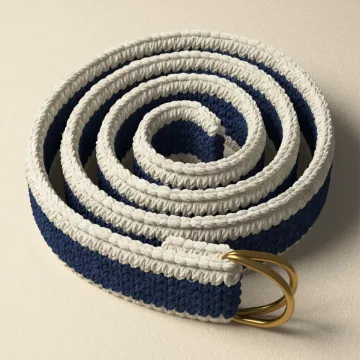
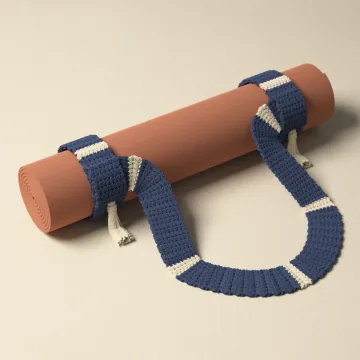
A long sash of granny groups that winds twice round the waist and ties. Stripes of rust and ochre lie along both edges with teal in the middle, and three braids with wooden beads and tassels hang from each end.