21 stitches and 36 rows to 4 in (10 cm) in thermal single crochet.
Check it on the belt itself, laid flat and not stretched, when 6 rows are done: 42 stitches of a row are about 8 in (20 cm) wide and the 6 rows are about ⅝ in (1.6 cm) tall. If they measure more, start again with a smaller hook; if they measure less, with a larger one.
How to measure it
Along a row, count every stitch and every chain between stitches as one.
The belt is worked the long way: each row runs from one end of the belt to the other. The right side is the side that faces you in row 1.
Row 1: put the hook under the upper strand only of each chain. The lower strand is left free. It is the "free loop below" of row 2.
From row 2 on each stitch takes hold of two loops. The first is the back loop of the next stitch. The second is a loop that lies free on the far side of the work, at the foot of that stitch: turn the top edge a little toward you and you see a line of them, one under each stitch. In row 2 they are the free strands of the chain. In row 3 they are the front loops of row 1: row 2 took only the back loops of row 1, and now that the work is turned its front loops are on the far side. In the same way row 4 takes the front loops of row 2, row 5 those of row 3, and so on to the end.
To change yarn, work the last yarn over of the last stitch before the change with the new yarn. Cut the old yarn, leaving a tail of about 6 in (15 cm), and leave the same on the new one.
In row 13 each thermal slip stitch closes the top of the belt in the same way as the chain closes the bottom. Keep it as loose as the row below it.
Leave a tail of about 6 in (15 cm) when you begin and when you fasten off, unless another length is given.
When a ball runs out, join the next at the end of a row: work the last yarn over of the last stitch with the new yarn, and leave a tail of about 6 in (15 cm) on both.
For another length begin with more or fewer chains: 5 stitches are about 1 in (2.5 cm). The belt is the measure of the waist, 8 in (20 cm) for the part that hangs, and the 8 stitches that are folded over the bars. A measure that is right between two sizes takes the larger.
To wear it: the two rings lie one on the other, an inner ring next to your body and an outer ring on top of it. Put the end without rings up through both of them, from the side of your body outward. Fold it back the way it came: over the curve of the outer ring, down through the inner ring and out under the curve of the inner ring. Pull it tight. It now lies over the outer ring and under the inner one, and holds.
Whip stitch: with the yarn on a yarn needle, pass the needle under the end of a row at the folded edge and under one strand of the belt below it, pull the yarn through, and go on in the same way. Backstitch: bring the needle up one place ahead, go down where the last stitch ended, and come up again one place beyond the place where you came up before.
Use a smooth, tightly twisted cotton, such as a mercerized one: a soft yarn makes a soft belt.
Buy whole balls from one dye lot.
Left-handed. Work everything as it is written, the other way: rows from left to right, rounds clockwise. Left-handed crochet
Abbreviations
Written in US terms. Where the UK name differs it is given beside the US one.
The ch 1 at the start of a row does not count as a stitch.
The first stitch of each row goes into the last stitch of the row before, and the last into its first stitch, so that every row has the same number of stitches. Put the marker in the first stitch of each row as you work it: that stitch is the easiest to miss.
Special stitches
tsc Thermal single crochet
Put the hook under the back loop only of the next st, and then under the free loop that lies straight below it, at the back of the work; yo, pull up a loop through both; yo, pull through the 2 loops on the hook. In UK terms: thermal double crochet.
tss Thermal slip stitch
Put the hook under the same two loops as for a tsc; yo, pull through everything on the hook. In UK terms: thermal slip stitch.
The ring end is the short end where rows 3 and 11 begin. Both changes of yarn were at this end: one tail of each of rows 2, 3, 10 and 11 hangs here. Weave each of the four into its own row, on the wrong side, over the 8 stitches nearest the ring end, where the fold will cover it. The tails of the foundation chain and of row 13 hang at the other end of the belt: weave each in along the edge it hangs from.
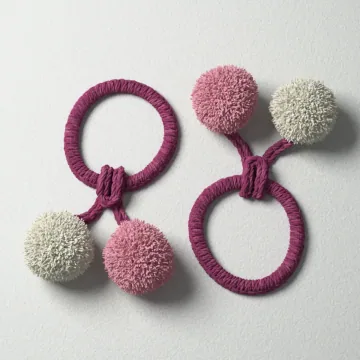
Rings: lay the belt flat with its wrong side up. Hold the two rings together as one and lay their straight bars across the belt, between the 8th and the 9th stitch from the ring end, with the curves toward the ring end. Bring the 8 stitches up through the two rings and fold them back over the bars, so that they lie on the wrong side of the belt and the curves stand out past the fold.
Cut a length of A about 40 in (102 cm) long. Whip stitch the folded short edge down to the wrong side: 13 stitches, one at the end of each row, each under one strand of the wrong side that lies below it, so that nothing shows on the right side. Pass the needle between the two layers to the bars.
Close to the bars sew across the belt through both layers with 8 backstitches, one in each of the navy rows, rows 3 to 10, between the 2nd and the 3rd stitch from the fold. The bars can turn and cannot slide out. Fasten off and hide both ends of this length between the layers.
Finishing
Press the belt flat with the hands from end to end. Let it lie under a book for a night if it curls.
About
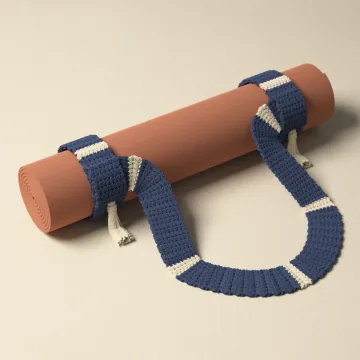
A firm, flat belt like a strip of webbing. Thermal single crochet, worked the long way, makes a cloth of two layers that hardly stretches. Navy, with a line of cream along both edges and two D rings at one end.