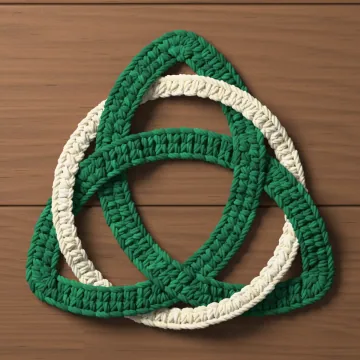
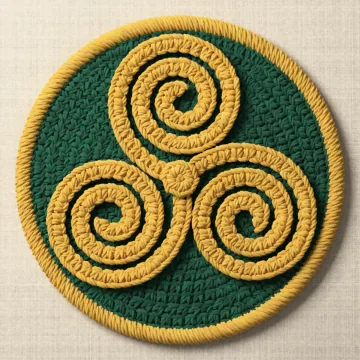
Celtic tree of life crochet pattern
Crochet, 12¾ in across, 3 colors, intermediate
PDF. Prints on US Letter and A4.
What you need
- Yarn A creamabout 100 yd (91 m), an estimaterounds 1 to 15 of the disc
- Yarn B forest greenabout 65 yd (59 m), an estimatesome of the pieces
- Yarn C moss greenabout 30 yd (27 m), an estimateround 16 of the disc and the leaves
- Yarn in all
- About 195 yd (178 m) or 100 g, an estimate
- Weight
- Medium weight, 4 on the label (UK aran)
- Hook
- 5 mm (US H-8), or the size that gives you the gauge
- Also
- A yarn needle, scissors, pins, a spray bottle and a 6 mm (J-10) hook for the cords
- Gauge
- 14 stitches and 15 rows to 4 in (10 cm) in single crochet (UK double crochet). How to check it
Instructions
How to read these rounds
US terms · Show UK terms
- ch chain, sl st slip stitch, sc single crochet (UK double crochet), hdc half double crochet (UK half treble).
- RS right side, the one that shows.
- 2 hdc in next st: both in one stitch. hdc in next 2 sts: one in each.
- [ ] 7 times: work what is inside 7 times in all. ( ): all of it goes into the one place.
- (8 hdc): the stitches you have when the round is done. How to read a pattern.
- Working in the round. Joining squares. Changing colors.
- A chain 1 at the start of a round does not count as a stitch.
- A leaf is worked round its chain. The end where the round begins and is joined is its base; the point with the ch-2 sp is its tip. The last sc goes in the same chain as the first. Its right side is the side that faces you.
Disc
Yarns in order of use: A, cream; C, moss green.
- StartWith A, make a magic ring.
- Rnd 1RSCh 1, 8 hdc in ring, pull the tail to close the ring, sl st in first hdc to joinleaves (8 hdc)
- Rnd 2Ch 1, 2 hdc in each st around, sl st in first hdc to joinleaves (16 hdc)
- Rnd 3Ch 1, hdc in same st, 2 hdc in next st, repeat: hdc in next st, 2 hdc in next st 7 times, sl st in first hdc to joinleaves (24 hdc)
- Rnd 4Ch 1, hdc in same st, hdc in next st, 2 hdc in next st, repeat: hdc in next 2 sts, 2 hdc in next st 7 times, sl st in first hdc to joinleaves (32 hdc)
- Rnd 5Ch 1, hdc in same st, hdc in next 2 sts, 2 hdc in next st, repeat: hdc in next 3 sts, 2 hdc in next st 7 times, sl st in first hdc to joinleaves (40 hdc)
- Rnd 6Ch 1, hdc in same st, hdc in next 3 sts, 2 hdc in next st, repeat: hdc in next 4 sts, 2 hdc in next st 7 times, sl st in first hdc to joinleaves (48 hdc)
- Rnd 7Ch 1, hdc in same st, hdc in next 4 sts, 2 hdc in next st, repeat: hdc in next 5 sts, 2 hdc in next st 7 times, sl st in first hdc to joinleaves (56 hdc)
- Rnd 8Ch 1, hdc in same st, hdc in next 5 sts, 2 hdc in next st, repeat: hdc in next 6 sts, 2 hdc in next st 7 times, sl st in first hdc to joinleaves (64 hdc)
- Rnd 9Ch 1, hdc in same st, hdc in next 6 sts, 2 hdc in next st, repeat: hdc in next 7 sts, 2 hdc in next st 7 times, sl st in first hdc to joinleaves (72 hdc)
- Rnd 10Ch 1, hdc in same st, hdc in next 7 sts, 2 hdc in next st, repeat: hdc in next 8 sts, 2 hdc in next st 7 times, sl st in first hdc to joinleaves (80 hdc)
- Rnd 11Ch 1, hdc in same st, hdc in next 8 sts, 2 hdc in next st, repeat: hdc in next 9 sts, 2 hdc in next st 7 times, sl st in first hdc to joinleaves (88 hdc)
- Rnd 12Ch 1, hdc in same st, hdc in next 9 sts, 2 hdc in next st, repeat: hdc in next 10 sts, 2 hdc in next st 7 times, sl st in first hdc to joinleaves (96 hdc)
- Rnd 13Ch 1, hdc in same st, hdc in next 10 sts, 2 hdc in next st, repeat: hdc in next 11 sts, 2 hdc in next st 7 times, sl st in first hdc to joinleaves (104 hdc)
- Rnd 14Ch 1, hdc in same st, hdc in next 11 sts, 2 hdc in next st, repeat: hdc in next 12 sts, 2 hdc in next st 7 times, sl st in first hdc to joinleaves (112 hdc)
- Rnd 15Ch 1, hdc in same st, hdc in next 12 sts, 2 hdc in next st, repeat: hdc in next 13 sts, 2 hdc in next st 7 times, sl st in first hdc to joinleaves (120 hdc)
Fasten off A.
- Rnd 16Join C with sl st in any st, ch 1, hdc in same st, hdc in next 13 sts, 2 hdc in next st, repeat: hdc in next 14 sts, 2 hdc in next st 7 times, sl st in first hdc to joinleaves (128 hdc)
- EndFasten off, leaving a 6 in (15 cm) tail.
Leaf make 11
Yarn C, moss green.
Finishing
- Block: pin the disc flat, right side up, to a true circle 12¾ in (32.5 cm) across, and the leaves right side up, 1⅜ in (3.5 cm) long and ⅞ in (2.2 cm) wide, their tips pointed. Spray them with water and let them dry. Weave in the ends of the disc on the wrong side.
- Cords: hold two strands of B together and use the 6 mm hook. For the tree make two chains of 43 ch, two of 42 ch and two of 36 ch; for the ring make two chains of 128 ch. Work them so that 13 ch measure 4 in (10 cm): a chain of 43 is then about 13¼ in (33.5 cm) long, one of 42 about 13 in (33 cm), one of 36 about 11 in (28 cm) and one of 128 about 39½ in (100 cm). Fasten off each, leaving tails of 4 in (10 cm) at both its ends. Lay every cord with the Vs of its chain up, and do not twist it.
- Lay the disc right side up and think of it as the face of a clock, 12 at the top. The middle line runs from 6 to 12 and the level line from 9 to 3; they cross in the magic ring, the middle of the disc. All distances are measured to the middle of the width of a cord. Pin every cord as you lay it.
- Trunk: lay the six cords of the tree upright, three on each side of the middle line, every cord with the middle of its length on the level line. The two of 43 ch, the inner cords, lie one to the left and one to the right of the middle line and touch each other along it; beside them, touching them, lie the two of 42 ch, the middle cords; and beside those, touching them, the two of 36 ch, the outer cords. They run straight from ¾ in (1.9 cm) below the level line to ¾ in (1.9 cm) above it.
- Upper crossings: above the trunk the three cords from the left lean over to the right and the three from the right lean over to the left, so that every cord of one side crosses every cord of the other, nine crossings in the shape of a diamond. On the middle line the two inner cords cross 1⅛ in (2.9 cm) above the level line, the two middle cords 2⅛ in (5.4 cm) above it and the two outer cords 3 in (7.6 cm) above it. On each side of the middle line an inner cord and a middle cord cross ½ in (1.3 cm) from it and 1⅝ in (4.1 cm) above the level line, an inner cord and an outer cord ⅞ in (2.2 cm) from it and 2⅛ in (5.4 cm) above, and a middle cord and an outer cord ½ in (1.3 cm) from it and 2½ in (6.4 cm) above.
- From the trunk upward every cord of the left meets first the inner, then the middle, then the outer cord of the right. The inner and the outer cord of the left go over the first, under the second and over the third. The middle cord of the left goes under the first, over the second and under the third.
- Lower crossings: lay the lower halves of the cords in the same way below the trunk, as the upper halves look in a mirror on the level line, with nine crossings at the same distances. From the trunk downward the inner and the outer cord of the left go under the first, over the second and under the third cord of the right they meet; the middle cord of the left goes over, under and over.
- Branches: from the crossings the cords spread out in smooth arches to their ends, which all lie 4¾ in (12.1 cm) from the middle of the disc. On the right the lowest branch, an inner cord, rises to 2⅜ in (6 cm) above the level line where it is 1⅞ in (4.8 cm) from the middle line, and bends down to its end at half past 2. The branch above it, a middle cord, rises to 3¾ in (9.5 cm) above the level line where it is 2¼ in (5.7 cm) from the middle line, and ends at half past 1. The highest, an outer cord, goes almost straight to its end at half past 12. On the left they end at half past 9, half past 10 and half past 11. The roots are the same in the mirror: on the right they end at half past 3, half past 4 and half past 5, on the left at half past 8, half past 7 and half past 6. See that left and right, and above and below, are alike.
- Ring: the two ring cords run round the disc in waves and cross each other 24 times, at every quarter past and quarter to the hour, 5⅛ in (13 cm) from the middle of the disc. The first ring cord lies 5⅝ in (14.3 cm) from the middle at every full hour and 4¾ in (12.1 cm) from it at every half hour; the second lies 4¾ in (12.1 cm) from it at every full hour and 5⅝ in (14.3 cm) from it at every half hour. The first ring cord, where it lies 4¾ in (12.1 cm) from the middle at the half hours, lies over the ends of the branches and roots and hides them; the second lies outside them there.
- Begin the first ring cord with its end at a quarter past 12 and lead it round against the clock, to 12, to 11 and on. Begin the second with its end at a quarter to 12 and lead it the same way. Each cord lies under the other at its own beginning, over it at the next crossing, under it at the one after that, and so on, over and under in turn all the way round, until it comes back to its beginning, where its two ends meet under the other cord.
- Take the tails to the back. With single lengths of B sew down all the cords along both their edges with small stitches through the top of the disc; at a crossing sew the cord that lies under to the disc and the cord that lies over to the one under it. Fasten the tails on the back.
- Leaves: lay every leaf right side up, over any cord it meets. One lies on the middle line, its base 3⅛ in (7.9 cm) above the level line, on the highest crossing, its tip straight up. The others lie in five pairs, one leaf to the right and one to the left as in a mirror, with every base on a branch; each is given by the middle of its base and by its tip. First pair, on the middle ones of the three branches of each side: base 1⅝ in (4.1 cm) from the middle line and 3⅝ in (9.2 cm) above the level line, tip 2¾ in (7 cm) from the middle line and 2⅞ in (7.3 cm) above the level line. Second pair, on the same branches, farther out: base 2⅞ in (7.3 cm) from the middle line and 3⅝ in (9.2 cm) above the level line, tip 3¾ in (9.5 cm) from the middle line and 2½ in (6.4 cm) above the level line. Third pair, on the lowest branches: base 1⅝ in (4.1 cm) from the middle line and 2⅜ in (6 cm) above the level line, tip 2¼ in (5.7 cm) from the middle line and 1⅛ in (2.9 cm) above the level line. Fourth pair, on the same, farther out: base 2⅝ in (6.7 cm) from the middle line and 2¼ in (5.7 cm) above the level line, tip 3¼ in (8.3 cm) from the middle line and 1 in (2.5 cm) above the level line. Fifth pair, on the same, farthest out: base 3¾ in (9.5 cm) from the middle line and 1⅝ in (4.1 cm) above the level line, tip 4⅛ in (10.5 cm) from the middle line and ¼ in (0.6 cm) above the level line. Sew each leaf down all round its edge with its tail.
- Hanging loop: with one strand of A and the 5 mm hook, ch 12 (about 2¾ in, 7 cm), leaving 6 in (15 cm) tails, and fasten off. With the tails, sew its two ends side by side to the back of the disc at 12, ¼ in (0.6 cm) below the edge, so that the loop stands up behind it.
- Weave in all the ends that are left with the yarn needle.
About
A round wall piece: six crochet cords run side by side in the trunk, weave through one another above and below it, and spread out as branches and roots into a knotted ring of two more cords, with moss leaves on the branches.