Flower graph crochet pattern
Intermediate, 15¼ × 16¼ in, 3 colors
PDF, for US Letter and A4.
What you need
- Size
- About 15¼ × 16¼ in (39 × 41 cm)With its border. The panel alone: about 14¾ × 15¾ in (37 × 40 cm)
- Yarn
- Medium weight, 4 on the label (UK aran), an estimate: about 310 yd (283 m) in all or 160 g.
- A aubergine160 yd (146 m), 80 gbackground
- B celery80 yd (73 m), 40 g
- C coral70 yd (64 m), 35 g
- Hook
- 5.5 mm (US I-9)
- Gauge
- 13 stitches and 15 rows to 4 in (10 cm) in single crochet, with the idle yarn carried. Test square
- Also
- Yarn needle, scissors and tape measure
Before you start
This pattern makes the front of a pillow only: the back and the seam are not written here.
Gauge
Work a test square first (23 rows)
A test piece to measure and pull out. It is not the start of the pattern.
Gauge is counted over 4 in (10 cm), so make the swatch bigger than that: about 6 in (15 cm) each way, and count in the middle of it. Work it as the piece is worked: in yarn A, with one of the other yarns carried along the row and worked over.
- StartCh 21.
- 1Sc in 2nd ch from hook and in each ch across20 sc
- 2–23Ch 1, turn; sc in each st across20 sc
Graph
One square is 1 single crochet in 1 row. Row 1 is the bottom row, and each row's number stands at the end it begins from.
- A aubergine
- B celery
- C coral
Key
- A aubergine
- B celery
- C coral
48 A: one single crochet in each of the next 48 stitches, in yarn A. Every row is 48.
After every row: ch 1 (not a stitch), turn.
New color: in the last pull of the stitch before.
The other yarns lie along the row: work over them, edge to edge.
Rows are written in the order you work them. How to read a graph
US terms. Show UK terms
Left-handed? Hook in the left hand; work the rows from left to right. No count changes.
Instructions
Press a row’s number when it is done. Key
Panel
- StartWith A, ch 49. Work row 1 beginning in the 2nd ch from hook.
- 1RS 48 A
- 2WS 48 A
- 348 A
- 422 A4 B22 A
- 521 A6 B21 A
- 619 A10 B19 A
- 717 A14 B17 A
- 815 A18 B15 A
- 913 A22 B13 A
- 1012 A8 B2 C4 B2 C8 B12 A
- 1111 A7 B4 C4 B4 C7 B11 A
- 1210 A6 B4 C2 A4 B2 A4 C6 B10 A
Stop and measure now, after row 12. The width, across the middle of the rows and not along the chain edge: about 14¾ in (37 cm). If it is wider, the whole picture will be larger: start again with a smaller hook, or keep going and expect a larger piece. If it is narrower, a larger hook. If the chain edge pulls in tighter than the rows, make the foundation chain with a larger hook. The height of the 12 rows worked: about 3¼ in (8 cm). If the rows are taller or shorter than this, the finished piece will be taller or shorter than the size given, in the same proportion.
- 139 A5 B6 C2 A4 B2 A6 C5 B9 A
- 148 A5 B6 C3 A4 B3 A6 C5 B8 A
- 158 A4 B7 C3 A4 B3 A7 C4 B8 A
- 167 A4 B7 C4 A4 B4 A7 C4 B7 A
- 177 A3 B8 C4 A4 B4 A8 C3 B7 A
- 186 A4 B7 C5 A4 B5 A7 C4 B6 A
- 196 A3 B7 C6 A4 B6 A7 C3 B6 A
- 205 A4 B6 C7 A4 B7 A6 C4 B5 A
- 215 A3 B6 C8 A4 B8 A6 C3 B5 A
- 224 A4 B5 C9 A4 B9 A5 C4 B4 A
- 234 A3 B5 C10 A4 B10 A5 C3 B4 A
- 244 A3 B3 C12 A4 B12 A3 C3 B4 A
- 253 A3 B3 C12 A6 B12 A3 C3 B3 A
- 263 A3 B2 C12 A8 B12 A2 C3 B3 A
- 273 A4 B12 A10 B12 A4 B3 A
- 283 A3 B11 A14 B11 A3 B3 A
- 293 A2 B10 A6 B6 C6 B10 A2 B3 A
- 3013 A5 B12 C5 B13 A
- 3111 A4 B18 C4 B11 A
- 3210 A3 B8 C6 B8 C3 B10 A
- 339 A2 B8 C10 B8 C2 B9 A
- 349 A8 C14 B8 C9 A
- 358 A7 C8 B2 C8 B7 C8 A
- 368 A6 C8 B4 C8 B6 C8 A
- 377 A6 C8 B6 C8 B6 C7 A
- 387 A6 C7 B8 C7 B6 C7 A
- 397 A5 C7 B10 C7 B5 C7 A
- 406 A6 C7 B10 C7 B6 C6 A
- 416 A5 C7 B5 C2 A5 C7 B5 C6 A
- 426 A5 C7 B4 C4 A4 C7 B5 C6 A
- 436 A5 C7 B3 C6 A3 C7 B5 C6 A
- 446 A5 C6 B3 C8 A3 C6 B5 C6 A
- 455 A5 C7 B3 C8 A3 C7 B5 C5 A
- 464 A6 C7 B3 C8 A3 C7 B6 C4 A
- 473 A7 C7 B4 C6 A4 C7 B7 C3 A
- 483 A7 C7 B4 C6 A4 C7 B7 C3 A
- 494 A6 C8 B4 C4 A4 C8 B6 C4 A
- 505 A5 C8 B4 C4 A4 C8 B5 C5 A
- 517 A3 C8 B5 C2 A5 C8 B3 C7 A
- 5210 A7 B2 A10 C2 A7 B10 A
- 5311 A5 B4 A8 C4 A5 B11 A
- 5411 A4 B6 A6 C6 A4 B11 A
- 5512 A2 B8 A4 C8 A2 B12 A
- 5623 A2 C23 A
- 5748 A
- 5848 A
- 5948 A
- Fasten off, leaving a 6 in (15 cm) tail.
Border
- With the right side facing, the round begins in the corner stitch at the start of the top edge and goes along the last row, down the side, along the foundation edge and up the other side. Row 59 is a right-side row, so that corner stitch is the first stitch you worked in row 59: it is the "first st" of Round 1. The ch 1 does not count as a stitch. A stitch in the end of a row goes into the side of the stitch that ends that row.
- The border is one round of 202 single crochet. Each corner is 3 single crochet worked into one place (the first and the last stitch of the last row, the first and the last chain of the foundation edge that hold a stitch of row 1: the turning chain is not counted), and those 3 are the only stitches of that corner: the row end beside each corner is skipped. A row of single crochet is shorter than a stitch is wide, so each side takes 49 stitches in its 57 other row ends and 8 of them are skipped, as Round 1 says: with the row end beside each corner, that is 10 row ends skipped on each side. So: 12 in the four corners, 46 along the top, 46 along the foundation edge and 49 up each side (12 + 46 + 46 + 49 + 49 = 202).
- StartA finished panel of 48 sc and 59 rows, RS facing.
- 1RS Join A with sl st in first st, ch 1, 3 sc in same st, sc in next 46 sts, 3 sc in last st, sk next row end, sc in end of each of next 3 rows, sk next row end, sc in end of each of next 6 rows, sk next row end, sc in end of each of next 6 rows, sk next row end, sc in end of each of next 6 rows, sk next row end, sc in end of each of next 7 rows, sk next row end, sc in end of each of next 6 rows, sk next row end, sc in end of each of next 6 rows, sk next row end, sc in end of each of next 6 rows, sk next row end, sc in end of each of next 3 rows, sk next row end, 3 sc in first ch of foundation edge, sc in next 46 chs, 3 sc in last ch of foundation edge, sk next row end, sc in end of each of next 3 rows, sk next row end, sc in end of each of next 6 rows, sk next row end, sc in end of each of next 6 rows, sk next row end, sc in end of each of next 6 rows, sk next row end, sc in end of each of next 7 rows, sk next row end, sc in end of each of next 6 rows, sk next row end, sc in end of each of next 6 rows, sk next row end, sc in end of each of next 6 rows, sk next row end, sc in end of each of next 3 rows, sk next row end, sl st in first sc to join202 sc
Stop here, after round 1. If a side ruffles, work it again with fewer stitches along it; if it pulls in, with more.
- Fasten off, leaving a 6 in (15 cm) tail.
Finishing
- Weave in every end along stitches of its own color.
More flowers
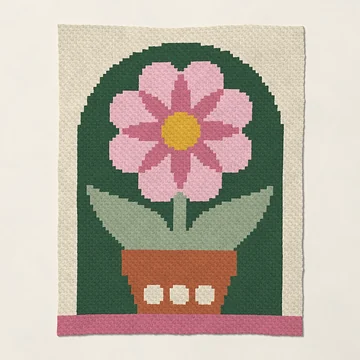
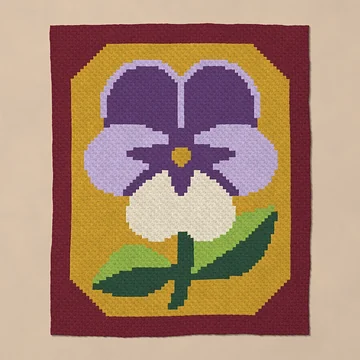
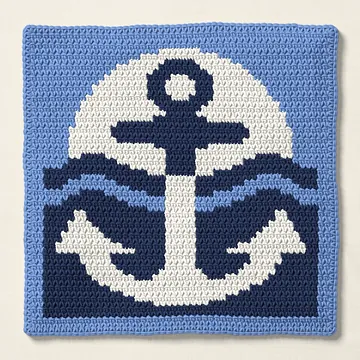
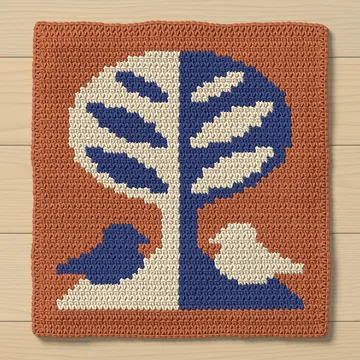
About this pattern
A folk flower with two leaves in celery and coral on an aubergine ground, worked in single crochet from the bottom row up, one stitch for each square of the graph. The yarn not in use is carried along the row inside the stitches, so the piece has 8 ends to weave in. With its border it is about 15.3 by 16¼ inches: the size of a pillow front.
Gauge
13 stitches and 15 rows to 4 in (10 cm) in single crochet, with the idle yarn carried.
In other yarn weights
The picture fixes the number of stitches, so a graph is resized by yarn and hook, not by counting. Each line is the same graph at a single crochet gauge inside the standard range for that yarn weight; the height follows the same proportion of stitch to row. Every size is about. The yarn amounts of this pattern are for its own gauge only. Each size is the panel without its border.
| Yarn | Single crochet to 4 in (10 cm) | Hook | Panel alone, about |
|---|---|---|---|
| Light (3) | 15 | 4.5 to 5.5 mm | 12¾ × 13½ in (32 × 34 cm) |
| Bulky (5) | 10 | 6.5 to 9 mm | 19¼ × 20½ in (49 × 52 cm) |
No yarn amount has been worked out for these, so they are not a choice on this page.
Notes
- Each square of the graph is one single crochet. Every row is 48 stitches.
- Row 1 is the bottom row of the graph and is a right-side row. The colors of every row are written in the order you work them. The direction in a row's label says where that row lies on the graph: a right-side row lies on the graph from right to left, a wrong-side row from left to right.
- Ch 1 and turn at the end of every row but the last. The chain 1 does not count as a stitch.
- To change color, work the last yarn-over of the stitch before in the new color.
- Carry the yarn you are not using along the top of the row below and work over it, so that it is hidden inside the stitches. Carry each yarn across every whole row, edge to edge, from the first row it appears in to the last row it appears in: join it at the start of that first row, and cut it at the end of that last row.
- Work firmly. A carried yarn can show between loose stitches, a dark yarn inside light stitches most of all. If it shows in your swatch, change to a smaller hook and measure again: the piece will then be smaller than the size given.
- Rows 1 to 3 and 57 to 59 have nothing carried inside, so they are a little thinner than the rows between.
- Worked flat only. In joined or spiral rounds the picture slants.
- In a row, "22 A" is 1 single crochet in each of the next 22 stitches with yarn A.
- The border is part of the piece: the first size given is with the border, the second is the panel alone.
- Leave a tail of about 6 in (15 cm) when you begin a yarn, and weave it in at the end with the others.
- Left-handed. Worked left-handed, these rows give a mirror image of the picture. To get the picture as drawn, read each row's runs in reverse order.
Yarn
To find how many balls: divide by the length on your yarn's label and round up. Buy them from one dye lot.
Yarn A: the estimate is from the stitches and chains of this size at this gauge, with 30 percent added.
Yarns B and C: the estimate is from the stitches of this size at this gauge, with 30 percent added.
To measure your own: work the swatch and measure it, mark the yarn where the swatch begins and ends, pull the swatch out and measure the yarn it took; divide by the area of the swatch and multiply by the area of the piece.
For an estimate from a swatch of your own: the yarn calculator.
Abbreviations
Written in US terms. Where the UK name differs it is given beside the US one.
- sc
- single crochet (UK: dc, double crochet)
- sl st
- slip stitch (UK: ss, slip stitch)
- st
- stitch
- RS
- right side
- WS
- wrong side
- sk
- skip (UK: miss)
Details
- In all
- 59 rows; 3,034 stitches (2,832 in the panel, 202 in the border); 338 color changes, at most 8 in a row; 8 ends to weave in
- Skill
- IntermediateSingle crochet throughout, 3 yarns, a graph of 48 by 59 units, at most 8 color changes in a row, 8 ends to weave in
You may sell what you make from it by hand, in small quantities. The PDF itself is not to be sold or shared. Selling, classes and kits: the rules