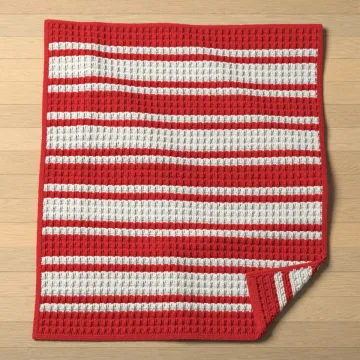
Tunisian basketweave throw crochet pattern
Intermediate · 2 colors · 2 sizes
Size: Throw Change size
PDF · US Letter · 7 pages · Change paper
Go to the instructions Row counter
- Size
- About 46¼ × 55¾ in (117 × 142 cm)
- Skill
- IntermediateThree Tunisian stitches and a border
- Yarn
- Bulky (5), about 2,030 yd (1,856 m), an estimate
- Hook
- 8 mm (US L-11)
Size 2 choices · Throw is pictured
Which size? Blanket size chart
Paper for the PDF
For your own crochet, gifts and handmade pieces you sell. Do not resell or share this PDF or copies of it. Selling, classes and kits: the rules
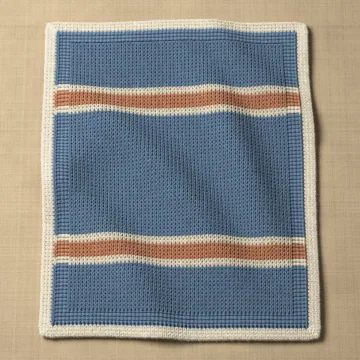
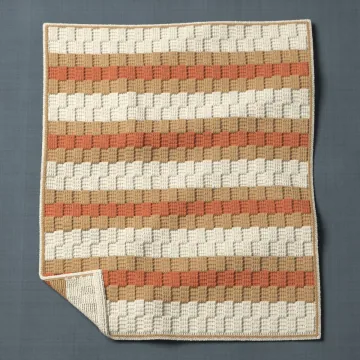
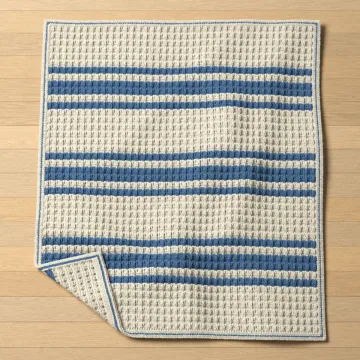
Blocks of Tunisian knit stitch and Tunisian purl stitch (both have the same name in UK terms) change places every six rows, like the weave of a basket. The oatmeal blanket is worked in one piece, with a narrow edge of simple stitch and a border in chestnut single crochet (UK double crochet).
Sizes
Gauge
11 stitches and 10 rows to 4 in (10 cm) in Tunisian simple stitch.
Check it on the blanket itself, laid flat and not stretched, when 10 rows are done: 22 stitches side by side are about 8 in (20 cm) wide, and the 10 rows are about 4 in (10 cm) tall. The blocks of knit and purl stitches have the same gauge. If they measure more, start again with a smaller hook; if they measure less, with a larger one.
How to measure it
Along a row, count every stitch and every chain between stitches as one.
In a thinner or a thicker yarn: how many stitches you need, and how large it comes out.
Before you start
How it is worked: Changing colors · Working in the round
Read the 14 notes
- Every row has two halves. The forward half picks up loops from right to left and leaves them all on the hook; "return" is the half that works them off again from left to right: yo, pull through 1 loop, then [yo, pull through 2 loops] until 1 loop is left on the hook. Do not turn: the right side always faces you.
- The loop left on the hook is the first stitch of the next row. It stands over the first vertical bar, so pass that bar over. In row 1 it stands over the ch nearest the hook. From row 2 on the last stitch of a row goes under the two strands at the very edge, so that the edge is firm.
- In row 1 there are no bars yet: put the hook under the bump at the back of each ch, yo, pull up a loop and leave it on the hook. The two strands of the V of each ch are left free for later.
- The stitches are pushed together on the hook or its cable: it may be shorter than the blanket is wide.
- A block is 6 stitches wide and 6 rows tall. In the next band of blocks a knit block stands over a purl block and a purl block over a knit block.
- The last row of a piece is plain single crochet, with no loops left on the hook and no return. Do not turn. Its ch 1 counts as no stitch: the first sc goes under the first vertical bar, straight below the ch. Work the others with the hook put in as for a tss, and the last one under the two strands at the very edge: each time yo, pull up a loop, yo, pull through both loops on the hook.
- In Rnd 1 of the border, work the sc of the sides under both strands at the end of each row: row 1 of the piece, the row of sc and all between them count. The end of the row of sc is the side of its last sc on the left, and the side of its first sc on the right. Work the sc of the top under both top strands of each sc of the last row, and the sc of the foundation under the two strands of the V of each ch.
- Leave a tail of about 6 in (15 cm) when you begin, when you join a yarn and when you fasten off, unless another length is given. The ends that are not sewn with are woven in.
- When a ball runs out, work the last yarn over of a stitch with the new yarn, and leave a tail of about 6 in (15 cm) on both. In the rows do it in the last yarn over of a return; in the rounds of the edging any stitch will do.
- In joined rounds, the first stitch of a round goes into the same stitch as the joining sl st. The joining sl st itself is not a stitch and is not worked into.
- The ch 1 at the start of a round does not count as a stitch.
- To join a yarn with a sl st, make a slip knot of it on the hook, put the hook in the place named, yo, and pull through the place and the loop on the hook.
- Edging: work along the last row, down the ends of the rows, along the other side of the foundation chain and up the ends of the rows. The 3 sc in one place turn a corner.
- Buy whole balls from one dye lot.
Instructions
Size: Throw Change sizeUS termsUK terms
First read the 14 notes just above.
- “[ ]” is a repeat.
- The count at the end is what the row leaves.
- Tick a row when it is done. Your place is kept in this browser.
- Left-handed? Work everything as it is written, the other way: rows from left to right, rounds clockwise. Left-handed crochet
How to read these rows
Square brackets “[ ]” hold a repeat: work what is inside as many times as it says. In UK terms sl st is slip stitch, sc is double crochet and yo is yarn round hook.
Blanket
Yarn A, oatmeal heather.
- FoundationWith A, ch 122.
- Row 1RSLoop on hook counts as tss, tss in 2nd ch from hook and in each ch across; returnleaves (122 tss)
- Rows 2 to 4Loop on hook counts as tss, tss in next 120 sts, tss in last st; returnleaves (122 tss)Next: row 2 of rows 2 to 4
Band 1 of blocks
- Rows 5 to 10Loop on hook counts as tss, tss in next 3 sts, repeat: tks in next 6 sts, tps in next 6 sts 9 times, tks in next 6 sts, tss in next 3 sts, tss in last st; returnleaves (8 tss, 60 tks, 54 tps)Next: row 5 of rows 5 to 10
Band 2 of blocks
- Rows 11 to 16Loop on hook counts as tss, tss in next 3 sts, repeat: tps in next 6 sts, tks in next 6 sts 9 times, tps in next 6 sts, tss in next 3 sts, tss in last st; returnleaves (8 tss, 60 tps, 54 tks)Next: row 11 of rows 11 to 16
Band 3 of blocks
- Rows 17 to 22Loop on hook counts as tss, tss in next 3 sts, repeat: tks in next 6 sts, tps in next 6 sts 9 times, tks in next 6 sts, tss in next 3 sts, tss in last st; returnleaves (8 tss, 60 tks, 54 tps)Next: row 17 of rows 17 to 22
Band 4 of blocks
- Rows 23 to 28Loop on hook counts as tss, tss in next 3 sts, repeat: tps in next 6 sts, tks in next 6 sts 9 times, tps in next 6 sts, tss in next 3 sts, tss in last st; returnleaves (8 tss, 60 tps, 54 tks)Next: row 23 of rows 23 to 28
Band 5 of blocks
- Rows 29 to 34Loop on hook counts as tss, tss in next 3 sts, repeat: tks in next 6 sts, tps in next 6 sts 9 times, tks in next 6 sts, tss in next 3 sts, tss in last st; returnleaves (8 tss, 60 tks, 54 tps)Next: row 29 of rows 29 to 34
Band 6 of blocks
- Rows 35 to 40Loop on hook counts as tss, tss in next 3 sts, repeat: tps in next 6 sts, tks in next 6 sts 9 times, tps in next 6 sts, tss in next 3 sts, tss in last st; returnleaves (8 tss, 60 tps, 54 tks)Next: row 35 of rows 35 to 40
Band 7 of blocks
- Rows 41 to 46Loop on hook counts as tss, tss in next 3 sts, repeat: tks in next 6 sts, tps in next 6 sts 9 times, tks in next 6 sts, tss in next 3 sts, tss in last st; returnleaves (8 tss, 60 tks, 54 tps)Next: row 41 of rows 41 to 46
Band 8 of blocks
- Rows 47 to 52Loop on hook counts as tss, tss in next 3 sts, repeat: tps in next 6 sts, tks in next 6 sts 9 times, tps in next 6 sts, tss in next 3 sts, tss in last st; returnleaves (8 tss, 60 tps, 54 tks)Next: row 47 of rows 47 to 52
Band 9 of blocks
- Rows 53 to 58Loop on hook counts as tss, tss in next 3 sts, repeat: tks in next 6 sts, tps in next 6 sts 9 times, tks in next 6 sts, tss in next 3 sts, tss in last st; returnleaves (8 tss, 60 tks, 54 tps)Next: row 53 of rows 53 to 58
Band 10 of blocks
- Rows 59 to 64Loop on hook counts as tss, tss in next 3 sts, repeat: tps in next 6 sts, tks in next 6 sts 9 times, tps in next 6 sts, tss in next 3 sts, tss in last st; returnleaves (8 tss, 60 tps, 54 tks)Next: row 59 of rows 59 to 64
Band 11 of blocks
- Rows 65 to 70Loop on hook counts as tss, tss in next 3 sts, repeat: tks in next 6 sts, tps in next 6 sts 9 times, tks in next 6 sts, tss in next 3 sts, tss in last st; returnleaves (8 tss, 60 tks, 54 tps)Next: row 65 of rows 65 to 70
Band 12 of blocks
- Rows 71 to 76Loop on hook counts as tss, tss in next 3 sts, repeat: tps in next 6 sts, tks in next 6 sts 9 times, tps in next 6 sts, tss in next 3 sts, tss in last st; returnleaves (8 tss, 60 tps, 54 tks)Next: row 71 of rows 71 to 76
Band 13 of blocks
- Rows 77 to 82Loop on hook counts as tss, tss in next 3 sts, repeat: tks in next 6 sts, tps in next 6 sts 9 times, tks in next 6 sts, tss in next 3 sts, tss in last st; returnleaves (8 tss, 60 tks, 54 tps)Next: row 77 of rows 77 to 82
Band 14 of blocks
- Rows 83 to 88Loop on hook counts as tss, tss in next 3 sts, repeat: tps in next 6 sts, tks in next 6 sts 9 times, tps in next 6 sts, tss in next 3 sts, tss in last st; returnleaves (8 tss, 60 tps, 54 tks)Next: row 83 of rows 83 to 88
Band 15 of blocks
- Rows 89 to 94Loop on hook counts as tss, tss in next 3 sts, repeat: tks in next 6 sts, tps in next 6 sts 9 times, tks in next 6 sts, tss in next 3 sts, tss in last st; returnleaves (8 tss, 60 tks, 54 tps)Next: row 89 of rows 89 to 94
Band 16 of blocks
- Rows 95 to 100Loop on hook counts as tss, tss in next 3 sts, repeat: tps in next 6 sts, tks in next 6 sts 9 times, tps in next 6 sts, tss in next 3 sts, tss in last st; returnleaves (8 tss, 60 tps, 54 tks)Next: row 95 of rows 95 to 100
Band 17 of blocks
- Rows 101 to 106Loop on hook counts as tss, tss in next 3 sts, repeat: tks in next 6 sts, tps in next 6 sts 9 times, tks in next 6 sts, tss in next 3 sts, tss in last st; returnleaves (8 tss, 60 tks, 54 tps)Next: row 101 of rows 101 to 106
Band 18 of blocks
- Rows 107 to 112Loop on hook counts as tss, tss in next 3 sts, repeat: tps in next 6 sts, tks in next 6 sts 9 times, tps in next 6 sts, tss in next 3 sts, tss in last st; returnleaves (8 tss, 60 tps, 54 tks)Next: row 107 of rows 107 to 112
Band 19 of blocks
- Rows 113 to 118Loop on hook counts as tss, tss in next 3 sts, repeat: tks in next 6 sts, tps in next 6 sts 9 times, tks in next 6 sts, tss in next 3 sts, tss in last st; returnleaves (8 tss, 60 tks, 54 tps)Next: row 113 of rows 113 to 118
Band 20 of blocks
- Rows 119 to 124Loop on hook counts as tss, tss in next 3 sts, repeat: tps in next 6 sts, tks in next 6 sts 9 times, tps in next 6 sts, tss in next 3 sts, tss in last st; returnleaves (8 tss, 60 tps, 54 tks)Next: row 119 of rows 119 to 124
Band 21 of blocks
- Rows 125 to 130Loop on hook counts as tss, tss in next 3 sts, repeat: tks in next 6 sts, tps in next 6 sts 9 times, tks in next 6 sts, tss in next 3 sts, tss in last st; returnleaves (8 tss, 60 tks, 54 tps)Next: row 125 of rows 125 to 130
The other edge
- Rows 131 to 134Loop on hook counts as tss, tss in next 120 sts, tss in last st; returnleaves (122 tss)Next: row 131 of rows 131 to 134
Last row
- Row 135RSCh 1, sc in first st, sc in next 120 sts, sc in last stleaves (122 sc)
- EndFasten off.
Border
Yarn B, chestnut.
- Hold the piece with the right side facing you and the last row at the top; the first st is the one at the right-hand corner.
- FoundationWork around the edge of the piece, right side facing: the 122 sts of the last row, the ends of the 135 rows, the 122 chs of the foundation, the ends of the 135 rows.
- Rnd 1Join B with sl st in first st, ch 1, 3 sc in first st, sc in next 120 sts, 3 sc in next st, sc in end of each of next 135 rows, 3 sc in next ch, sc in next 120 chs, 3 sc in next ch, sc in end of each of next 135 rows; join with sl st in first scleaves (522 sc)
- Rnd 2Ch 1, sc in same st as join, 3 sc in next st, sc in next 122 sts, 3 sc in next st, sc in next 137 sts, 3 sc in next st, sc in next 122 sts, 3 sc in next st, sc in next 136 sts; join with sl st in first scleaves (530 sc)
- Rnd 3Ch 1, sc in same st as join, sc in next st, 3 sc in next st, sc in next 124 sts, 3 sc in next st, sc in next 139 sts, 3 sc in next st, sc in next 124 sts, 3 sc in next st, sc in next 137 sts; join with sl st in first scleaves (538 sc)
- EndFasten off.
Finishing
- Weave in the ends with the yarn needle, changing direction once or twice.
- Dampen the blanket, lay it out flat with the right side up, pat it out to its size with its corners square (Throw about 46¼ × 55¾ in (141.5 cm) or 117 × 142 cm; Large about 55 × 65½ in (166.5 cm) or 140 × 166 cm), and leave it to dry.
In all: 4 ends to weave in.