Texture · Beginner
Cobble stitch
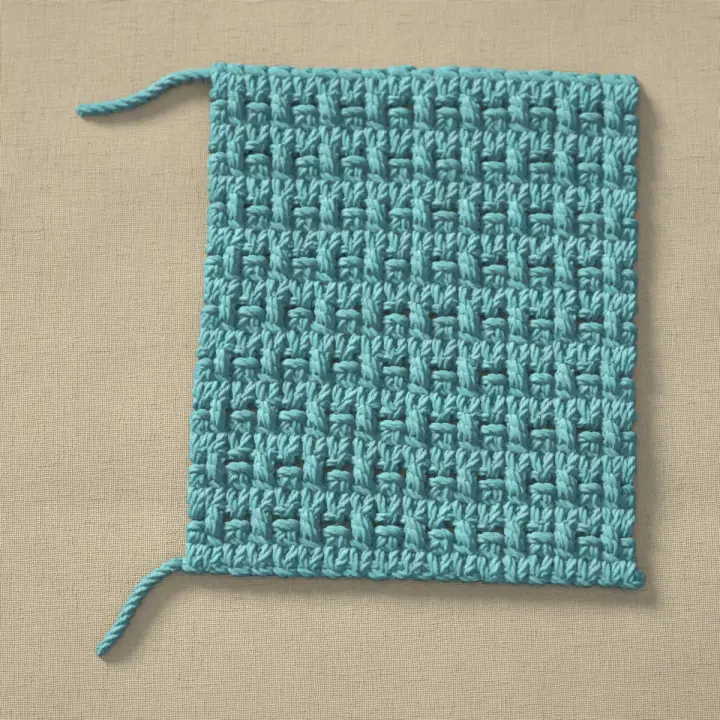
Cobble stitch is single crochet (UK double crochet) studded with small bumps. Each bump is a treble crochet (UK double treble) worked between two single crochets. The treble crochet is far taller than its neighbors, so it cannot stand up: it folds over and pops out on the other side of the work. A row of bumps and a plain row of single crochet take turns.
How to work it
A treble crochet after a single crochet

Start the row with a single crochet in the first stitch. Work a treble crochet into the next stitch. It stands more than twice as tall as the single crochet beside it.
A plain row, then bumps again

Work the next row in single crochet, one in every stitch, the treble crochets included. Then work a row of bumps again. The bumps are made on wrong-side rows and show on the right side, each one straight above the one below.
The stitch pattern, row by row
- Multiple
- Chain a multiple of 2 (6 or more).
- Starting chain
- The rows here are written for a chain of 20, which is 10 times the multiple of 2.
- The ch 1 at the start of a row does not count as a stitch.
- Row 1 is the right side.
- A treble crochet squeezed between two single crochets cannot stand up, so it folds outward into a bump on the right side.
- Foundation. Ch 20.
- Row 1 (RS). Sc in 2nd ch from hook and in each ch across (19 sc).
- Row 2. Ch 1, turn; sc in next st, [tr in next st, sc in next st] 9 times (10 sc, 9 tr).
- Row 3. Ch 1, turn; sc in each st across (19 sc).
Repeat rows 2 and 3 for the pattern.
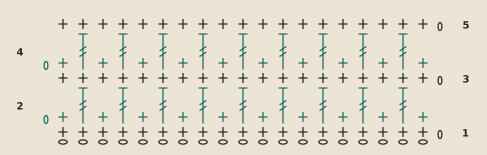
What each symbol meansHow to read a chart
Abbreviations in these rows
- ch
- chain stitch
- sc
- single crochet (UK double crochet)
- tr
- treble crochet (UK double treble)
- RS
- right side
- st
- stitch
At a glance
- Also called
- aligned cobble stitch
- Used for
- blankets and baby blankets; scarves; a close, bumpy fabric
- Multiple
- The chain is a multiple of 2 (6 or more).
- Row repeat
- Rows 2 and 3.
- One bump
- A treble crochet with a single crochet on each side of it
- Bumps are made on
- Every second row, with the wrong side facing
- They show on
- The right side
Nothing is added and nothing is skipped: a row of bumps has one stitch in every stitch, like a plain row. The texture comes only from the difference in height between the two stitches. The fabric is dense.
Every row of bumps puts its treble crochets in the same places, so the bumps stand in straight columns. Tutorials name these rows the aligned cobble stitch as well as the cobble stitch.
When it goes wrong
- My bumps are on the wrong side.
- A bump falls on the side away from you as it is made. The rows of bumps are wrong-side rows, so that the bumps show on the right side. Check that the first plain row was counted as a right-side row.
- My stitch count changes.
- A row of bumps has as many stitches as a plain row. On the plain row, work a single crochet into the top of every treble crochet as well as every single crochet.
Left-handed
The pictures show the hook held in the right hand. For the left hand, read each picture as its mirror image.
Patterns that use it
Questions
- What is the multiple for cobble stitch?
- An even number of chains, 6 or more. That gives an odd number of stitches, so a row of bumps begins and ends with a single crochet. The rows here are written for 20 chains and 19 stitches.
- Which side is the right side?
- The side with the bumps. They are worked with the wrong side facing and fold through to the right side.
- Is the aligned cobble stitch the same thing?
- Yes. Both names are given to these rows, in which the bumps line up in columns.
- What is cobble stitch used for?
- Blankets and scarves, and anything that suits a dense fabric with a bumpy surface.