Texture · Easy
Suzette stitch
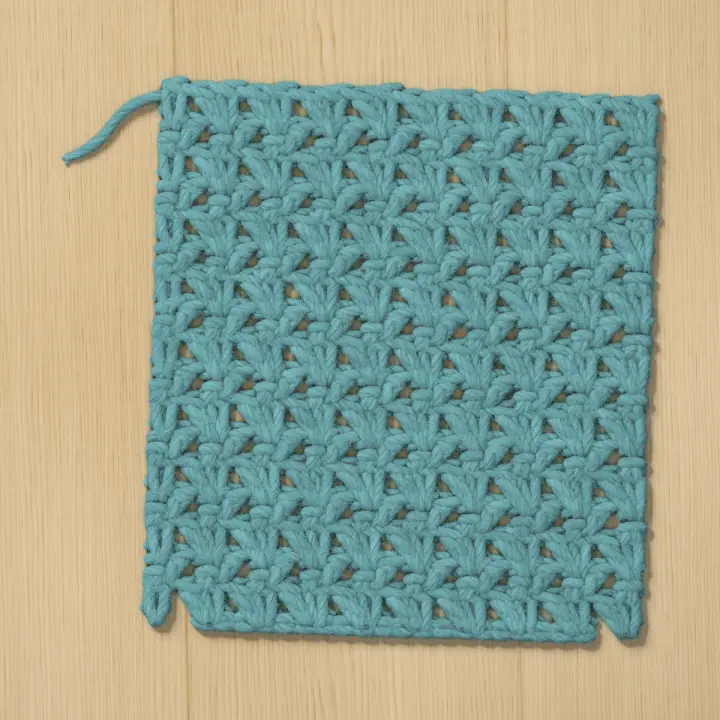
Suzette stitch is one small group, repeated: a single crochet (UK double crochet) and a double crochet (UK treble) worked into the same stitch, then one stitch skipped. From the second row on, every group goes into a single crochet of the row below and every double crochet is skipped. After the first row there is one row to repeat, and the stitch starts on an even number of chains.
How to work it
Two stitches in one place

Work a single crochet into the stitch. Then work a double crochet into that same stitch. The two stand side by side on one foot.
The stitch pattern, row by row
- Multiple
- Chain a multiple of 2 (8 or more).
- Starting chain
- The rows here are written for a chain of 20, which is 10 times the multiple of 2.
- The ch 1 at the start of a row does not count as a stitch.
- Row 1 is the right side.
- Stitches in parentheses, or several of one stitch, are all worked into the one place named after them.
- Foundation. Ch 20.
- Row 1 (RS). (sc, dc) in 2nd ch from hook, [sk next ch, (sc, dc) in next ch] 8 times, sk next ch, sc in next ch (10 sc, 9 dc).
- Row 2. Ch 1, turn; (sc, dc) in first st, [sk next st, (sc, dc) in next st] 8 times, sk next st, sc in last st (10 sc, 9 dc).
Repeat row 2 for the pattern.
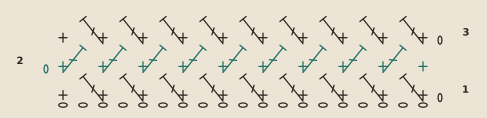
What each symbol meansHow to read a chart
Abbreviations in these rows
- ch
- chain stitch
- sc
- single crochet (UK double crochet)
- dc
- double crochet (UK treble)
- RS
- right side
- sk
- skip
- st
- stitch
At a glance
- Used for
- blankets and baby blankets; scarves; washcloths and dishcloths
- Abbreviation
- None. Patterns write the group as (sc, dc) in next st.
- In UK terms
- Suzette stitch, the same name: a double crochet and a treble in the same stitch
- Multiple
- The chain is a multiple of 2 (8 or more).
- Row repeat
- Row 2.
- Sides
- Looks much the same on both sides.
- Edges
- The side edges are straight: a row that begins with a chain that does not count begins and ends in a stitch, and that chain is not worked into. Inside the edges the stitches lean one way and then the other.
The fabric is solid, with no real holes, and has an even, pebbly texture. It looks the same on both sides, which suits things that are seen from both, such as scarves and blankets.
It asks for nothing beyond the chain, the single crochet and the double crochet, so it is a good early step past plain rows. The one thing to watch is where each pair goes. After you turn, the stitches of the row below take turns: a single crochet, a double crochet, a single crochet. Work into the first stitch and then into every second stitch, and each pair lands on a single crochet.
The stitch count stays the same from row to row. A pair makes two stitches and uses up two: the one it stands in and the one that is skipped.
Makers finish the edge in slightly different ways. The rows on this page end with a single crochet alone in the last stitch. Some patterns end the row with a full pair there.
Suzette stitch can be worked in rounds as well as in rows.
When it goes wrong
- My rows are getting wider.
- A stitch that should have been skipped was worked. After each pair, skip one stitch. Count the pairs at the end of a row: there should be the same number as in the row before.
- The texture looks muddled after a few rows.
- The pairs have drifted onto the double crochets. Every pair belongs on a single crochet of the row below. Start each row with a pair in the very first stitch and the others fall into place.
- One edge is lumpy.
- Check the two ends of the row. It begins with a pair in the first stitch and ends with one single crochet in the last stitch.
Left-handed
The pictures show the hook held in the right hand. For the left hand, read each picture as its mirror image.
Variations
- Grit stitch. Built the same way, with two single crochets in every other stitch in place of the single crochet and double crochet. It is a different fabric.
- Sedge stitch. Three stitches in one place, a single crochet, a half double crochet (UK half treble) and a double crochet, with two stitches skipped between groups.
- Lemon peel stitch. The same two stitches taking turns, but one in each stitch, with nothing skipped.
Questions
- What is the multiple for Suzette stitch?
- An even number of chains: a multiple of 2. The starting chain calculator works out the number for the width you want.
- Is Suzette stitch the same as grit stitch?
- No. They are built alike, two stitches in every other stitch, but grit stitch uses two single crochets and Suzette stitch a single crochet and a double crochet.
- Is Suzette stitch reversible?
- Yes. The two sides look the same.
- How many rows are there to learn?
- Two: the first row into the chain, and one row that repeats.