Cross stitch guide
Cross stitching on black fabric
Black cloth is harder to stitch because its holes do not show against it. Put something white, or a light, under the cloth. Light it well from above and hold it taut. The holes come back, and the rest is ordinary cross stitch.
On this page 8 parts
Why dark cloth is harder
On white Aida each hole is a dark dot on a light ground, and the eye finds it at once. On black Aida the hole is dark on dark. Nothing is wrong with the cloth, and nothing about the stitch changes. You simply cannot see where the needle goes.
Everything that helps does one of two things: it makes the holes show, or it lets you find them without seeing them.
Make the holes show
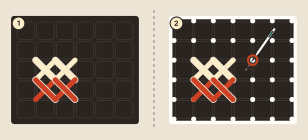
- Put white under the cloth. Lay a white pillowcase, towel or sheet of paper across your lap. White shows through every hole, as in the picture.
- Or put a light under it. A small lamp on the floor, pointed away from your eyes, lights the holes from behind. So does any small light held under the cloth, such as a thin lit tracing pad on your lap. By day, hold the work up toward a window.
- Light the front as well. Stitch by a window or under a bright lamp that falls on the work from above.
- Stretch the cloth. Use a hoop or frame and pull the cloth taut. The holes open up when it is tight. Do not pull so hard that the weave is dragged out of line.
- Magnify. Reading glasses, a clip-on lens or a magnifier on an arm makes each hole bigger.
Find the holes without seeing them
- Feel with the needle. Run the point of the needle gently across the cloth until you feel it drop into a hole, then push it through. You get quicker at this with time.
- Grid the cloth. Lines of running stitch in a pale thread, matching the bold lines of the chart, mean you never count more than a few squares in the dark. See gridding.
Choose the cloth
Aida before linen. The holes of black Aida are easier to see than the fine weave of black linen or evenweave. Take Aida for a first dark piece.
Which count is a choice between two things, and stitchers go both ways.
- A lower count, such as 14, has bigger holes that are easier to find.
- A higher count, such as 16, packs the stitches closer, so less black shows through pale stitches. On 14 count, some stitchers add a strand to pale colors for the same reason.
If seeing the holes is your trouble, go lower. If cover is, go higher.
Which thread colors read on black
Bright and light colors are at their strongest on black. That is the reason to choose black cloth.
Dark threads do the opposite. Black and other very dark colors sink into the cloth, and outlines stitched in them are lost. A chart that leans on dark outlines may not suit black cloth, unless you change those colors for lighter ones. Stitch a few crosses of the darkest colors in a corner first and see whether you can tell them from the cloth.
Look after your eyes, and the cloth
- Go slowly and take breaks. Dark cloth is tiring to look at, and a piece on it takes longer than the same piece on white.
- Keep a second project on light cloth to turn to when your eyes have had enough. Stitching in comfort has more on light and posture.
- Test for dye before you wash. Dark cloth can give off color when wet. Wet a corner in cool water first, and see whether any color comes away.
Questions people ask
Is black Aida harder than white? Harder to see, not harder to stitch. With white under the cloth and good light, most of the difference goes.
Can I stitch any pattern on black? Any chart can be worked on any color. Whether it looks right depends on its threads: light and bright ones show, dark ones do not.
Do I need special equipment? No. A white cloth on your lap and a good lamp are enough to start.
See it before you stitch
On this site you can try a design on black before you buy a thing. Open any of the patterns and press Black under Fabric color: the preview shows the design on black cloth, and you can see at once which threads carry and which are lost. Designs drawn for dark cloth open on black by themselves. Cross stitch fabric colors explains how to choose a ground.