Cross stitch guide
Stitching in comfort
Put a good light on the work first, add a magnifier only if the holes are still hard to see, bring the work up to you so that you do not bend over it, and stop for a few minutes every hour. This page is general information, not medical advice: for pain, numbness or tingling that does not go away, or for eyes that ache after close work, see a doctor or an optometrist.
On this page 8 parts
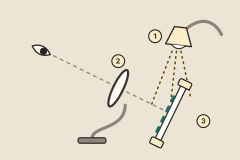
Light first
Poor light tires the eyes, and it makes you lean in toward the cloth. If you struggle to see the holes, better light is the first thing to try, before a magnifier.
- Daylight is best. Sit by a window when you can.
- Otherwise use a lamp close to the work, with its light falling on the cloth from above (1).
- A small light can travel with the work: a clip-on light fixes to the hoop, the frame or the table.
Dark cloth needs extra help. Stitching on black fabric covers it.
Magnifiers
A magnifier sits between your eyes and the cloth (2). The kinds, from simplest:
- magnifying glasses, worn like reading glasses;
- a small lens that clips on to your own glasses;
- a lens that hangs round the neck;
- a lens on a stand or a bendy arm, for the table, the floor or the frame, often with a lamp built in.
How strength is stated. Some lenses are marked in diopters (D) and some as a power, such as 2×. To turn one into the other, divide the diopters by 4 and add 1. A 4 diopter lens is 2×. An 8 diopter lens is 3×.
A stronger lens has to be closer to the cloth, because the work must lie within the lens's focal length. That is about 10 inches (25 cm) for a 2× lens and about 5 inches (12.5 cm) for a 3× lens, which leaves less room for your hands and the needle.
The chart can be made easier to see too: print it larger.
A lower fabric count helps in the same way. The squares of 11 or 14 count are bigger than those of 18 count Aida, and their holes are easier to see.
Finding your distance
Hold the work at the distance where you see it most sharply. If that distance keeps getting longer, so that you hold things farther away to focus on them, you may need reading glasses: have your eyes tested.
Chairs and posture
- Sit with your lower back supported and your shoulders relaxed.
- Have your feet flat on the floor.
- Bring the work up to you (3) so that your neck is only a little bent. A stand does this best: set it at the height and angle where you look at the cloth without craning.
- Rest your elbow on the arm of the chair, or tuck it in to your side, as long as that does not tense the arm.
Hands
The movement you repeat is the needle hand going from the front of the cloth to the back and round again. A stand takes most of it away. With the hoop or frame held for you, one hand stays above the cloth and one below, and they pass the needle to each other. A stand also rests the hand that would hold the hoop, and lets you sit straighter. Hoops, frames and stands describes the kinds.
Trouble from repeating a movement comes on gradually. It can show as pain, tingling or numbness. If it does not go away, or gets worse, see a doctor.
Stitching with one hand
With a stand or a table clamp holding the frame, cross stitch can be done with one hand. The frame stays where it is, and the same hand pushes the needle down through the cloth, goes behind, and brings it back up.
Breaks, and resting your eyes
Take short breaks often, not long ones now and then: a few minutes every hour. Get up, stretch and change position.
For the eyes, eye-care bodies give people who work at screens a simple rule, and it is easy to keep at the hoop too: every 20 minutes, look at something about 20 feet (6 m) away for 20 seconds. Tired eyes usually recover with rest. If yours often ache after close work, or you get headaches with it, have your eyes tested: glasses that are wrong for you can be the cause. Eye pain that is severe needs medical help straight away.
Where to go next
Hoops, frames and stands for something to hold the work. Supplies for the rest of the kit.