Cross stitch guide
Cross stitch supplies
You need five things to cross stitch: cloth, a blunt tapestry needle, six-strand floss, small scissors and a chart. Everything else, a hoop included, is a help that can wait.
On this page 9 parts
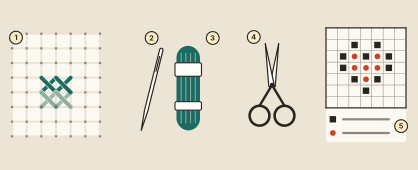
The five things you need
- Cloth (1). For a first piece, choose 14 count Aida in a light color. Aida is woven as a grid of small squares with a hole at each corner, and it is stiff enough to hold in the hand. The count is the number of squares to the inch, so a higher count means smaller stitches. Cross stitch fabric covers the other kinds.
- A tapestry needle (2). It has a blunt point, which slides through the holes without splitting the cloth, and a long eye that takes several strands. A size 24 suits 14 count. Finer cloth takes a size 26: the bigger the number, the thinner the needle. Cross stitch needles gives the size for each count.
- Six-strand cotton floss (3). A length of floss is six fine strands that pull apart. You stitch with a few of them, usually two on 14 count. Cross stitch thread explains the kinds.
- Small scissors (4). A small, sharp, pointed pair cuts the thread close to the cloth.
- A chart (5). The chart is the design on a grid, with a key that says which thread each symbol stands for. For a first piece, look for a small one in whole crosses.
Useful, and not needed to start
- A hoop or frame holds the cloth taut while you stitch. Some stitchers always use one and others never do, so it can wait until you know which you are. A hoop is two rings of wood or plastic, one inside the other. Take the cloth out when you stop for the day, so the rings do not leave a mark. Hoops, frames and stands compares them.
- A needle minder is a small magnet that sits on the cloth and holds the needle when you put the work down.
- A thread organizer keeps the colors apart: cardboard or plastic bobbins in a box, a ring, or a card with holes. Floss storage and organization shows the ways.
- A needle threader helps when the eye is hard to see.
- A magnifier helps on fine cloth. They come as glasses, as a lens that clips on, and built into a lamp.
Scissors
Two pairs do different jobs. The small pointed pair is for thread only. A larger pair cuts the cloth to size. Keep both for needlework and nothing else, so they stay sharp and clean.
Lamps and lighting
Good light matters more than any gadget, because counting small squares in dim light tires the eyes. Daylight by a window is good. After dark, put a lamp close to the work. A daylight bulb is a common choice. Light, magnifiers and comfort goes further.
Thimbles and finger guards
A thimble is a cap worn on the finger that pushes the needle. Cross stitch asks for little pushing, because a blunt needle passes through holes that are already there. A thimble, in metal, leather or plastic, is for a finger that gets sore anyway.
Which thread colors to buy first
Buy the colors your pattern lists, and no others. The key gives each color as a thread number. Every cross stitch pattern on this site lists its colors as DMC numbers. Paste those numbers into the thread shopping list to see which threads you already own and which to buy.
A checklist before you start
- A chart, printed or on a screen
- Cloth, cut with a margin all round the design
- A tapestry needle of the right size for the cloth
- Every thread color in the key
- Small scissors
- Good light
To know how big to cut the cloth, put the pattern's size in stitches into the fabric calculator.
Stitching on a budget
Cross stitch costs little to begin. Start with one small pattern that uses few colors, a small piece of Aida, a needle, and only the threads that pattern lists. Scissors you already own will do: a clean pair of nail scissors for the thread, and clean, sharp household scissors for the cloth. Leave the hoop and everything else until you know you like it.
Where to go next
With the five things in hand, Cross stitch for beginners sets out a first project and what to learn in which order.