Cross stitch guide
How many strands for cross stitch
Use two of the six strands on 14 count and 16 count Aida, three on 11 count, and one or two on 18 count. If your chart's key gives a number, the key wins.
On this page 7 parts
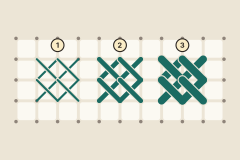
Strands by fabric count
| Fabric | Stitches to the inch | Strands of six-strand cotton |
|---|---|---|
| 11 count Aida | 11 | 3 |
| 14 count Aida | 14 | 2 |
| 28 count evenweave or linen, over two | 14 | 2 |
| 16 count Aida | 16 | 2 |
| 32 count evenweave or linen, over two | 16 | 2 |
| 18 count Aida | 18 | 1 or 2 |
Why the number changes with the count
A cross has to cover its square of cloth. On a low count the squares are big, so it takes more thread to fill them. On a high count the squares are small, and the same thread crowds them.
- Too few strands (1 in the picture): the cloth shows between the legs of the cross and the color looks thin.
- Too many strands (3 on a fine fabric): the needle is hard to pull through, the holes are forced open, and the stitches look lumpy.
- The right number (2 on 14 count): the cross fills its square and still lies flat.
Where strand charts differ
Published charts do not all agree. The chart above keeps to the common fabrics and gives each one a number that at least two published charts give it. This is what published charts say about the other fabrics, and where they part company:
- 6 and 8 count. These very open fabrics take more than three strands: one chart says 4 on 8 count, another says all 6.
- 14 count. Everyone starts with 2. Several charts allow 3 for fuller cover.
- 25 count over two. Two published charts say 3. The fabric calculator on this site says 2, the number it gives from 12 to 16 stitches to the inch, and this fabric has 12.5. 25 count fabric says how to choose between two and three.
- 18 count. Charts say 2, or 1 or 2.
- 22 count Hardanger. Two published charts say 1. The fabric calculator on this site says 1 or 2, as it does for 18 count and every finer fabric. 22 count fabric says what the second strand does.
So test before you commit. Stitch a few whole crosses in a corner of the cloth, with each number of strands you are weighing up, and look at them in daylight. Keep the one that covers without crowding.
When a chart or a stitch asks for something else
- The key says so. A chart's key often gives the strands for each kind of stitch. Follow it: the design was planned for that cover.
- Backstitch. Outlines are usually worked with fewer strands than the crosses, most often one. Backstitch has the details.
- Over one. On evenweave or linen stitched over one thread, the stitches are tiny: 28 count over one is 28 stitches to the inch (2.5 cm). Use one strand.
- Fuller cover. Three strands on 14 count give a denser, more solid color. Stitchers reach for it when a pale thread goes on dark cloth, or a dark thread on pale cloth, and the fabric shows through two.
- Texture. You can mix numbers of strands in one piece, for example a background in one strand behind a subject in two.
Two strands have one more thing in their favor. You can cut a single strand twice as long, fold it in half and begin with a loop start, which needs no knot and no tail.
What "1 ply" and "2 ply" mean
Some keys and thread labels say ply where they mean strand. A floss sold as "6 ply" is the ordinary six-strand thread, and "use 2 ply" means use two strands.
Strictly, a ply is something smaller: one of the fine threads that are twisted together to make a single strand. Those are not meant to be pulled apart. If you untwist a strand into its plies you have gone one step too far.
Common questions
Can I use just one strand? Yes, on fine fabric: 18 count and finer, or anything stitched over one. On 14 count one strand leaves the cloth showing, so keep it for a chart whose key asks for it.
Do I ever use all six? Not on the usual counts. Only the most open fabrics, 6 and 8 count, take four strands or more.
My chart does not say. What now? Use the chart above for your fabric, then stitch a test corner.
Where to go next
The fabric calculator, opened on a design of 100 by 100 stitches on 14 count, gives the strands along with the fabric size and changes them when you change the count. To take strands out of the six without a tangle, see separating the strands. Then work out how much floss the design will take. The count pages start with 14 count Aida, 16 count Aida and 18 count Aida.