Starting · Beginner
Loop start
A loop start fastens a new thread with no knot and no loose tail. Fold one strand of floss in half, thread the two cut ends through the needle, and after the first half stitch pass the needle through the loop on the back of the cloth. It works only with an even number of strands.
How to work it
Cut one strand, fold it and thread the cut ends
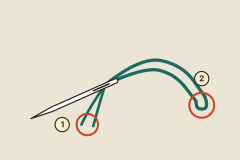
Cut one strand about twice as long as the thread you usually stitch with, and fold it in half. Put the two cut ends (1) through the eye together, as if they were one thread. The fold (2) is now the far end of the thread. For four strands, fold two strands the same way.
Make the first half stitch
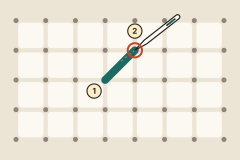
Bring the needle up from the back at the first corner of your first stitch (1). Draw the thread through, but stop while the fold is still hanging behind the cloth. Take the needle down at the opposite corner of the square (2). That is a half stitch. Do not pull it tight yet.
Pass the needle through the loop
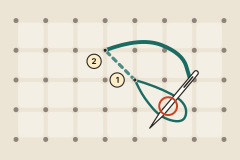
Turn the cloth over. The fold hangs from hole 1 as a loop, and the needle has come through at hole 2. Slip the needle through the loop.
Pull it snug
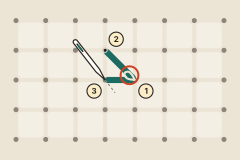
Pull the thread until the loop closes round it and lies flat against the back. The thread is now fastened. Take the needle back through the cloth at the next corner (3) and carry on stitching.
At a glance
- Also called
- loop method, knotless loop start, loop knot start
- Used for
- starting a thread without a knot; stitching with two strands of one color
- Strands
- An even number only: two, four or six. Each folded strand counts as two.
- Colors
- One color in the needle. A blend of two different colors cannot be started this way.
- Length to cut
- About twice your usual length, because the strand is folded in half.
A knot on the back of the cloth can show from the front as a small bump, which is why cross stitch threads are begun without one. The loop start is a quick, tidy way to do it when it fits: there is no tail to hold under the first stitches, and the back stays flat.
It fits only when the number of strands is even, because every strand in the needle is half of a folded one. With one strand or three there is no fold to catch. Start those threads another way: lay a tail along the back and work the first few stitches over it, or use a waste knot. Both work with any number of strands.
The two halves of the strand have to be the same color, since they are one piece of thread. For a blend of two colors in one needle, use one of the other starts.
Tips
- Line the two cut ends up before threading, so that they go through the eye together and neither half ends up longer than the other.
- How much of the fold to leave behind the cloth is habit. Some stitchers leave a short loop and some a long one, and both close the same way when the thread is pulled.
When it goes wrong
- The fold pulled through to the front
- The thread was drawn all the way through before the needle caught the loop. Take the stitch out and begin again, stopping while the fold is still behind the cloth.
- The chart asks for three strands
- A loop start cannot make an odd number. Begin the thread by stitching over a tail or with a waste knot.
Variations
- Other ways to start without a knot. Stitching over a tail and the waste knot work with any number of strands and with blended colors.
Questions
- Does a loop start work with one strand or three?
- No. It needs an even number of strands, because each strand is folded in half and counts as two. Use another start for one, three or five.
- Can I use a loop start with two different colors?
- Not for a blend. The two halves of a folded strand are the same thread, so both are the same color.
- Which end goes through the needle, the fold or the cut ends?
- The two cut ends. The fold stays at the far end of the thread, where it becomes the loop that the needle passes through.