Stitches · Beginner
Backstitch
Backstitch is a line of short straight stitches that meet end to end. In cross stitch it draws the outlines and the lettering, and it is worked last, over crosses that are already stitched.
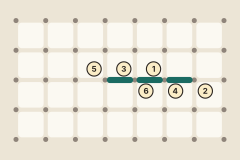
How to work it
Come up one hole ahead
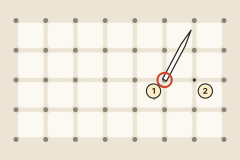
The diagrams work from right to left. Start one hole along from where the line begins: bring the needle up through that hole from the back of the cloth (1) and pull the thread through.
Go down at the start of the line
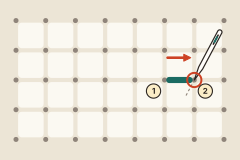
Take the needle backward and push it down through the hole where the line begins (2). The first stitch now lies on the cloth from 1 to 2.
Come up one hole further on
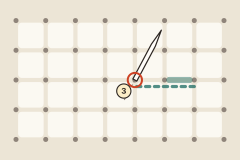
Behind the cloth, pass the hole you first came up through and bring the needle up through the next hole along the line (3).
Go back down into the last stitch
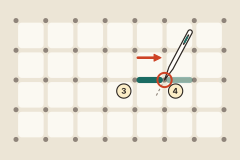
Push the needle down through the hole where the last stitch began (4). It is the same hole the thread came up through at 1, so the two stitches meet with no gap between them.
At a glance
- Also called
- back stitch
- Used for
- outlines round stitched shapes; lettering; fine detail over finished crosses
- When
- After the crosses in that part of the design are finished.
- Strands
- Makers differ. A common rule is one strand fewer than the crosses, so one strand of backstitch over two-strand crosses; other stitchers use the same number for both.
- Needle
- A blunt tapestry needle, as for the crosses, most often a size 24 or 26. Some stitchers go a size smaller for backstitch.
- On the chart
- Lines drawn over the grid of symbols. The key says which thread each line is and how many strands to use.
- Stitch length
- One square at a time for curves and fine detail. A straight run may be worked in longer stitches.
Backstitch is what gives a cross stitched picture its lines: the edge of a shape, a stem, a whisker, a row of small letters. The crosses fill the squares of the chart, and the backstitch is laid over them afterwards to outline them and add detail.
Stitchers do not agree on how much it matters. Some instructions for beginners call backstitch optional, and some teachers call it the one stitch besides the cross that nearly every pattern needs. Either way it comes last.
A chart shows backstitch as solid lines laid over the squares, often black and heavier than the grid. The key says which thread each line stands for. A line does not have to follow the edge between two colors, and it may cut across a square. Stitch where the line is drawn, not where the colors change.
Begin and end the thread behind the crosses. On the back, run the needle under a few finished stitches right beside the start of the line, then come up at the first hole. At the end of the line, run it under a few stitches again and cut it close.
Keep the stitches short where the line bends or the detail is small: one square each. Along a straight edge the same line can be made in longer stitches that span two or three squares, which is quicker. Short stitches look neater and keep their place better, so if a long one looks slack, break it into shorter ones.
A line can run in any direction, and a slanting one is worked the same way, from hole to hole across the corner of a square. Where a charted line ends in the middle of a square, the needle has to pierce the block there, as it does for a quarter stitch. A sharp needle makes that easier.
Every cross stitch pattern on Floss Field is charted in full crosses only, with no backstitch. This page is for charts from elsewhere that ask for it, and for adding an outline or a few letters of your own.
Tips
- Go down through the very hole the thread came up through on the stitch before. Sharing that hole is what makes the line unbroken.
- Leave the backstitch until the crosses under it are done, so that the line lies on top of them.
- Study the lines on the chart before you begin, and mark each one off on the chart as you stitch it if that helps you keep your place.
When it goes wrong
- Small gaps show between the stitches
- The needle went down beside the last stitch. Take it down through the same hole the thread came up through.
- A long stitch looks slack or strays from its line
- It spans too many squares. Take it out and work the same line in shorter stitches.
- The line on the chart does not meet a hole
- It ends in the middle of a square. Take the needle through the middle of the block at that point, or change to a sharp needle for that stitch.
Variations
- Backstitch in hand embroidery. On fabric with no holes to count, the same stitch follows a drawn line and you choose how long each stitch is.
Questions
- Do I backstitch before or after the cross stitches?
- After. Backstitch is worked over crosses that are already stitched, to outline them and add detail.
- How many strands do I use for backstitch?
- Often one strand fewer than the crosses: one strand of backstitch where the crosses are worked in two. Some stitchers use the same number for both. If your chart says, follow the chart.
- How is backstitch shown on a cross stitch pattern?
- As solid lines drawn over the grid, often black and heavier than the grid lines. The key names the thread for each line and the number of strands.
- How do I start and end a backstitch thread?
- Behind the crosses. Run the needle under a few finished stitches on the back beside the start of the line, and again at its end.
- Do the cross stitch patterns on Floss Field need backstitch?
- No. Every cross stitch pattern here is charted in full crosses only.