Cross stitch guide
Cross stitch thread and floss
Cross stitch is worked in stranded cotton, also called embroidery floss: a thread of six fine strands that you pull apart and use two or three at a time. It is sold in small skeins, and each color has its own number.
On this page 10 parts
What stranded cotton is
Stranded cotton is six fine strands, twisted loosely together so that they come apart again. The cotton is mercerized, a treatment that gives it a soft shine. A skein holds 8 meters (8.7 yards) of the six-strand thread and is held by two paper bands. One band carries the maker's name. The other carries the color number.
Keep the band with the number. A chart names each color by that number, and it is the only sure way to buy the same thread again.
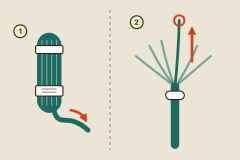
To take thread from a skein, find the loose end and pull it gently (1). On a DMC skein the end that pulls out cleanly is the one at the longer band, the band with the number. Other makers wind their skeins differently, so try both ends once and remember which one runs free.
Separating the strands
You almost never stitch with all six strands. You take out the number the chart asks for and put those back together.
- Cut a length of thread.
- Pinch it loosely a little below one end, so that the six strands spread at the tip.
- Pick one strand and draw it straight up and out (2). The rest of the thread gathers into a bunch below your grip. It straightens as soon as the strand is free.
- Pull out the next strand the same way. Always one at a time.
- Lay the strands you need side by side, ends together, and thread them through the needle as one.
Pulling two strands out together leaves them twisted round each other. Strands that are separated and laid back together lie flat and cover the cloth better. How many strands for cross stitch says how many to use on each fabric.
How long to cut
Cut 15 to 18 inches (38 to 46 cm). Each pass through the cloth wears the thread a little, so a long thread frays and knots before you reach its end. If yours tangles, cut shorter.
A loop start uses one strand folded in half, so that strand is cut twice as long.
The makers and their numbers
DMC, Anchor and Madeira all make six-strand cotton, and there are others. Each maker numbers its colors in its own way. The same number from two makers is not the same color: black is 310 from DMC, and the nearest Anchor thread is 403. Many charts are keyed in DMC numbers, and so is every cross stitch pattern on this site. Thread conversion explains how to move from one maker's numbers to another's.
Not every color code is a plain number. DMC makes three whites: BLANC is white, B5200 is snow white, and 3865 is winter white. They are three different threads, so buy the one the key names.
Thread is dyed in batches, and two batches of one number can differ very slightly. For a large area of one color, buy all the skeins you need at the same time.
Does floss go bad?
Not if it is kept clean, dry and out of the sun. Age alone does not spoil cotton floss, and thread that has been stored well for many years is still good to stitch with. Damp and long spells in sunlight are what damage it. One caution with old thread: a skein bought years ago and a new skein of the same number may not match exactly, so do not mix them inside one patch of color.
Hand-dyed and overdyed floss
Hand-dyed floss is colored by hand, one batch at a time. The color shifts along the length of the thread, and one skein is never quite like the next. That is the point of it: a patch of stitches comes out softly shaded instead of flat.
Two things follow. Makers differ about washing: one says its threads are colorfast, another says a few of its colors are not and advises against washing the finished piece. Read the maker's care note before you wet anything. And a hand-dyed color has no true match among solid colors, because it sits between two or three of them.
Pearl cotton, silk and wool
- Pearl cotton (also written perle or perlé) is a single twisted thread with a high shine. It does not divide. It is sold by size: 3, 5, 8 and 12, and the larger the number, the finer the thread.
- Silk floss is stranded and is used the same way as cotton floss. It costs more and is chosen for its shine and fineness.
- Wool yarn is the thread of canvaswork and needlepoint, not of cross stitch on Aida.
A thread that does not divide comes in one thickness only. With floss you add or drop a strand to suit the cloth. With pearl cotton or tapestry yarn you cannot, so it only suits the fabric count that its thickness covers.
Beeswax and thread conditioner
A thread conditioner is beeswax, or a synthetic wax that does the same job. You draw the thread across it before stitching, so that it picks up a coat too thin to see. The coat smooths fuzz and helps the thread resist tangling. Stitchers are split on it: some condition every length, many never do, and with plain cotton it is rarely needed. It earns its place with metallic and other specialty threads.
When the thread misbehaves
| What you see | What to do |
|---|---|
| The thread goes fuzzy or frays | Cut shorter lengths. Check the needle: one that is too small makes the thread rub its way through the cloth. |
| The thread twists up on itself | Let the needle hang from the cloth every few stitches until the thread stops spinning. |
| It knots as you pull it through | Use a shorter length, and separate the strands one at a time before threading. |
| The cloth shows through the stitches | Add a strand. Dark thread on light cloth, or light thread on dark cloth, needs the most cover. |
Where to go next
Work out how much floss a design needs, then keep it in order with organizing floss. Two tools on this site work from thread numbers: tick off the colors you own on the thread checklist, and the thread shopping list shows what a pattern still needs.