Cross stitch guide
Joining two pieces of fabric
If the cloth is only short of margin, sew strips of plain cloth to its edges. If the design itself runs off the cloth, starting again on a bigger piece is the sure cure. Needlepoint has a way to seam two pieces of canvas with their holes lined up, and it is the last resort for cloth.
First, which problem is it?
Cloth is too small in one of two ways, and the cure is different for each.
- The design fits, but the margin is too narrow to hoop, frame or lace. Add plain cloth to the edges. The join is never seen.
- The design does not fit. A second piece would have to carry the rest of the stitches, so a seam would run through the picture. Starting again is the surer cure.
Adding margin with plain cloth
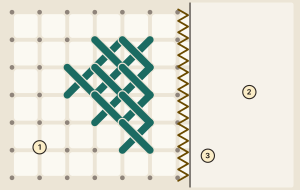
This is the safe one. The added cloth only has to hold on.
- Find a piece of plain cotton with a firm weave, such as muslin. It will not show, so any color will do.
- Lay the edge of your stitching cloth (1 in the picture) over the edge of the cotton (2), with the weave of both running straight.
- Sew the two together just inside the edge of the stitching cloth. A zigzag by machine does it (3).
- Add a strip to each side that is short.
The extra cloth goes into the hoop, or round the board when the piece is laced. It stays hidden in the finished piece.
Joining a second piece to carry the design
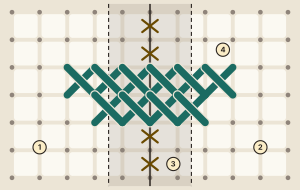
Needlepoint workers join two pieces of canvas to make rugs and wall hangings bigger than one piece. The method below is theirs, and it is described for canvas. On Aida or evenweave, treat it as a last resort and try it on two scraps first. The picture shows it carried over to Aida.
It depends on one thing: the two grids must match hole for hole. So the second piece has to be the same cloth and the same count as the first.
- Fold the edge of each piece to the back by about 1/2 inch (1.3 cm), along a straight line of the weave.
- Bring the two folds together (1 and 2 in the picture) so that the threads and holes of one piece carry straight on into the other. Pin them and check along the whole seam.
- Sew the folds together with strong sewing thread in small crossed stitches (3).
- Stitch across the seam. Work the design as if the two pieces were one (4). Near the seam the needle goes through two layers.
On canvas the seam ends up hidden, because needlepoint covers its whole ground. Dark colors and a mix of colors over the seam hide it best, and a row of stitches that stops in a straight line beside the seam shows it up. Cross stitch often leaves cloth bare, and nothing covers a seam there.
When to start again instead
Start again on a bigger piece when:
- the seam would fall across open cloth, where nothing covers it
- you cannot get the same cloth in the same count
- only a little has been stitched so far
Next time, cut the cloth with its full margin. The fabric calculator, opened on a design of 100 by 80 stitches, adds 3 inches (7.5 cm) on every side for framing and gives the size to cut.
Where to go next
- For the other things that go wrong: fixing mistakes.
- For cutting cloth with a margin and stopping its edges fraying: preparing fabric.
- For canvas and the craft worked on it: the needlepoint section.