Cross stitch guide
How to cross stitch letters and words
Chart the words on a grid before you stitch them. Pick an alphabet, add up the width of the letters and the gaps between them, and compare that with the space you have. Then find the middle of the line and count out from the middle of the cloth.
On this page 7 parts
Choose an alphabet for the space
Charted alphabets come in two kinds. Block letters are built from cross stitches. Line letters are drawn in backstitch. What decides whether your words fit is the height of the letters, the width of each one, and the blank squares between letters and between lines.
- A narrow alphabet gets more letters into a line. Use one when the space is tall and thin.
- Small letters are narrower than capitals in many alphabets, though not in all. Some alphabets have both, some only capitals.
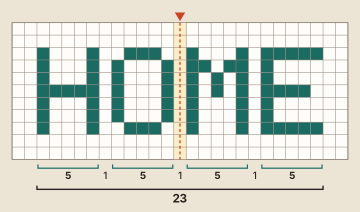
The text generator offers five alphabets. Block has capitals 7 squares high, with small letters, and every letter is the same width. Serif, Bold and Narrow are capitals 9 squares high. Typewriter has capitals 8 squares high and small letters. The word HOME takes 23 squares across in Block, 24 squares in Narrow, 33 squares in Serif and 37 squares in Bold or Typewriter. Block also comes in a large size, with every stitch doubled: 46 squares wide and 14 high. Small letters save width in Typewriter, where Home is 32 squares wide, and none in Block, where it is still 23.
Count the width of a word
Add the width of every letter to the gaps between them.
- Write down the width of each letter in squares. In a block alphabet where every letter is 5 wide, HOME is 5, 5, 5 and 5.
- Add one blank square between each pair of letters: three gaps.
- Add it up: 20 + 3 = 23 squares.
A space between two words is wider than the gap between two letters: three squares or more. For a line of several words, add those in too.
Stitches divided by the fabric count give the size. On 14 count, 23 stitches are about 1 5/8 inches (4.2 cm) wide. If the line is too wide for its space, choose a narrower alphabet, use small letters, or break the words over two lines.
Center a line
- Find the middle of the word. Halve its width. HOME is 23 squares, an odd number, so its middle is the 12th square, with 11 on each side. For an even number the middle is the line between two squares.
- Find the middle of the space. Fold the cloth in half to find the center line, or use the center arrows on the chart.
- Count out from the middle. Start stitching at the middle of the word, on the center line, and work outward, or count back half the width from the center to find where the first letter begins.
To set words into a space on an existing chart, do the same with numbers. Take the width of the space, take away the width of the words, and halve what is left. That is the number of blank squares on each side. If the number left over is odd, one side gets the extra square.
Center each line on its own. Lines of different length then sit under each other in the middle.
Space the letters and the lines
- Keep the same gap between all the letters of a word: usually one square.
- Some pairs of letters look further apart than they are. Once the line fits, move a letter a square closer where the word looks uneven.
- Between lines, leave enough blank rows that the tails of g, j, p, q and y on one line clear the tall letters of the line below.
- Draw the longest line first. If that fits, the rest will.
Moving from letter to letter on the back
Within a word the next letter is one square away, so the thread can pass behind the cloth to it. Keep those passes short. A thread dragged a long way across the back shows through to the front.
Between words, and at the end of each line, fasten the thread off and start again.
Common mistakes
- Starting at the left edge and hoping. Count the width first, or the last letter may not fit.
- Forgetting the gaps. Four letters have three gaps.
- Centering by eye. Halve the numbers.
- Carrying the thread behind bare cloth from one word to the next.
Where to go next
Type your words into the text generator, opened on the word HOME, and it draws the chart, gives the width in stitches and the size on your fabric, and makes a PDF. For initials and a year at the edge of a finished piece, see signing your work. Ready-charted words are in the sayings patterns.