Cross stitch guide
How to make a cross stitch pillow
A finished cross stitch becomes a pillow front. Sew strips of fabric round it until it is the size of the pillow, sew it to a fabric back with right sides together, turn it out and fill it. A back made of two overlapping pieces lets the cover come off for washing.
On this page 8 parts
Two kinds of pillow
- A stuffed pillow. The front is sewn to a one-piece back, filled with loose polyester filling and sewn shut. It is the simplest to make and suits small pillows. It cannot be opened again.
- A cover over an insert. The front is sewn to a back that opens, and a ready-made pillow insert goes inside. The cover comes off to be washed or stored flat. This guide makes the cover with an envelope back, which needs no fastening.
Either way, wash and press the stitched piece first. How to wash cross stitch covers that.
The size to stitch and cut
Work from the outside in, and draw the plan before you cut anything.
- The pillow. Choose the insert. The front is cut to the size of the insert plus a seam allowance on each side.
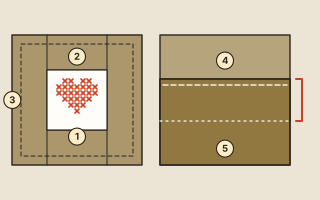
- The seam allowance. This is the strip between the sewing line and the cut edge, numbered 3 in the picture. A quarter inch (0.6 cm) and half an inch (1.3 cm) are both in use. Choose one and keep to it for every seam.
- The stitched panel. Cut it with a little bare cloth showing round the design, plus a seam allowance.
- The borders. Strips of fabric fill the space between the panel and the edge. Cut each strip as wide as it will show, plus two seam allowances.
A worked example, with half inch (1.3 cm) seams and a 14 inch (35.6 cm) insert:
- The front is cut 15 inches (38.1 cm) square.
- A design of 84 by 84 stitches on 14 count is 6 inches (15.2 cm) square. With half an inch (1.3 cm) of bare cloth and a seam allowance on every side, the panel is cut 8 inches (20.3 cm) square.
- The border strips are cut 4.5 inches (11.4 cm) wide, so that 3.5 inches (8.9 cm) of each shows.
The fabric calculator, opened on a design of 84 by 84 stitches with a 1 inch (2.5 cm) margin, gives the panel size on other counts.
Sew the front
- Trim the stitched piece to the panel size (1). Follow one thread of the cloth with the scissors so that the edge is straight.
- Pin a border strip (2) to the top edge, right sides together, and sew. Do the same at the bottom. Press the seams flat.
- Pin and sew a strip to each side, running the whole height of the front. Press.
- Measure the front. It should match the size on your plan. This is the moment to fix it if it does not.
A light iron-on interfacing pressed to the back of the stitched cloth steadies it and helps the front keep its shape.
Make the envelope back
- Cut two back pieces. Each is as wide as the front and about two thirds of its height.
- Hem one long edge of each piece: fold it under twice and sew it down.
- Lay the front face up. Lay one back piece on it face down, raw edges level with the top, hem toward the middle. Lay the second piece face down level with the bottom. The two hemmed edges overlap across the middle (4 and 5).
- Pin, then sew all the way round on the sewing line.
- Cut across the corners close to the seam, turn the cover right side out through the overlap, and push the corners out.
- Put the insert in through the overlap.
Or stuff it
For a stuffed pillow, cut one back piece the size of the front. Sew round with right sides together and leave an opening wide enough for your hand. Turn it out, push out the corners, fill it, and sew the opening closed by hand.
A zipper is the third way to close a cover. It is sewn into one of the seams, and the insert goes in through it.
Common mistakes
- Forgetting a seam allowance. Every seam takes one from each piece it joins. The one that is easiest to forget is the allowance round the outer edge, where the front joins the back.
- Cutting the stitched cloth too close. Leave bare cloth between the design and the seam, or the border will crowd the stitching.
- A cover that cannot come off. A stuffed pillow has to be cleaned whole. If it will be used every day, make a cover.
Questions people ask
Can I cross stitch straight onto a pillow cover? Yes, on a ready-made cover of plain fabric, with waste canvas to give you a grid to count on. How to cross stitch on clothes with waste canvas shows the method.
What fabric for the back and borders? Plain woven cotton is easy to sew and is a common choice.
Where to go next
Not sure the piece should be a pillow? What to do with finished cross stitch lists the other ways to finish it. A design from the small patterns makes a pillow front with wide borders.