Cross stitch guide
Cross stitch on clothes with waste canvas
Waste canvas is a stiff, open canvas that lends plain cloth a grid to count. Baste it to the garment, cross stitch through the canvas and the cloth together, then dampen the canvas and pull its threads out one by one. Only the stitches stay.
On this page 12 parts
What waste canvas is
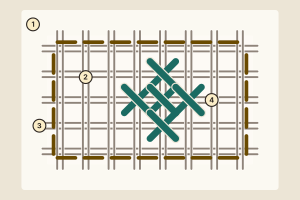
Waste canvas is an open canvas woven in pairs of threads and stiffened with a starch that water softens. A garment's cloth (1) has no holes to count. So the canvas (2) is basted on top (3), and the crosses (4) go through the holes of the canvas and through the cloth under it. When the design is finished the canvas comes out, thread by thread. That is the waste in its name.
It is sold in several counts, 8.5, 10 and 14 among them. 14 count is the usual one, and it gives stitches the size of 14 count Aida: a design 42 stitches wide comes to 3 inches (7.6 cm). Work each cross over one pair of threads, into the large holes between the pairs.
What you need
- Waste canvas, cut at least 1 inch (2.5 cm) bigger than the design on every side.
- The garment, washed and pressed first, so that it shrinks before the stitches go in and not after.
- Floss that does not run. The piece gets wet at the end, so test your floss first.
- Sewing thread for basting.
- A hoop, tweezers and a needle.
Which needle
On a T-shirt or other knit, the blunt tapestry needle you use on Aida is enough. Thick or closely woven cloth such as denim needs a sharp needle to get through. Whichever you use, put it down in the holes of the canvas. A canvas thread that has been pierced is very hard to pull out. The needle sizes guide has the sizes.
How to use it, step by step
- Place the canvas. Fold it in quarters to find its center, and lay that where the middle of the design should be. Line the canvas threads up with the straight grain of the cloth.
- Baste it on. Sew long running stitches round the edge. For a bigger piece, sew one or two more lines through the middle.
- Hoop it. Fit a hoop over the canvas and the cloth together. Keep the cloth flat, but do not stretch it. Check that only the front of the garment is in the hoop.
- Stitch from the center. Take the needle straight down and straight up, one movement at a time. Neighboring crosses share a hole, as they do on Aida. Keep the stitches relaxed: tight ones pucker the cloth and grip the canvas.
- Fasten the ends well. Run each end under the backs of several stitches. A garment goes through the wash again and again.
- Trim. Take out the basting. Cut away the spare canvas, and leave about 1 inch (2.5 cm) round the stitches to take hold of.
- Dampen the canvas. A wet cloth or a spray softens the starch. Some stitchers wet it right through.
- Draw the threads out. Pull one thread at a time with tweezers, flat along the cloth and never upward. Take out all the threads that run one way first. The ones that cross them then slide out easily.
- Dry and press. Let the piece dry, then press it from the wrong side.
Stretchy cloth
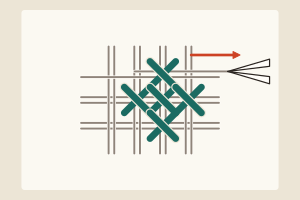
T-shirts, jersey and baby clothes stretch, and stitches do not. Before you baste, iron a piece of interfacing or stabilizer to the wrong side of the cloth, behind where the design will go. It stops the cloth from moving under the needle. Hoop it gently and keep the stitches loose.
When the canvas is out, a second piece of soft interfacing, ironed on behind the stitching, keeps the thread ends in place and away from the skin.
Jeans and denim
Denim is thick and firm, so it keeps its shape under the needle. Use a sharp needle to get through it. Pockets and hems are the usual places for a small design.
A hat or cap
A hat takes a small motif in the same way: canvas basted to the outside, crosses through both, threads drawn out. A knitted hat stretches like any knit. Its own stitches can also serve as the grid, with no canvas at all: see cross stitch on crochet and knitting.
A jacket or hoodie
Treat a denim jacket like jeans. For a hoodie or sweatshirt, pull the cloth gently between your hands. If it gives, treat it as stretchy cloth: stabilizer behind, a gentle hoop, relaxed stitches.
Water-soluble and stick-on canvas
Soluble canvas is a thin plastic sheet punched with holes at 14 count. You baste it on and stitch through it like waste canvas. Then you soak the piece in warm soapy water for about 10 minutes, and the sheet dissolves. Rinse it well. There are no threads to pull, but the sheets are small, about 8 inches (20 cm) square, and cost more. Keep to whole crosses and backstitch on it.
Stick-on grids are sheets of stabilizer with a grid printed on them. They press onto the cloth, so there is nothing to baste. Follow the packet for taking them off: the washable kind rinses away in water.
When something goes wrong
- A canvas thread will not move. Dampen it again. If it is caught in a stitch, snip it close to the stitches and pull it from both ends.
- The cloth puckers. The stitches are too tight, or the cloth was stretched in the hoop.
- The design sits crooked. The canvas was not lined up with the grain of the cloth.
- A color has run. The floss was not colorfast. See how to wash cross stitch.
Questions people ask
Can I use Aida in place of waste canvas? No. Waste canvas is made to come apart when it is wet. Aida and ordinary canvas are not, and their threads are very hard to pull out from under the stitches. You can stitch a motif on Aida, cut it out and sew it on as a patch.
Which patterns work? Small ones in whole crosses. Every cross stitch pattern on this site is charted in full crosses: start with the small patterns.
Where to go next
The fabric calculator, opened on a design of 42 by 42 stitches with a 1 inch (2.5 cm) margin, gives the size of canvas to cut. For cloth with a grid of its own, see other cross stitch fabrics. To print a design on the cloth and stitch over the marks, see how to make a stamped pattern.