Cross stitch guide
Cross stitch needle size chart
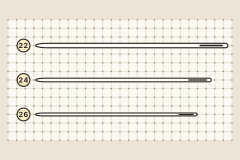
Cross stitch is worked with a tapestry needle: a blunt needle with a large eye. Use size 24 on 14 count Aida and size 26 on 16 and 18 count. The chart below gives the size for the common fabrics, and the section under it covers the rest.
On this page 7 parts
Needle size by fabric count
| Fabric | Stitches to the inch | Tapestry needle |
|---|---|---|
| 11 count Aida | 11 | Size 22 |
| 14 count Aida | 14 | Size 24 |
| 28 count evenweave or linen, over two | 14 | Size 24 |
| 16 count Aida | 16 | Size 26 |
| 32 count evenweave or linen, over two | 16 | Size 26 |
| 18 count Aida | 18 | Size 26 |
Where needle charts differ
A needle chart is a rule of thumb, and published charts do not all agree. The chart above keeps to the common fabrics and gives each one a size that at least two published charts give it. This is what published charts say about the other fabrics, and where they part company:
- 6 and 8 count. These open fabrics take a larger needle: size 20 for 8 count, and size 18, or 16, for 6 count.
- 16 count. Most charts say 26. One thread maker says 24, and one chart says either.
- 18 count. Some charts say 26, as the chart above does, and some say 28.
- 36 count over two. Most charts say 28. One says 26 or 28.
- 22 count Hardanger. Two published charts say 26. The fabric calculator on this site goes by the stitches to the inch and names the finest size, 28, from 20 to the inch up (and for 36 count over two, whose holes are finer than 18 count Aida's at the same 18 stitches to the inch), so it says 28 here. 22 count fabric weighs up the two.
- Evenweave and linen over two. Most charts go by the size of the stitch, so 28 count over two takes the same size 24 as 14 count Aida. Some name a size finer for it, 26.
When two sizes are named, try both. The right needle slips through the hole without pushing it wider, and its eye takes your strands without a fight.
How to tell the needle is the wrong size
- Too big: the needle is hard to pull through, and it leaves a hole that the thread does not fill.
- Too small: the eye drags the thread through the cloth, and the thread goes fuzzy and frays.
What the size number means
Needle sizes run backward. The bigger the number, the shorter and finer the needle: a size 26 is smaller than a size 24, and a 24 is smaller than a 22. Tapestry needles are made from size 13, which is very large, to size 28, which is very fine. Cross stitch uses the fine end. Sizes 24 and 26 between them cover most projects.
Which kind of needle
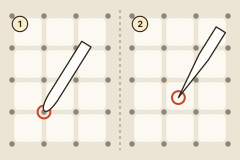
- Tapestry needle. Blunt, with a large eye. The blunt point finds the hole and slides between the threads of the cloth (1). It does not split them, and it does not split the stitches already there. This is the needle for cross stitch.
- Embroidery needle (also called crewel). Sharp, with a long eye, in sizes numbered from 1 to 10 or 12. It is made for plain fabric, where the needle has to pierce the cloth (2). Some stitchers keep one for backstitch over dense stitching and for fractional stitches, which go through the middle of an Aida block.
- Chenille needle. The same sizes as tapestry needles, but sharp.
- Sewing needle. An ordinary sewing needle is sharp and its eye is small. Floss is hard to thread through it, and the point pierces the cloth and the stitches already there. It is the wrong tool here.
- Beading needle. Very fine and long, so that it passes through the hole of a small bead. Adding beads to cross stitch says when you need one.
"Which needles are best" is a question of kind and size, not of maker: a blunt tapestry needle in the size for your fabric.
What needles are made of, and why they tarnish
A needle is steel wire with a thin plating. Most are plated with nickel. Some are plated with gold, which is smoother and resists tarnish, and is the usual choice for stitchers whose skin reacts to nickel.
Plating wears with use. When a needle looks dull or marked, or feels rough as it passes through the cloth, replace it: a rough needle wears the thread. And do not park the needle in the cloth between sessions, because it can leave a mark.
Where to go next
The fabric calculator, opened on a design of 100 by 100 stitches on 14 count, names the needle along with the fabric size, and changes it when you change the count. Each count has its own page, starting with 14 count Aida, 16 count Aida and 18 count Aida. Then learn threading a needle and how many strands go through it.