Starting · Beginner
Threading a needle
Fold the end of the floss over the needle, pinch the fold flat between finger and thumb, slide the needle out and push its eye down onto the fold. Every strand goes through together, and the thread stays dry. If that fails, a needle threader does it for you.
How to work it
Fold the end over the needle and pinch
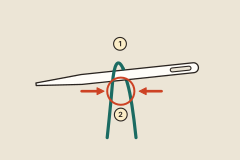
Lay the thread over the needle a little way from its end and fold it down on both sides, so that it hugs the needle (1). Pinch the fold tight between finger and thumb, just under the needle (2).
Push the eye onto the fold
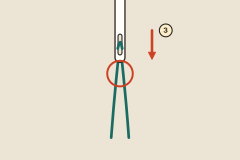
Slide the needle out of the fold and keep pinching, so that only the very top of the fold shows between finger and thumb. Bring the eye of the needle down onto it (3) and work the needle down between your fingertips until the fold is through the eye.
Or use a needle threader
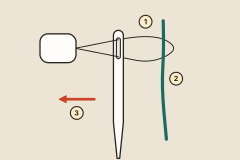
Push the wire loop of the threader through the eye of the needle (1). Put the end of the thread through the wire loop (2). Pull the threader back out of the eye (3): it brings the thread with it.
At a glance
- Also called
- how to thread a needle, needle threader
- Used for
- getting two strands through the eye together; threading without wetting the floss
- Needle
- A blunt tapestry needle, most often a size 24 or 26. The 24 is the larger of the two and the easier to thread.
- Kinds of needle threader
- A loop of fine wire on a small handle, which is cheap and easily broken, or a flat metal hook, which is sturdier and suits tapestry needles.
Stranded floss is several loose strands and not one firm thread, and the strands part at the eye. The fold and the pinch both do the same job: they hold the strands together while the eye goes over them.
The same pinch works without the fold. Cut the end clean with sharp scissors, hold it between finger and thumb so that the tip barely shows, and bring the eye down onto it.
Wetting the end of the thread is the old habit. A clean cut and a pinch usually do the job dry, so keep it for when nothing else works, and then only just dampen the tip.
For a loop start the needle is threaded with the two cut ends of one folded strand. Line the two ends up, pinch them together and thread them as one.
Tips
- If the thread will not go in, turn the needle over and try from the other side. The two sides of an eye are not quite alike, and one usually takes the thread more easily.
- If the strands you need will not fit a size 26 needle, go up to a size 24.
When it goes wrong
- Only one of the two strands goes through
- The ends were not together. Fold both strands over the needle as one and pinch them, or cut the two ends level and pinch them tip to tip.
- The end of the thread is fluffy and splits at the eye
- Cut a fresh end with sharp scissors. A clean end holds together.
- The wire of the threader breaks or pulls out of its handle
- That is the weak point of the wire kind. A flat metal threader lasts longer.
Questions
- How do I thread a needle with embroidery floss?
- Fold the end over the needle, pinch the fold flat, slide the needle out and push the eye onto the fold. Then pull the fold through until the short end is free.
- How does a needle threader work?
- Its wire loop goes through the eye, the thread goes through the loop, and pulling the threader back out draws the thread through the eye.
- What is the best needle threader for cross stitch?
- Choose by kind. The thin wire loops are the cheapest and break soonest. A flat metal threader with a small hook lasts longer and suits tapestry needles.