Cross stitch guide
Cross stitch on crochet and knitting
Treat each stitch of the crochet or knitting as one square of the chart. Thread a blunt needle with yarn about as thick as the yarn of the piece, and work one cross over each stitch, through the gaps at its corners.
On this page 8 parts
Which crochet to stitch on
Two crochet fabrics make a grid you can count: single crochet (called double crochet in United Kingdom patterns) and Tunisian simple stitch.
- Single crochet. Every stitch is one square of the chart. Work the crochet a little tight, with a hook one size smaller than usual, so the ground is firm.
- Tunisian simple stitch. It has a row of upright bars with an opening beside each one, and its small, even squares take a chart easily. The needle goes through the openings, so each cross lies over a bar and shares its openings with the crosses next to it.
Yarn and needle
Use a blunt yarn needle, the one for weaving in ends. Stitch with yarn about as thick as the yarn of the piece, so that the crosses cover. If yours is thinner, use it doubled. For anything that will be washed, choose yarn of a fiber like the piece's own, so that the two can be washed the same way.
Where the needle goes
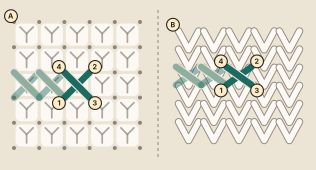
On single crochet (A in the picture):
- Bring the needle up at the bottom left corner of the stitch (1).
- Take it down at the top right corner (2). That is the first leg.
- Bring it up at the bottom right corner (3).
- Take it down at the top left corner (4). The cross is made.
For a row of one color, work the first leg of every cross along the row, then come back and cross them, as on Aida. Some makers start from the other bottom corner. Either way, make every cross in the piece the same, so that all the top legs lean one way.
Keep the yarn easy. It should lie flat without pulling the crochet in. Weave the ends into the back. The yarn shows on the back, so the piece has one good side. That suits things with a hidden inside, such as a pillow cover or a bag.
On knitting
Plain stockinette is the knitting to stitch on, and a firm, close knit is easier than a loose one. Each V on its face is one knitted stitch. Cross stitch is worked on it the same way as on crochet, with the knitted stitches as the grid: B in the picture shows a cross over one V.
Knitting stretches and embroidery does not. Leave the stitches loose enough that the fabric can still give. A piece of interfacing behind thin knitting stops it from pulling out of shape.
Knitters have a stitch of their own for this, called duplicate stitch or Swiss darning. The yarn follows the V of each knitted stitch and covers it, so the motif looks knitted in.
Which charts suit it
Small, simple ones in whole crosses. A stitch of yarn is far bigger than a stitch on Aida, so a few squares go a long way: letters, initials and plain shapes work best. Every cross stitch pattern on this site is charted in full crosses. Try the small patterns, or chart a name with the text generator.
How big a chart comes out
Count the stitches of your own piece. Measure how many stitches lie side by side in 1 inch (2.5 cm), and how many rows are stacked in 1 inch (2.5 cm). Then divide.
At 5 stitches to the inch, a motif 20 squares wide is 4 inches (10.2 cm) wide. The two numbers are often different, so a design may come out a little squat or a little tall. On single crochet some makers count two rows as one square to even this out, and others keep to one stitch, one square. The crochet section's guide to gauge shows how to measure a swatch, and resizing a pattern covers changing a chart's size.
The crochet stitch called cross stitch
Crochet has a stitch of its own named cross stitch, made with the hook: stitches worked so that they cross one another. It is not embroidery. The crochet section and its stitches are the place for it.
Where to go next
To put cross stitch on cloth with no grid at all, such as a T-shirt or jeans, see cross stitch on clothes with waste canvas.