Needlepoint guide
Needlepoint canvas too stiff, too limp or crooked
Stiff canvas is normal, and a frame and short threads make it pleasant to stitch. Limp canvas wants a frame too. A canvas that leans was pulled by its stitches. Basketweave and a light hand prevent it, and blocking puts most of it right.
On this page 7 parts
Find your canvas here
| What you see | Why | What to do |
|---|---|---|
| New canvas is stiff as card and scratches the thread | It has plenty of sizing, which is good | Put it on a frame, use 18 inch (45 cm) lengths, go on |
| It has been rolled and will not lie flat | The sizing has set in a curl | Roll it the other way, or tack it to a frame |
| It smells of a storeroom | Closed storage | Air it flat, away from sun and damp. If you see mold, do not stitch on it |
| It flops over your hand | Light sizing, or the sizing has been washed out | Use stretcher bars, drum tight: tap it, and it springs back with no dip |
| It has gone soft as you worked | Handling and damp hands wear sizing away | Put it on a frame now, and stop gripping the stitched part and the bare edges: hold the frame |
| It leans like a slanted window | Slanted stitches pulled it | Block a finished piece. For a half-stitched one, see "Stop it as you go" |
| One side draws in or ripples | Stitches pulled tight, or thread too thick | Loosen your hand, or use fewer strands |
| A painted line climbs across the threads | The canvas was printed or painted off the grain | Follow the threads and the chart, not the line |
| The cut edge slants across the threads | It was cut off the grain | Find a canvas thread and trim along it: see "Canvas off the grain" |
What sizing is
Canvas is woven from cotton or linen and then stiffened with sizing, which is a kind of starch or glue. Sizing holds the threads in place, so that the holes stay square and can be counted. Most sizing dissolves in water. That one fact explains the rest of this page: a wet canvas goes soft, a damp canvas can be pulled into a new shape, and it keeps that shape when it dries.
Canvases differ from the start. Rug canvas, the coarsest, is the stiffest. Mono canvas is woven of single threads, one over and one under; it is firm, but its threads slide. Interlock canvas has pairs of fine threads twisted round each thread they cross, so its threads are locked and slide less. Congress cloth, a fine mono canvas of 24 threads to the inch (2.5 cm), comes both stiff and soft. Garment canvas, for things that should drape, has no sizing at all. Canvas and mesh sizes sets out the kinds.
Canvas that is too stiff
Leave it stiff if you can. It will soften a little by itself as you handle it, and stiffness is what keeps the piece square.
- Flatten it. Roll it gently against the curl, or lay it under books for a night. Do not fold it: a crease in sized canvas stays.
- Bind the edges. Masking tape over the cut edges keeps them from scratching you and catching the thread.
- Put it on a frame. On stretcher bars the stiffness stops mattering, because nothing has to bend.
- Stab. Take the needle straight down, pull it through, and come straight up in a second move. The other way, scooping, takes the needle down and up again in one move, as in sewing a hem. Through stiff canvas that is hard work, and it bends the threads.
- Cut shorter lengths. Sizing rubs thread. About 18 inches (45 cm) for wool and cotton, less for silk and metallics.
- Check the needle. A needle one size larger opens the hole, so that thread does not scrape through. One that has to be forced is too large.
- Spare your hands. Hold the frame and not the canvas, and rest often. If the edge of the frame bites, pad it.
When can you soften it on purpose? Only a blank canvas, only lightly, and only if it will be held on a frame. Tack it square to the bars first. Mist it, wipe it once with a barely damp cloth, and let it dry where it is. A painted or printed canvas is never wetted before it is stitched, unless you have tried every color and it holds. Water can lift paint and ink, and the stitches over them will be stained: how to paint a canvas has the trial. Do not put any canvas in a washing machine or crumple it soft.
If you want soft work, buy soft canvas. A canvas softened by force is only a canvas that has been weakened.
Canvas that is too limp
Limp canvas can be a poor one, an old one, a softer kind bought by mistake, or a good one that has been wet.
- Look for damage. Hold it to the light. Broken or hairy threads, knots and threads that have wandered out of line are reasons to choose another canvas.
- Square it. Pin it face up to a padded board with its threads straight in both directions.
- Frame it. Move it to stretcher bars, drum tight, tacks no more than 1 inch (2.5 cm) apart. For most limp canvas this is the whole cure.
- Back the edges. If the margin is narrow or weak, sew strips of firm cotton to the edges and tack those.
- Work in basketweave. Its woven back stiffens the piece as you go.
- Use an easy hand. Soft threads slide, so a pull that stiff canvas would stand draws holes together here.
Starch. A blank cotton canvas can be stiffened with laundry starch, and needs no iron:
- Spray both sides. Lay it on clean paper, spray one side lightly, turn it and spray the other.
- Pin it square. Move it to a padded board covered with a clean cloth, and pin it with its threads straight both ways.
- Let it dry pinned.
Starch rinses out again, so it goes the first time the piece is wet. It also feeds insects, so it is better on a trinket than on an heirloom. Keep it off painted canvas until a corner has shown that the colors hold.
What not to use. Older handbooks stiffen the back with animal glue, rice paste or wallpaper paste, to hold a blocked piece in shape. Do not. Pastes and animal glues attract insects, they make the work hard and hard to clean, and they hide a lean without curing it. The next damp day or damp cloth can let it go again. White glue and plastic sprays are hard or impossible to take out again.
Canvas that leans
Why it leans
A slanted stitch pulls across the canvas threads at an angle. One does nothing. Thousands that all slant the same way push the threads over, and a square turns into a slanted shape. Three things decide how far: the stitch, how hard you pull, and whether the canvas was held while you did it. Thick or springy thread adds to it.
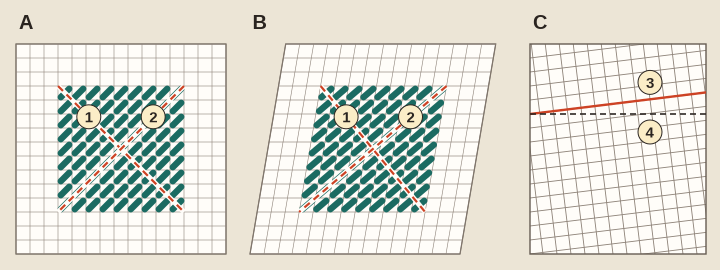
Which stitches pull most and least
| Pull | Stitches | Why |
|---|---|---|
| Least | Basketweave | Its back crosses both ways and holds the square |
| Little | Upright stitches: upright Gobelin, brick, Parisian, bargello, long stitch | They run with the threads, so they can narrow a piece but not slant it |
| Little | Stitches that slant both ways: cross stitch with each cross finished as you go, kalem, Smyrna cross | The slants balance |
| More | Box stitches all slanting one way: Scotch, mosaic, cashmere | Long slanted stitches, one direction. Turning every other block the other way helps |
| More | Slanted Gobelin, encroaching Gobelin, diagonal mosaic, diagonal Scotch | Rows of slants with nothing against them |
| Most | Continental and half cross in large areas, worked in the hand | Every stitch pulls one way over the whole piece |
Stop it as you go
- Change to basketweave wherever the area is wide enough: see basketweave or continental.
- Put it on a frame today. If the piece already leans, first put a drop of water on each color and press white cloth on it. If no color comes off, dampen the piece, pull it square by hand, tack it to the bars with its threads parallel to the wood, and leave it to dry before you stitch on. The water is what lets the canvas keep its new shape. If a color runs, frame it dry as straight as it will go, and leave the rest to a finisher.
- Stab instead of scooping. Down in one move, up in another.
- Pull until the thread lies flat, and no more. If the holes on each side of a stitch grow larger, you are pulling too hard.
- Check the diagonals. Now and then, measure from corner to corner of the stitched area both ways.
- Turn the slant where you may. In a background of blocks, alternate the direction.
How far is it out?
Measure both diagonals of the stitched area. For a square of 10 inches (25 cm), the difference tells you the lean:
| Difference between the diagonals | The top edge has moved sideways by |
|---|---|
| 3/8 in (9 mm) | 1/4 in (6 mm) |
| 3/4 in (1.8 cm) | 1/2 in (1.3 cm) |
| 1 3/8 in (3.6 cm) | 1 in (2.5 cm) |
On a square of any size the sideways shift is about seven tenths of the difference. On a rectangle the diagonals still show whether it leans, since a true one has two the same, but the table does not fit. Lay a set square or the corner of a sheet of paper along the bottom edge instead, with its corner on the corner of the stitching, and measure how far the top has moved from its upright edge.
How much can blocking undo?
Blocking works because water loosens the sizing, so that the threads can be moved, and drying sets them again. It puts right most leans made by easy stitching. It does less for stitches that were pulled tight, because the thread itself is holding the canvas over, and a large area of tight continental can come off the board straight and creep back. Block it again before you give up. Leave it pinned until it is bone dry: a piece taken off damp goes back.
What is left can be handled in finishing. A finisher can square a pillow over a firm lining, lace a piece over board, or cut the mat, the card border inside a picture frame, to hide a slanting edge. Tight stitches can be cut out and worked again. Glue on the back is not the answer.
Canvas off the grain
Lengthwise threads give less than crosswise ones, so keep them running up and down. They lie along the selvage, the firm woven edge that does not fray. On a piece with no selvage, pull it gently by two opposite sides and then by the other two: the direction that gives less is the lengthwise one.
- Find the grain. Run a blunt needle along the groove beside one thread, from one side to the other.
- Mark it. Follow that groove with a pencil in the margin.
- Trim to it. On a blank canvas, cut along the thread on all four sides. Bind the edges again.
- Tack by the thread. On a frame, line the threads up with the wood, and let the cut edge fall where it will.
- On a painted canvas, do not force the threads to meet a crooked picture. Keep the threads square, count from the chart if there is one, and where a line wavers between two threads choose one and stay on it. Straight borders and letters matter most, because the eye sees those.
A canvas with its threads wavy in the middle and straight at the sides was handled or badly woven. Dampen a blank one, pull it straight and dry it pinned. A painted one is better sent back.
Questions people ask
Should new canvas be washed first? No. Washing takes out the sizing that you paid for.
Will my stitching stay stiff? It stays firm. Thread fills the holes, and the piece softens somewhat with blocking and use.
Can I iron canvas flat? A blank canvas may be pressed when it is dry, under a cloth, with no steam. Keep an iron away from paint until a corner has shown it is safe, and away from synthetic threads.
Does thread choice make a canvas lean? Yes. A thick or springy thread packs the holes and pushes. The same stitch can pull more in one thread than another, so try it in the margin.
Is plastic canvas different? Yes. It has no sizing and needs no blocking, though a hard pull can curl it.