Needlepoint guide
Stitches for sky, clouds, water and sand
For a plain sky use brick or Nobuko, for still water level stitches such as darning or Ming, for moving water wave stitch or bargello, and for foam French knots on top. Keep the sky's stitch smaller than the water's, and lay both so that the horizon stays level.
On this page 12 parts
Start here
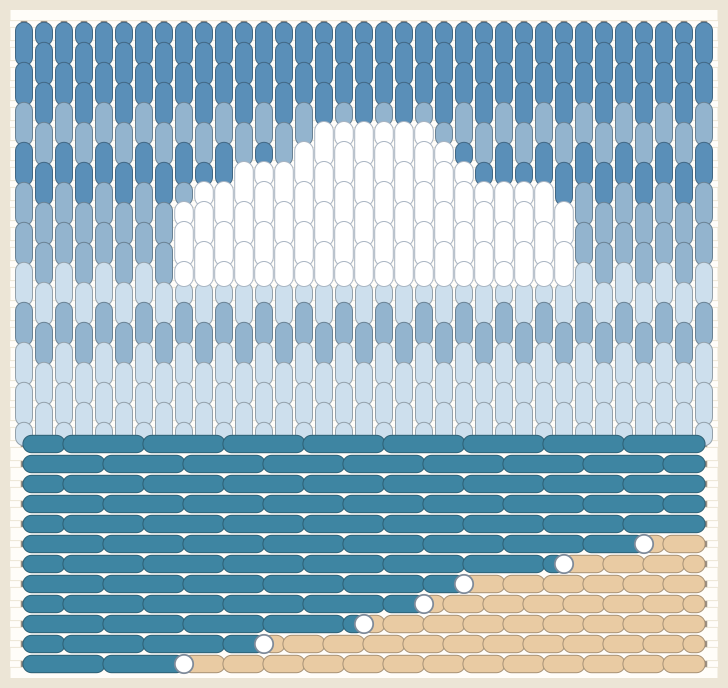
- Decide what is far and what is near. The far part gets the smaller and smoother stitch: sky, then distant hills, then the sea, then the waves and the beach.
- Choose one stitch that moves. One only: the water, or the clouds. Everything around it stays quiet.
- Look at the paint. If it is shaded the way you like, let it show: take a thin thread, or an open stitch, one that leaves canvas bare between its stitches, such as T stitch.
- Find your part in the table, and count whether it fits.
A sky in three bands that fades has its steps below. Which stitch to use has sand and clouds in a short form. This page has the rest.
By part
Plain sky: brick or Nobuko. Brick is upright and leads the eye nowhere. Nobuko slants, and suits a sky with some air moving in it. The rows under it are for a sky that is wider, smaller, painted, shaded or stormy.
Room is canvas threads across by threads up, for two repeats each way. A repeat is the smallest piece of a pattern that comes again and again. Three look better. Where a row names two or three stitches, their rooms stand in the same order with a semicolon between. One figure alone serves for all of them. Tent stitch fits anywhere: it is the small slant over one crossing of two canvas threads, worked as continental in lines and as basketweave in areas.
| Part | Stitch | Thread | Room |
|---|---|---|---|
| Clear sky | Brick, Nobuko | Floss or silk, its strands laid: combed flat side by side and not twisted | 4 x 4; 4 x 8 |
| Wide clear sky | Ming, double brick over four | Ribbon or laid strands for calm, one thick strand for texture | 8 x 16; 8 x 8 |
| Small sky behind a detailed scene | Slanted Gobelin, tent | Pale blue, overdyed: a thread that shifts in color along its length | 2 x 4 |
| Clear sky with a little texture | Parisian | Pale blue floss or silk, laid | 4 x 12 |
| Shaded sky | Encroaching Gobelin, whose rows overlap by a thread and hide the joins | Blues that differ only a little, a row or two of each | 2 x 5 |
| Painted sky | T stitch, skip tent | One or two strands | 4 x 4 |
| Windy sky | Double Nobuko, or Nobuko in two close blues | Silk | 8 x 4; 4 x 8 |
| Sunset | Brick in rows of color, medieval mosaic, darning | Three or more shades, or one overdyed | 4 x 4; 12 x 16; 8 x 4 |
| Storm | Diagonal Parisian, Byzantine | Two grays, one shiny | 12 x 6; 10 x 10 |
| Night | Basketweave, then stars | Matte dark blue | Any |
| Flat or far clouds | Twill on its side, Hungarian | A strand more than the sky | 9 x 6; 8 x 8 |
| Puffy clouds | Balloon, double Hungarian | Thick and soft | 16 x 20; 16 x 8 |
| Mountains far off | Double brick, oriental if there is room | Grayed, paler than the near hills | 8 x 4; 32 x 32 |
| Still water | Darning, Ming, level long stitch | Shiny silk or floss | 8 x 4; 8 x 16; any |
| Ripples | Medieval mosaic, Nobuko, diagonal Parisian | Two close shades | 12 x 16; 4 x 8; 12 x 6 |
| Waves | Wave stitch, bargello, beetle | A shade to a row | 12 x 6; two waves; 12 x 20 |
| Foam, spray | French knots, beads | White with a strand of sparkle | 1 |
| Waterfall | Upright long stitch, uneven lengths, knots at the foot | Silk and translucent thread | Any |
| Reflections | The water's stitch, with rows of the other color let in | The object's color, duller | Below |
| Under water | Skip tent or T stitch over the paint | Thin, blue-green | 4 x 4 |
| Seaweed | Feather stitch, stem stitch, ribbon | Pearl cotton | A strip of 6 |
| Coral | French knots, bullion knots | Wool or pearl cotton | 1; 4 |
| Wet, smooth sand | Encroaching Gobelin, level brick | Silk, a darker sand | 2 x 5; 4 x 4 |
| Dry, trodden sand | Serendipity, criss-cross Hungarian with a knot in the gaps | Tweedy wool | 6 x 6; 8 x 8 |
| Shells | Ray stitch, one fan to a shell; satin | Pearl cotton | One, 4 x 4 |
| Ice | Pavilion | Pale silk, or a translucent ribbon | 8 x 16 |
| Glass and other clear things | See-through things, below | Thin or translucent |
On 13 and on 18 mesh. Mesh is the number of canvas threads in an inch (2.5 cm). 4 threads are 0.31 inch (7.8 mm) on 13 mesh and 0.22 inch (5.6 mm) on 18. 8 threads are 0.62 inch (1.6 cm) and 0.44 inch (1.1 cm), 12 are 0.92 inch (2.3 cm) and 0.67 inch (1.7 cm), 16 are 1.23 inches (3.1 cm) and 0.89 inch (2.3 cm).
Thread and needle, as estimates in strands of floss. Begin with the lower number, and add a strand if canvas shows.
| Stitch | 13 mesh, size 20 needle | 18 mesh, size 22 needle |
|---|---|---|
| Brick, and other upright or level stitches: one strand more than tent stitch | 8 or 9 | 5 to 7 |
| Nobuko, and other slanted stitches: as tent stitch | 7 or 8 | 4 to 6 |
Both needles are tapestry needles, which are blunt.
A sky in three bands that fades
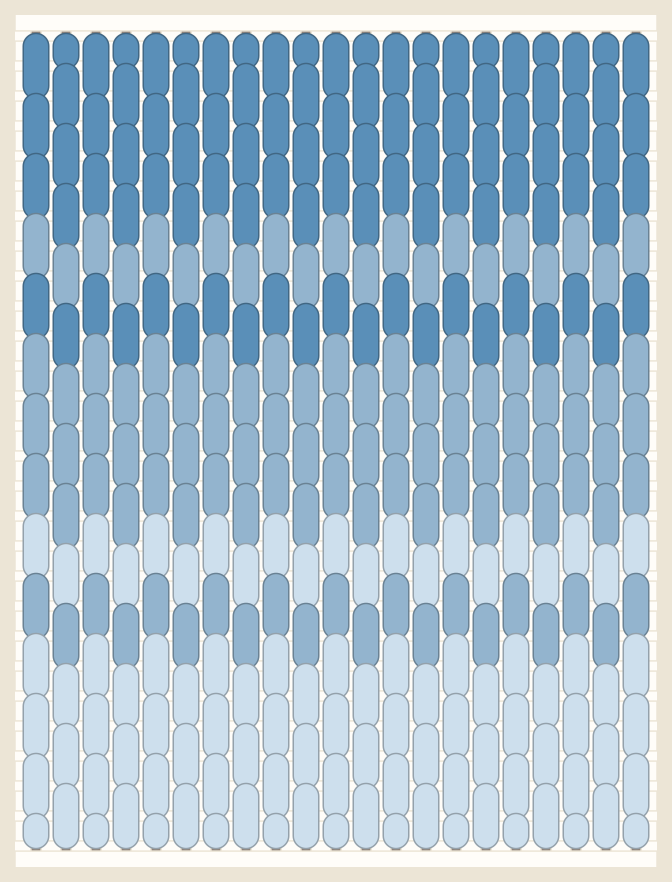
The stitch is brick: upright, over two threads, every other stitch one thread lower. Each zigzag row is one shade. Where two shades meet, one row of each is let into the other, so there is no line.
| Row, from the top | Shade | Plain or traded |
|---|---|---|
| 1, 2, 3 | Dark | Plain |
| 4 | Middle | Traded with row 5 |
| 5 | Dark | Traded with row 4 |
| 6, 7, 8 | Middle | Plain |
| 9 | Pale | Traded with row 10 |
| 10 | Middle | Traded with row 9 |
| 11, 12, 13 | Pale | Plain |
Thirteen rows are 27 threads tall: 2.1 inches (5.3 cm) on 13 mesh and 1.5 inches (3.8 cm) on 18. On 18 mesh that takes 5 to 7 strands of floss in a size 22 needle, and on 13 mesh 8 or 9 in a size 20.
- Choose three blues of one family that are clearly lighter and darker than each other. Skip one shade each time, so that each band can be told from the next: DMC 322, 3755 and 3841 leave out 334 and 3325 of the Baby Blue row. The darkest goes at the top.
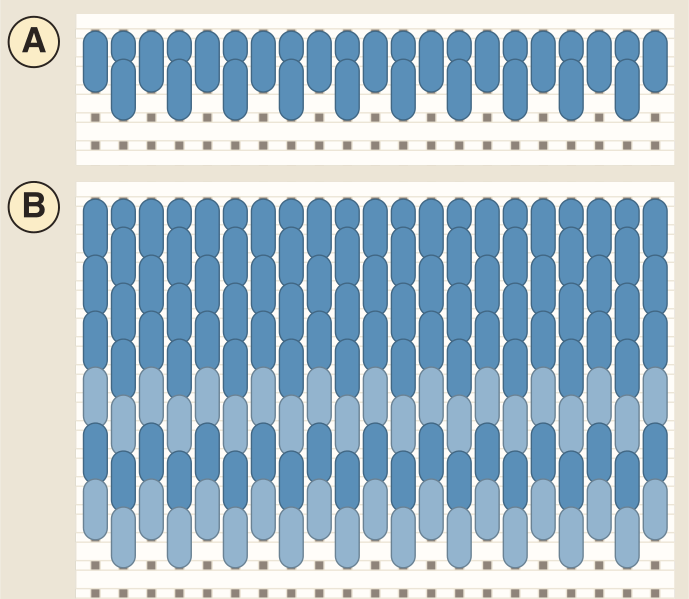
- Level the top. In the dark shade, work a short upright stitch over one thread in every other hole of the top line: come up one thread below the line and go down on it. Leave the holes between them empty for now. All the stitches of this sky, long and short, come up at the foot and go down at the top.
- Work the first row in the dark shade, one upright stitch over two threads for every hole of the top line (A). For an empty hole, come up two threads below the line and go down in that hole. For a hole with a short stitch, come up three threads below the line and go down in the hole at the foot of the short stitch.
- Follow the table, one row at a time, to the right and back to the left by turns. Come up in a bare hole two threads below the foot of the stitch above, and go down in the hole at its foot.
- Trade the rows where the shades meet: row 4 is middle, row 5 dark again (B).
- Level the foot. Every other stitch of the last row ends one thread higher than the rest. Put a short stitch over one thread under each of those, in the pale shade: come up on the bottom line and go down at the foot of the long stitch. They are the short stitches at the foot of the finished strip above.
For a taller sky, make the plain parts longer and let in two rows of each shade at a join in place of one. From the top: 6 rows dark, then middle, dark, middle, dark, then 6 rows middle, then pale, middle, pale, middle, then 6 rows pale. Those 26 rows are 53 threads tall: 4.1 inches (10.4 cm) on 13 mesh and 2.9 inches (7.5 cm) on 18.
For a sunset take more shades, from blue through rose to gold, and set the palest just above the horizon. For a blend with no rows at all, mix strands in the needle.
Clouds
- Outline nothing. A line makes a cloud look cut out. Let sky stitches and cloud stitches share their holes.
- Make it nearer than the sky: a stitch one size larger, or the same stitch with a strand more.
- Or fuzzier: one strand of a soft, hairy thread beside a smooth white.
- Flat at the foot. Most clouds are level below and round above. Keep the lower edge on one row of holes.
- The edges. Where a patterned cloud meets the sky, shorten its stitches and leave the sky to fill the steps. Compensating is drawn step by step.
- White on a white canvas needs no paint under it, but a gray or lilac shade at the foot gives it weight.
A wave with foam, step by step

It is 24 threads wide and 13 tall: 1.85 x 1 inch (4.7 x 2.5 cm) on 13 mesh and 1.33 x 0.72 inch (3.4 x 1.8 cm) on 18.
- Mark two lines of holes: the level of the crest, and 13 threads below it the level line.
- Work the first row, from left to right: 25 upright stitches, one in each hole, over four threads in the palest shade (A). Their tops lie this many threads below the crest, from the left: 9, 9, 8, 8, 7, 6, 5, 4, 3, 2, 1, 0, 0, 0, 1, 3, 6, 8, 9, 9, 8, 8, 7, 6, 5.
- Work the second row in the middle shade, one stitch under each, over four threads. Where fewer than four are left above the level line, stop there (B). Where the first row already reaches that line, there is no stitch.
- Fill the last part in the dark shade, from the second row down to the level line. The three longest are over five threads (C).
- Stitch the sky down to the crest, if there is one behind.
- Add the foam. Put French knots in the top holes from the tenth stitch to the steep side, and a few more down that side. Two or three smaller ones go above, for spray (D). Use white with one strand of filament beside it, a very fine shiny thread.
To go on to the right, count on from the eighth number, 4: the last seven are also the first seven of the next wave. For a flat sea of small waves take wave stitch. For foam in a line, buttonhole stitch along the crest makes a lacy edge.
A beach edge

- Draw the edge from hole to hole, with a fine waterproof pen. Let it move by one, two or three threads from row to row, and now and then by none.
- Work the water in rows of level stitches over four threads. Begin every other row with one over two, so that the ends do not line up. At the edge cut the last stitch to whatever fits.
- Work the sand in level stitches over two threads, from the right side toward the water. Begin every other row with one over a single thread, so that each row is moved by one thread from the last. Cut the last stitch of a row to whatever fits, and end it in the hole where the water ended (C).
- Wet the sand. Use a darker sand for the first two or three stitches beside the water.
- Add foam last: a French knot or a bead in the hole at the end of each water row, or in two of three, so the line is broken (D).
For a beach seen from the side, with the edge nearly level, let the water and the sand keep the same stitch and change only the color.
Reflections

- Find the waterline and count the object up from it. This post is six rows tall and three stitches wide.
- Turn it upside down. What was nearest the line above is nearest the line below.
- Work every other row of the reflection, in tent stitch, and leave the rows between for the water. Begin right under the line. Here five rows spread over nine, since a reflection on moving water is longer than the thing.
- Move some rows one stitch to the left or right, more of them farther from the line.
- Fill the water around and between (B), in the same slant or the same level stitch.
- Use a duller thread for the reflection, a shade nearer the water's.
On still water keep every row and move none. Over level stitches lay the reflection in the same direction, in short pieces.
Level horizons, and which way to slant
- A horizon is one row of holes from edge to edge. Mark it with basting, long loose running stitches in pale sewing thread that you pull out later, and count it from the top at both sides.
- End both areas on it. Sky stitches go down into those holes and sea stitches come up from them. Nothing crosses.
- Slanted stitches make a level edge look ragged. Where the sky is Nobuko or diagonal mosaic, put one row of tent stitch along the horizon.
- Level stitches calm, upright ones stand, slanted ones move. Slant rain or wind all one way. A river seen from above takes a slant that runs with it.
- Change the stitch where the color changes, not in the middle of a plain area. In one wide sky keep to one stitch.
- Straight stitches beside slanted ones: the slanted first, the straight last.
Glass, bubbles and other see-through things
Three ways, for a window, a jar, a veil, a raindrop or a wing.
| Way | How | Good for |
|---|---|---|
| Open stitch over the paint | Skip tent, T stitch or Alicia's lace in one strand, a pale gray or the color seen through it | Windows, jars, wings |
| Clear thread over the paint | A translucent ribbon in level or slanted long stitches, laid flat, in pieces of 15 inches (38 cm) | Water, ice, tumblers |
| Stitch what is behind, then mark the glass | Tent for the scene, right through. Then an outline in backstitch, one fine pale strand, and two or three white stitches for the light | Wine glasses, bubbles, a small vase |
Do not fill clear glass with a thick stitch: it turns into china. A glass far back needs only its outline. A hint of one side, not both, reads as a bubble.
Under water and seaweed
- Cover the painted weed. Work the water straight across it, after making a color copy of the canvas.
- Keep the water thin: skip tent or T stitch in one or two strands, deeper in color toward the foot.
- Grow the weed on top with feather stitch, from the bottom up, bending its line by a thread at every second stitch.
- Vary it. Flat leaves in silk ribbon, one or two twisted once. Fine weed in stem stitch. Round weed in French knots.
- Add bubbles: three clear beads, or three small knots, rising at uneven distances.
Use a sharp needle over finished stitches, and one strand more where the weed must cover.
What goes wrong
| What you see | Cure |
|---|---|
| The sky comes forward and the house sinks | The sky's stitch is the larger. Take it out, or use a thinner thread |
| Stripes of color in the water | A thread that changes color along its length, in level rows. Turn every second strand end for end, or change to a stitch that breaks the row |
| The bands of the sky have hard lines | The shades are too far apart. Put one between, or let in two rows of each shade at the join, as for a taller sky |
| The horizon leans | One side was counted from the top, the other by eye. Count both |
| Waves look like hills | Both sides are equally steep. Make one side drop by two and three threads a stitch |
| Foam looks like pearls on a string | Space the knots unevenly and vary their size |
| Canvas shows in the water | Level stitches cover less. Add a strand, or paint the canvas blue first |
| The clouds look dirty | Blue fuzz came up with the white. Work the white before the blue beside it, and come up in empty holes |
Questions
What stitch is best for sky? Brick or Nobuko for a plain one, and brick if you want one answer. It fits any shape and it does not lead the eye.
What stitch is best for water? Darning or Ming for still water, wave stitch for moving water, Nobuko for something between.
Is there a cloud stitch? In hand embroidery there is: small upright stitches with a second thread laced through them, an open filling. On canvas the name is given to more than one pattern, so look for the diagram.
Should sky and water be the same blue? No. The sky is usually paler. Beside bright water a light gray-blue sky is enough.
Can I leave a painted sky unstitched? On a framed picture, yes. Skip tent over it gives the whole picture one kind of surface and takes little thread.
Try them on waves, a beach, clouds, sailboats or lighthouses.