Needlepoint guide
Stitches for stars and snowflakes
For a tiny star or flake use one upright cross or one Smyrna cross. For a small one use an eyelet: straight stitches that all end in one center hole. For a large one count out arms from that hole and add branches or knots. Use a thin thread, and work them on top of a finished sky of tent stitch.
On this page 12 parts
- Choose by the room you have
- Why so many flakes have eight arms
- A snowflake with branches, step by step
- Three more flakes: six arms, knots and crosses
- Three stars in straight stitches
- A five-pointed star in tent stitch
- An eight-sided star of mosaic boxes
- A night sky
- Thread and needle
- When a painted flake does not fit the grid
- What goes wrong
- Questions
Choose by the room you have
Count the canvas threads across the painted star or flake, then take the row that fits. Between two rows take the smaller: for 3 threads the row of 2, for 5 to 7 the row of 4, for 11 the row of 10, for 13 the row of 12. The ground covers the paint that is left. The figures are counted out from one center hole, all but the star in tent stitch. Mesh is the number of canvas threads in an inch (2.5 cm), and an intersection is the place where two of them cross.
| Threads across | Star or flake | On 13 mesh | On 18 mesh |
|---|---|---|---|
| 1 | A bead, or one French knot | A dot | A dot |
| 2 | One upright cross, or one Smyrna cross | 0.15 in (4 mm) | 0.11 in (3 mm) |
| 4 | A star of two crosses, one Algerian eye, one square eyelet | 0.31 in (8 mm) | 0.22 in (6 mm) |
| 8 | A star of sixteen rays | 0.62 in (1.6 cm) | 0.44 in (1.1 cm) |
| 9 | A flake of knots | 0.69 in (1.8 cm) | 0.5 in (1.3 cm) |
| 10 | A flake of crosses | 0.77 in (2 cm) | 0.56 in (1.4 cm) |
| 10 wide, 12 tall | A flake with six arms | 0.77 x 0.92 in (2 x 2.3 cm) | 0.56 x 0.67 in (1.4 x 1.7 cm) |
| 10 wide, 15 tall | A long-rayed star | 0.77 x 1.15 in (2 x 2.9 cm) | 0.56 x 0.83 in (1.4 x 2.1 cm) |
| 12 | An eight-sided star of mosaic boxes | 0.92 in (2.3 cm) | 0.67 in (1.7 cm) |
| 14 | A flake with branches | 1.08 in (2.7 cm) | 0.78 in (2 cm) |
| 17 wide, 15 tall | A five-pointed star in tent stitch | 1.31 x 1.15 in (3.3 x 2.9 cm) | 0.94 x 0.83 in (2.4 x 2.1 cm) |
To fill an area with stars, see a star in an octagon. Four more snowflakes, and a star outlined from hole to hole, are in stitches for Santa and Christmas.
Why so many flakes have eight arms
A real snowflake has six arms, because the crystal it grows from has six sides. The holes of canvas stand in squares. A line that runs up, across or corner to corner meets a hole at every thread, and those lines make eight arms. So eight is the easy number.
Six is possible as well. Make two arms upright over six threads. Make the other four over five threads to the side and three up or down. That slant is 31 degrees where a true flake has 30, and the arm is 5.8 threads long where the upright ones are 6. The eye does not see the difference.
A snowflake with branches, step by step

It is 14 threads across.
- Find the center hole. Count seven threads from it to each side and be sure they are free.
- Lay the straight arms. Come up four threads above the center and go down in the center. Do the same from below, from the left and from the right.
- Lay the slanted arms. Come up three threads out and three up, and go down in the center. Do the other three corners (A). Eight stitches now share one hole.
- Make the straight arms longer. On each one come up seven threads from the center and go down where the first stitch began (B).
- Add branches to the straight arms. Each arm has two. On the top arm, come up two threads out to the side and six threads above the center, and go down on the arm, four threads above the center. Do the same on its other side, and turn the pair for the other three arms.
- Add branches to the slanted arms. Each has two stitches over two threads that go down at its tip. On the upper right arm, come up two threads to the right of the tip for the level one, and two threads above the tip for the upright one. On every arm both come in from outside: the upright one from above on the two upper arms, from below on the two lower (C).
- Finish the middle. Leave it, or sew a bead into it (D).
Come up at the outer end of every arm and branch and go down nearer the middle. The center hole then stays clean and open.
Three more flakes: six arms, knots and crosses

- A. Six arms. Work two arms over six threads, up and down. Work four over five threads to the side and three up or down. Then put a French knot in each of the six spaces: four threads straight left and right of the center, and at the four places two threads to the side and four up or down.
- B. Knots on spokes. Work four spokes over three threads and four on the slant over two intersections. Put a knot one hole beyond each spoke, and the last one in the center hole. Work the middle knot last: come up in the center hole, wrap the needle and go down in the next hole to the right. The knot then rests on the spoke there and cannot slip through the hole. A small bead does as well.
- C. Small crosses. Work one upright cross over two threads at the center. Work four more with their centers four threads away, up, down, left and right. Between them work four slanted crosses over two intersections, centers two threads out and two up or down. Make the second stitch of every cross lean the same way.
In B and C no stitch is longer than three threads, so they catch least. Keep the long arms of A for an ornament or a picture.
Is there one snowflake stitch? No. Several different stitches go by the name, from a single eyelet to a whole repeating pattern. If a guide asks for snowflake stitch, look for its own diagram.
Three stars in straight stitches

- A. Sixteen rays, 8 threads across. First the eight long ones: over four threads up, down, left and right, and over three intersections on the slant. Then eight short ones between them: each comes up two threads one way and one the other from the center. Sixteen stitches go down in one hole, so use the thinnest thread you have and open the hole first with a large needle.
- B. A long-rayed star, 10 wide and 15 tall. Rays over five threads go up, left, right and down. A second stitch over five threads makes the lower ray ten long. Four slanted rays over two intersections go between.
- C. Two crosses, 4 threads across. One upright cross over four threads, then a slanted cross over two intersections on top, its center in the same hole.
A five-pointed star in tent stitch
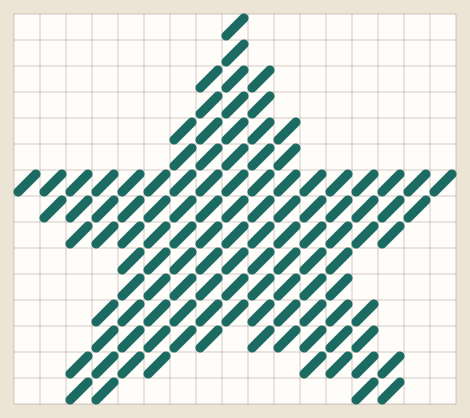
Tent stitch is the small slant over one intersection: up at the lower left, down one thread to the right and one thread up. Continental shows how to work a row of it. This star has 114.
| Row, from the top | Stitches | Row | Stitches |
|---|---|---|---|
| 1, 2 | 1 | 9 | 13 |
| 3, 4 | 3 | 10, 11 | 9 |
| 5, 6 | 5 | 12 | 11 |
| 7 | 17 | 13 | 5, 1 bare, 5 |
| 8 | 15 | 14 | 4, 5 bare, 4 |
| 15 | 2, 9 bare, 2 |
- Mark the middle column and the top row.
- Work row 7 first, 17 stitches with the ninth in the middle column. It is the widest, so a wrong start shows at once.
- Work up to the point, each row centered over the one below.
- Work down to the two feet. From row 13 on there is bare canvas between them.
Edges that rise to the right come out smooth, and edges that fall to the right come out in steps, because every tent stitch leans one way. A line of backstitch in the same thread evens them.
An eight-sided star of mosaic boxes

This one is built of mosaic, three slanted stitches in a box two threads by two. It is 12 threads across.
- Work the four boxes in the middle. They meet in the center hole. The long stitch of each points to that hole, so the boxes lean right at the upper right and lower left, and left at the other two.
- Work outward on the four diagonals, one box more on each, touching at the corners.
- Add a pair of boxes on each side, at the top, the bottom, the left and the right. The two touch on the middle line, and their outer edge is six threads from the center hole. Two bare threads stay between the pair and the four middle boxes. The long stitches lean in toward the center, so the top pair makes a V. That is 16 boxes (A).
- Fill the eight bare boxes between the arms in a second color (B). All keep the slant of their quarter.
Repeated side by side every 12 threads, the eights leave a bare stepped diamond, eight threads across, wherever four corners meet. Put a star of two crosses in the middle of it. Leave the rest bare, or work it in tent stitch before the star. Patterns called star octagon work in the same way: groups of slanted stitches ring a space, and the space stays open or holds a star. Their counts differ from chart to chart. One is worked next.
A star in an octagon
Star octagon is an eight-sided ring of slanted stitches, six threads across, with a star in an opening two threads square.

- Find the center hole (the red dot).
- Work the upper right group (A), in the thread for tent stitch: five stitches side by side, which all lean up to the right. Come up at the outer end of each, by its number, and go down at the inner end, because neighboring groups share holes there. The table has both.
- Mirror it in the other three quarters (B). All twenty stitches point to the middle.
- Go on. The next center is three threads to the side and three down, and shares the group between (C).
- Add the stars last, in a second thread: a Smyrna cross over two threads, or a bead. An opening may also stay bare.
| Stitch | Over, in intersections | Up, counted from the center hole | Down, counted from the center hole |
|---|---|---|---|
| 1 | 1 | 1 right and 3 up | 2 up |
| 2 | 2 | 2 right and 3 up | 1 up |
| 3 | 1 | 2 right and 2 up | 1 right and 1 up |
| 4 | 2 | 3 right and 2 up | 1 right |
| 5 | 1 | 3 right and 1 up | 2 right |
Allow 18 threads each way for three rings side by side: 1.4 in (3.5 cm) on 13 mesh, 1 in (2.5 cm) on 18.
A night sky

- Choose a quiet ground. Basketweave in a dark blue or black matte thread shows stars best. On a painted sky use skip tent or T stitch in a dark thread. Sky and water has more.
- Make a color copy of a painted canvas, so that you know where the stars were.
- Ground of tent stitch: ground first. Work it right over the painted stars, and lay every star on top.
- Ground of longer stitches: large stars first. Work each large star on bare canvas, then the ground up to it, with tent stitch in the small spaces between its arms. The small stars still go on top, after the ground.
- Set one or two large stars off center and well apart: sixteen rays (1), or the eight long ones alone (2).
- Add two or three middling ones, Smyrna crosses (3), not in a line and not at one distance.
- Scatter one-stitch stars, upright crosses over two threads (4), three to each middling star or more. Leave some of the sky empty.
- Add shine last. One strand of fine metallic, or a bead here and there. Bright on every star is no brighter.
An even starry ground (B). One upright cross over two threads every eight threads, and the next row four threads lower and four to the side. It is laid on finished tent stitch. For an open one leave out the tent, on canvas that is already dark.
Falling snow (C). Finish everything under it first. Then a large flake or two, three or four crosses, and many single knots or beads, closer together toward the foot of the picture. In front of a dark tree a flake may cross the edge: snow falls in front of things.
Thread and needle
Braid is a round metallic thread sold by size, and the larger number is the thicker: 4 is fine, 16 is thick. Floss is stranded cotton, and the strands are counted one by one. The needle is a tapestry needle, which is blunt, and there the larger number is the thinner: size 22 is thinner than size 20.
| For | On 13 mesh | On 18 mesh |
|---|---|---|
| Eyelets and arms, in metallic | Size 8 braid, one strand | Size 4 braid, one strand |
| The same in cotton or silk floss | 3 strands | 2 strands |
| A tent star in metallic | Size 16 braid | Size 8 braid |
| Slanted stitches in floss: mosaic boxes, the ring of a star octagon | 7 or 8 strands, as for tent | 4 to 6 strands |
| Crosses over two threads | Size 8 braid, or floss, 4 strands | Size 4 or 8 braid, or floss, 2 or 3 strands |
| French knots | 3 strands of floss | 2 strands of floss |
| Tapestry needle | Size 20 | Size 22 |
Strand counts are estimates. White over dark may need one strand more, or every stitch made twice through the same holes. Cut metallics 12 inches (30 cm) long. Metallic and sparkle threads tells how to keep them from fraying.
When a painted flake does not fit the grid
- Find its middle hole. Take the hole nearest to the painted center, and tie a bit of thread in it.
- Count to each tip. Write down the threads up, down, left and right.
- Even them out. Where two opposite arms differ by a thread, use the longer for both. The paint under it is hidden.
- Take the nearest figure from the table at the top, the smaller if you are between two.
- Or stitch the ground over it and put your own flake where it fits. Nobody misses the painted one.
- Or lay the arms freely, on finished stitching, with a sharp needle that can go between the holes. Keep each stitch short.
What goes wrong
| What you see | Cure |
|---|---|
| The center is a lump | Too much thread in one hole. Use one strand, and go down in the center each time |
| The center hole is torn wide | The arms were pulled hard. Pull only until each lies flat |
| One arm looks short | It began a hole too near. Count from the center outward before you come up |
| The flake sinks into the ground | The ground is thicker than the flake. Make each stitch twice, or use a thicker thread |
| Dark fuzz on the white | The needle came up through dark stitches. Bring the needle up slowly in an outer hole, straight up and then straight down, not slanted through the dark stitches |
| A thread shows as a shadow from star to star | It was carried behind a thin sky. End it at each star, under the ground stitches |
| The sky looks like wallpaper | The stars stand at even distances. Move some, leave some out |
| The eyelets face different ways | In snow it does not matter. In a row of stars, begin each at the top and go round one way |
Questions
What stitch is best for snowflakes? For small ones, Smyrna cross or Algerian eye. For a large one, straight stitches from one hole with branches.
What is the easiest star? One upright cross over two threads in a metallic thread.
Do I stitch the stars before the sky or after? After, on a tent stitch sky. When the sky is a pattern of longer stitches, the large stars come before it and the small ones after.
Can they go on a belt or a pillow? Crosses and tent stars can. Long arms and beads catch, so keep those for ornaments and pictures.
Where are patterns to try them on? Among the snowflakes and the stars.