Needlepoint guide
Metallic and sparkle threads
For gold or silver that shows, take one strand of metallic braid, 12 inches (30 cm) long: size 16 and a size 20 needle on 13 mesh, size 8 or 12 and a size 22 needle on 18. For a light sparkle, add one strand of fine filament, 18 inches (45 cm) long, to the thread and needle you already use. Stab: straight down, pull through, straight up.
On this page 13 parts
- Choose by what you want to see
- The kinds of metallic thread
- Why metallic thread shreds, and seven cures
- Thread it, start it and end it
- Make it lie flat and shine
- Mix one strand of sparkle with floss, silk or wool
- A whole background in silver or gold
- Gold or silver: which one?
- Snow, stars, water, jewels and halos
- Lay a gold line on top
- Heat, water and tarnish
- What goes wrong
- Questions people ask
Choose by what you want to see
Words used here. Mesh is the number of holes to the inch (2.5 cm) of canvas: 13 is coarser than 18. Tent stitch is the small slanted stitch of most needlepoint. A ground is a background. Floss is cotton sold as six fine strands lying together. A laying tool is a smooth stick, held in the hand that is not stitching, that keeps thread flat; a large blunt needle does the same work. To couch is to lay a thread on top of the canvas and tie it down with a finer one.
| You want | Take | Then |
|---|---|---|
| Solid gold or silver: a star, a buckle, a crown | Braid | Tent stitch or a small cross |
| A wide bright flash: a wing, a gift ribbon, foil | Flat metallic ribbon | Long straight stitches, laid flat |
| A hint of sparkle in snow, water or a dress | Filament beside floss, silk or wool | The stitch you would use anyway |
| White that glitters: snow, ice, pearls | Pearl or white braid, or filament over white floss | Tent, scattered crosses, knots |
| Soft old gold or brass | Twisted metallic cord, or metallic pearl cotton | Tent, backstitch, couching |
| A fine line: whiskers, rigging, rays | Size 4 braid, or one strand of metallic floss | Straight stitches over the finished ground |
| A smooth raised line of gold | Cord or gold laid on the surface | Couching |
| A bright fluorescent: a fish, a jersey, a sign | Fluorescent braid | As braid. It can run thicker than its number, so try a size down: fluorescent threads |
Then work a patch an inch (2.5 cm) square in the margin before you decide. Metallic looks brighter on the spool than on the canvas, and again different under a lamp.
The kinds of metallic thread
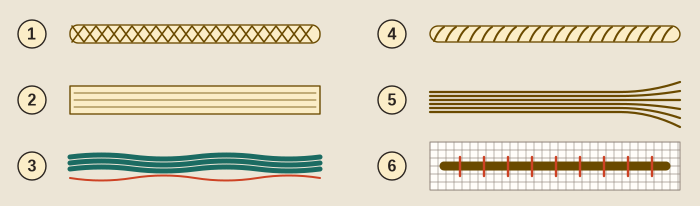
| Kind | On 13 mesh | On 18 mesh | Needle | Cut | Suits |
|---|---|---|---|---|---|
| Braid, plain colors | Size 16, one strand | Size 8 (softer) or 12 (fuller) | 20 on 13, 22 on 18 | 12 to 14 in (30 to 35 cm) | Tent, crosses, small patterns |
| Braid, high shine colors | Size 16, or 12 if it crowds | Size 8 | The same | 12 in (30 cm) | Accents |
| Flat ribbon | 1/8 in (3 mm) | 1/16 in (1.5 mm) | 18 or 20 on 13, 22 on 18 | 15 in (38 cm) | Long stitch, upright Gobelin, Rhodes |
| Blending filament | 1 or 2 strands with another thread | 1 strand with another thread | The one the other thread takes | 18 in (45 cm) | Any stitch |
| Metallic pearl cotton, size 5 | One strand, in long or open stitches: in tent stitch it leaves canvas showing | One strand | 20 on 13, 22 on 18 | 14 in (35 cm) | Tent on 18, accents |
| Metallic floss, stranded | With other thread | All its strands, or with other thread | 22 | 12 in (30 cm) | Lines over the top, very fine canvas |
| Twisted cord, soft | One strand as thick as size 16 braid, about 0.8 mm | One strand as thick as size 8 or 12, about 0.5 to 0.6 mm | 20 on 13, 22 on 18 | 12 in (30 cm) | Brass, horns, frames |
| Cord too stiff to sew, wired braid, gold thread for couching | Lay it | Lay it | A fine one for the ties | The length of the line | Outlines, halos, ropes |
On other canvas: size 8 braid on 24 mesh, size 24 on 12, size 32 on 10, and size 32 or a 1/8 inch (3 mm) ribbon on 7 mesh plastic canvas. All are starting points, for the margin to settle. Numbers rise with thickness: size 4 is about 0.35 mm across, 8 about 0.5 mm, 12 about 0.6 mm, 16 about 0.8 mm and 32 about 1.5 mm. The colors are metallic polyester and nylon, for the most part, and not metal.
Why metallic thread shreds, and seven cures
A metallic is a soft core with a thin bright film round it. The film breaks where it is bent and scraped: at the eye of the needle, and in the canvas hole at every pass. So make fewer passes, wider holes and less rubbing. Try these in order.
- Cut it shorter. 12 inches (30 cm) for braid and the rest, 18 (45 cm) for filament that runs beside another thread. A length that is bald at the end was too long.
- Take the next thicker needle, one with a smaller number: if you have a 24 on 18 mesh, take 22, and if a 22 still drags, 20. It opens the hole for the thread. If the canvas threads bend aside, it is too thick.
- Look at the eye. Run a thread through it and feel for a catch. Throw away a needle with a rough or rusty eye. Turn the needle over as well: an eye is smoother from one side.
- Seal both ends with a dot of fray stop liquid or clear nail polish, and let them dry.
- Stab. Straight down, pull through, straight up. On a frame, always.
- Keep the needle near the short end, an inch or two (2.5 to 5 cm) from the tip of the tail. The thread in the eye wears whatever you do. There, the worn bit is waste that you cut off, and the long part stays good.
- Go a size finer, or lay the thread on top and couch it. A thread that shreds whatever you do is not meant to be pulled through.
Thread it, start it and end it
Braid and ribbon are too soft at the tip to push through an eye. A slip of paper carries them.
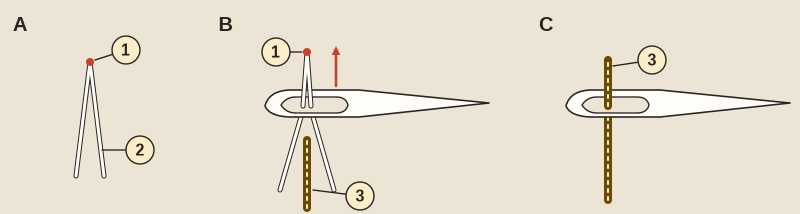
- Fold a strip of paper in half, narrower than the eye and 2 inches (5 cm) long (A).
- Push the fold through the eye.
- Open the two ends and lay the end of the braid between them (B).
- Pull the fold gently on through the eye. The braid comes with it (C). Take the paper off.
Fine filament slides out of the eye again, so lock it.
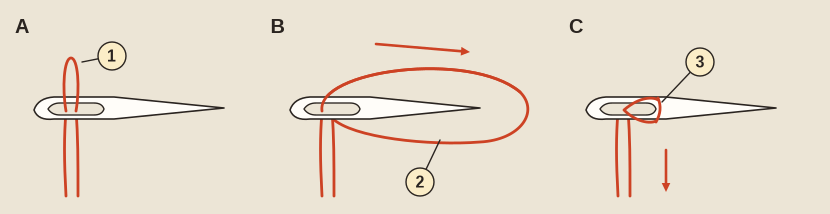
- Fold about 2 inches (5 cm) of the filament back on itself.
- Push the fold up through the eye.
- Open it and take it over the point, then slide it back along the needle.
- Pull gently until it sits snug at the eye. The long end is the one you stitch with.
To start, use an away knot, a knot on the front that is cut off again:
- Knot the end of the thread and go down from the front, 3 inches (8 cm) from your first stitch. The knot stays on the front.
- Come up where you begin and stitch a few rows.
- Cut off the knot, from the front.
- Turn the canvas over, thread the tail that is left into a needle, and run it under four or five stitches.
Where there are finished stitches beside you, run under four or five of them on the back instead, and once round the last.
To end, run under four or five stitches on the back, turn, and run back under two. A slippery thread needs that turn. No knot stays in the work: it would make a bump. How to start and end a thread has pictures of each way.
Cut metallics with old scissors, or the ones you keep for the purpose: they blunt fine blades.
Make it lie flat and shine
- Take out the curl first. Draw the length between two fingers a few times, or through a sponge wetted and squeezed almost dry.
- Hold it over a laying tool as the stitch closes: slip the stick under the loop, let the loop draw down flat on it, and slide the stick out at the last moment. Braid is oval and ribbon is flat, and each has a broad side that shines. Lay the strands flat has a picture.
- Let the needle hang every few stitches, so the twist runs out.
- Pull less than you do with wool. A tight metallic sinks between its neighbors.
- Choose longer stitches for more shine. Light is thrown back by a straight run of thread, and each dip into a hole breaks it. Upright and level stitches flash differently from each other, so a pattern in one color can be made of direction alone.
Mix one strand of sparkle with floss, silk or wool
It is the easiest metallic there is: the other thread does the covering, so keep its strands as they are and add to them.
| Your thread | Add, for a glint | Add, for plain sparkle |
|---|---|---|
| Floss on 13 mesh, 7 or 8 strands | 1 strand of filament | 2 strands |
| Floss on 18 mesh, 4 to 6 strands | 1 strand | 2 strands, and drop 1 of floss if it crowds |
| Silk, or silk and wool, one strand | 1 strand | Size 4 braid beside it |
| Tapestry wool on 13 mesh, one strand | 1 strand: wool swallows it | 2 strands |
| Fine wool on 18 mesh, one strand | 1 strand | Work a second pass on top instead |
- Cut both threads 18 inches (45 cm) long.
- Lock the filament in the eye as above, then thread the other beside it.
- Fasten on with both together.
- Smooth them together before each stitch, so that the filament is not left in a loop. It does not stretch, and the other thread does.
- Lay it on the upper side with the laying tool if you want it seen.
Over finished stitches. For frost, or wet stones, or a sheen on a bird, work the area in plain thread first. Then go back with one strand of filament alone, up and down in the same holes, over some of the stitches and not all.
A whole background in silver or gold
A large metallic ground is slow, hard on thread and easily too much. Choose one that shines where it can.
| Ground | How | Shine | Thread |
|---|---|---|---|
| Skip tent, metallic in the gaps | Floss first, then size 8 braid or a bead in each gap | A scatter of points | Little metallic |
| T stitch over colored canvas | One strand of fine braid | A lit net, the color glows through | Little |
| Floss and filament in any ground stitch | Gray floss with silver, tan or yellow floss with gold | Soft and even | Little metallic, the usual floss |
| Parisian or Hungarian, long stitches metallic | Short stitches in floss | Bright rows | About half and half |
| Upright Gobelin or brick in ribbon | Laid flat, over four threads | Brightest, like foil | A good deal |
| Basketweave in braid | One strand throughout | Even glitter, like metal cloth | The most |
- Color the canvas first, gray under silver, tan or yellow under gold, with paint that holds in water. White canvas between metallic stitches looks like holes.
- Keep it small. Silver behind one figure is enough. Give matte wool or cotton the rest.
- Work the subject first, all but its outermost row of stitches. Then work the metallic, and that last row at the end, so that rough braid is not dragged through the same holes as soft thread.
- Start each length in a different place, so that the ends on the back do not make a ridge.
- Buy it all at once. Any amount is an estimate, and short lengths waste an end each. Take what the thread calculator gives for the area, and buy a spare spool.
Background stitches has the stitches side by side.
Gold or silver: which one?
- Warm colors take gold. Red, brown, orange, cream and olive. Cool blues, grays, pinks and white take silver or pearl.
- Bright gold is yellow. Beside real yellow thread it goes flat. Antique and dark golds read as metal.
- Silver is gray in shade. Put it where light will fall on it, against something dark.
- White sparkle beside white vanishes. Set it in the palest gray or blue instead, or edge it.
- One metal in a piece looks planned. Two need a reason.
Gold on a Christmas stocking
Put gold thread where light catches it and nothing rubs: stars, trim, a halo, a line under the cuff. A stocking comes out once a year, so a little gold lasts on it.
| Where | Gold thread | How |
|---|---|---|
| Star, buckle, crown | Braid, one strand: size 16 on 13 mesh, 8 or 12 on 18 | Tent stitch, or Smyrna cross |
| A line under the cuff, or round heel and toe | Cord or braid laid on top | Couching, over the finished ground |
| Halo | Gold laid in a ring | Couching |
| The name | Gold-colored floss and one strand of filament | Tent stitch, the letters before the ground |
| A whole gold ground | Gold-colored cotton, silk or wool, and one strand of filament | Basketweave |
- Keep stitches in braid in from the edges. Leave the top inch (2.5 cm), where hands and presents go in, to plain thread, and the two rows beside the edge of the design, where the seam will be.
- Let a couched line run to the seam. It goes from one edge of the design to the other, and on over the two extra rows outside it, so that the seam crosses it and no gap shows. Take its tails to the back there, in the outermost row, by the steps below.
- If you block it yourself, block first and lay the couched lines on afterward.
- If a finisher blocks it, lay the lines on before you send it, and write on the form that it has metallic thread laid on top. Raised work is blocked face up, and metallic has neither steam nor a bare iron on it.
- Keep the iron off it when the stocking is made up. Press from inside, through a cloth, or not at all.
A white, gold or neutral stocking has colors for the rest.
Snow, stars, water, jewels and halos
| Subject | Thread | Stitch |
|---|---|---|
| Fallen snow | White floss with filament | Skip tent, brick, or scattered French knots |
| Snowflake on a finished sky | Size 4 braid or metallic floss | Straight stitches from one middle: stitches for stars and snowflakes |
| Star | Braid | Algerian eye, Smyrna cross |
| Water in light | Filament with blue floss | Long level stitches, a glint in one row of four |
| Jewel | Bright braid or ribbon | Rhodes, one to a stone |
| Halo, crown edge | Gold laid in a ring | Couching |
| Tinsel and lights | Braid, beads | Couched line with beads |
Lay a gold line on top
This is for one gold thread. For a broader line, lay a second one close beside it when the first is done.
- Leave a tail. Lay the gold on the line with an inch (2.5 cm) to spare at each end, on the front.
- Tie it down with small stitches of fine thread, every two or three canvas threads, always square across it. Couching has each step drawn.
- Nudge it straight with the laying tool as you go.
- Take the tails to the back. Thread one into a large-eyed needle and go down through the hole at the very end of the line. Do the same at the other end.
- Fasten them to the back with three or four stitches of the fine thread, and trim.
Heat, water and tarnish
- Never an iron straight on it. The film melts or shrinks. White cloth between, low heat and no steam on the metallic; raised work face down on a towel.
- Wet it only after a trial. Press a wetted length on white cloth. Reds are the likeliest to bleed, and blues and greens can.
- No bleach, and no rubbing. How to clean needlepoint has the gentle way.
- Thread with real silver or copper in it darkens. Keep it from rubber bands and damp hands, and cover what is finished.
- Not for belts, seats or anything rubbed, unless it is a few short stitches of braid.
What goes wrong
| Problem | Cure |
|---|---|
| It shreds near the needle | The seven cures above, in order |
| The end frays before you begin | Seal it, cut the length, and seal the other end |
| The stitches look dull | They are twisted, too tight or too short. Lay them, loosen, or use a longer stitch |
| White canvas shows between them | A braid a size thicker, or canvas colored first |
| The braid crowds and stands up | A size thinner. High shine colors run thick |
| Filament hangs in loops | It was fed faster than the other thread. Smooth both before each stitch |
| It comes loose on the back | Fasten again with a turn back on itself |
| It roughs up the wool beside it | Leave the one row of wool that touches it until the metallic is done, as in a metallic ground |
Questions people ask
Is there a gold thread that does not shred? No. Soft twisted cord is easier to pull through than braid, filament carried beside floss rubs least, and gold laid on top does not go through the canvas at all except at its ends. Every one lasts better in short lengths.
Can I stitch a whole piece in metallic? You can. It has no resting place for the eye, so most of it goes unseen.
How many strands? Braid, ribbon and cord: one. They cannot be divided. Filament: one or two beside another thread.
Where are velvet, ribbon and fuzzy threads? In variegated, metallic and textured threads, with glow in the dark. The thread and needle chart has the plain ones.