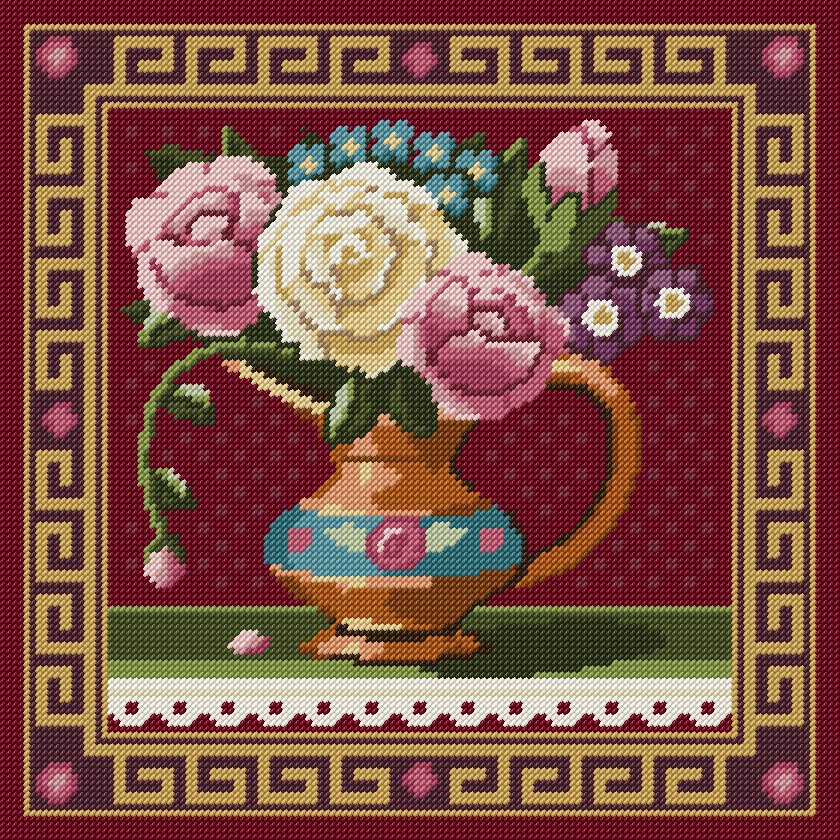
Victorian burgundy sampler with pitcher needlepoint pattern
Advanced · 24 colors · 14 × 14 in · 10 mesh · 19,600 stitches
Download free PDFPDF, US Letter · 135 KBFor your own stitching, gifts and handmade pieces you sell. Do not resell or share this PDF. What you may do, in full
You will need
- Canvas: 10 mesh, cut 18 × 18 in
- Needle: tapestry, size 16 or 18
- Thread: 24 colors of six-strand floss, 8 to 10 strands in the needle, about 61 skeins in all (an estimate)
- Thread: 24 colors of pearl cotton size 3, 2 strands in the needle, about 43 skeins in all (an estimate)
- Thread: 24 colors of tapestry wool, 1 strand in the needle, about 41 skeins in all (an estimate)
- Thread: 24 colors of Persian wool, 3 strands in the needle, about 44 skeins in all (an estimate)
Make it a pillow. Backing fabric, an insert the size of the stitching or an inch larger, and cord or piping for the edge. The seam takes the last two rows: stitch two extra rows all round, or keep the edge plain. How to finish a pillow
A copper pitcher overflows with pink and cream roses, purple auriculas and blue forget-me-nots on a green cloth with a white lace edge. The ground is dotted burgundy, inside a gold and plum Greek key border with pink rosettes.
Size and details
The chart is 140 × 140 stitches: a pillow on 10 mesh canvas.
Worked in tent stitch throughout.
Advanced. Many colors, or changes every few stitches: best with a canvas or two behind you.
How the level is set
Advanced: 24 colors. Changes of color are about 3 stitches apart, leaving out the border. With 10 colors or more, closer than 4.5 apart is Advanced, 4.5 or more is Intermediate, and a design with this many colors is never Beginner.
| Mesh | Stitched size | Canvas to cut |
|---|---|---|
| 10 | 14 × 14 in 35.6 × 35.6 cm | 18 × 18 in 45.7 × 45.7 cm |
| 12 | 11.7 × 11.7 in 29.6 × 29.6 cm | 15.7 × 15.7 in 39.8 × 39.8 cm |
| 13 | 10.8 × 10.8 in 27.4 × 27.4 cm | 14.8 × 14.8 in 37.5 × 37.5 cm |
| 14 | 10 × 10 in 25.4 × 25.4 cm | 14 × 14 in 35.6 × 35.6 cm |
| 18 | 7.8 × 7.8 in 19.8 × 19.8 cm | 11.8 × 11.8 in 29.9 × 29.9 cm |
Mesh is the number of canvas threads to the inch; the row in bold is the mesh this chart is sized for. Canvas to cut includes a margin of 2 in (5.1 cm) of bare canvas on every side. Leave at least that much.
Paper for the PDF
Threads and canvas
Pearl cotton size 3: 2 strands in the needle on 10 mesh, and a skein is 16.4 yd. DMC pearl cotton goes by the same numbers, for the shades it is made in.
- DMC 814 Dark Garnet 5,517 stitches about 68 yards 9 skeins
- DMC 3820 Dark Straw 3,500 stitches about 44 yards 6 skeins
- DMC 154 Very Dark Grape 3,147 stitches about 39 yards 5 skeins
- DMC 712 Cream 933 stitches about 12 yards 2 skeins
- DMC 934 Black Avocado Green 881 stitches about 11 yards 2 skeins
- DMC 936 Very Dark Avocado Green 652 stitches about 9 yards 1 skein
- DMC 3731 Very Dark Dusty Rose 500 stitches about 7 yards 1 skein
- DMC 470 Light Avocado Green 499 stitches about 7 yards 1 skein
- DMC 902 Very Dark Garnet 490 stitches about 7 yards 1 skein
- DMC 963 Ultra Very Light Dusty Rose 463 stitches about 6 yards 1 skein
- DMC 921 Copper 415 stitches about 6 yards 1 skein
- DMC 3350 Ultra Dark Dusty Rose 343 stitches about 5 yards 1 skein
- DMC 3822 Light Straw 336 stitches about 5 yards 1 skein
- DMC 400 Dark Mahogany 292 stitches about 4 yards 1 skein
- DMC 3354 Light Dusty Rose 251 stitches about 4 yards 1 skein
- DMC 807 Peacock Blue 244 stitches about 4 yards 1 skein
- DMC 677 Very Light Old Gold 222 stitches about 3 yards 1 skein
- DMC 3765 Very Dark Peacock Blue 194 stitches about 3 yards 1 skein
- DMC 402 Very Light Mahogany 189 stitches about 3 yards 1 skein
- DMC 938 Ultra Dark Coffee Brown 179 stitches about 3 yards 1 skein
- DMC 552 Medium Violet 100 stitches about 2 yards 1 skein
- DMC 3348 Light Yellow Green 90 stitches about 2 yards 1 skein
- DMC 3045 Dark Yellow Beige 84 stitches about 2 yards 1 skein
- DMC 553 Violet 79 stitches about 1 yard 1 skein
19,600 stitches in the chart, about 257 yards in all. The yards are estimates for 10 mesh. The skeins are estimates too, about 43 in all.
Thread colors are approximate screen matches to DMC numbers. Check against real thread before you buy.
The numbers are DMC color numbers, which its six-strand cotton and its pearl cotton share. Wool and silk are numbered differently: match those by eye. For how many strands and which needle, see which thread suits which mesh.
The yards are of thread as it is threaded in the needle: stitched with several strands together, a thread takes that many yards of single strand for every yard listed. For six-strand cotton on 10 mesh, the thread and needle chart gives 8 to 10 strands.
You also need blank needlepoint canvas (mono canvas) in the mesh you choose (see mesh sizes), cut to the size in the table above, and a tapestry needle.
An estimate. The length of thread one stitch uses on the front and back of the canvas, times the number of stitches, plus 30 percent for starting, ending and the tail left in the needle. Each count is estimated as basketweave or continental and rounded up to a whole yard, so the yards in all are a little more than the thread calculator gives for every stitch at once. The 30 percent is this site's own choice. The thread calculator works the same estimate for any count and mesh.
Getting it onto your canvas
This is a counted chart: one square of the chart is one stitch. Find the center of your canvas and the center of the chart (the red arrows above and to the left of the chart), and count out from there, a color at a time.
Nothing is printed on the canvas, so no transfer is needed. How to needlepoint covers the first stitches.
Downloads
- Chart for US Letter paper PDF · 5 pages
- Chart for A4 paper PDF · 5 pages
Each file has the thread key, with an estimate of the yards and skeins of each color, and the sizes on its first page, then the chart with a symbol in every square and a heavier line every ten. A chart too large for one page is divided over several, with two rows or columns repeated in gray where the pages join; a page may be turned on its side for a part that is wider than it is tall.
More patterns like this
Advanced 14 × 14 in · 24 colors
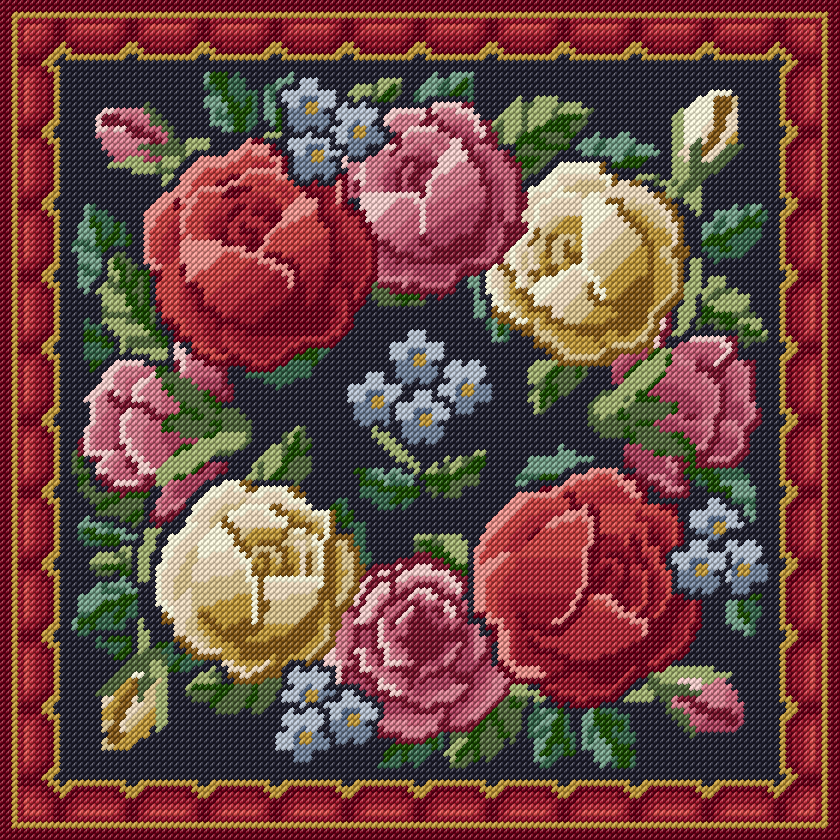
Victorian rose wreath
Advanced 16 × 12 in · 24 colors
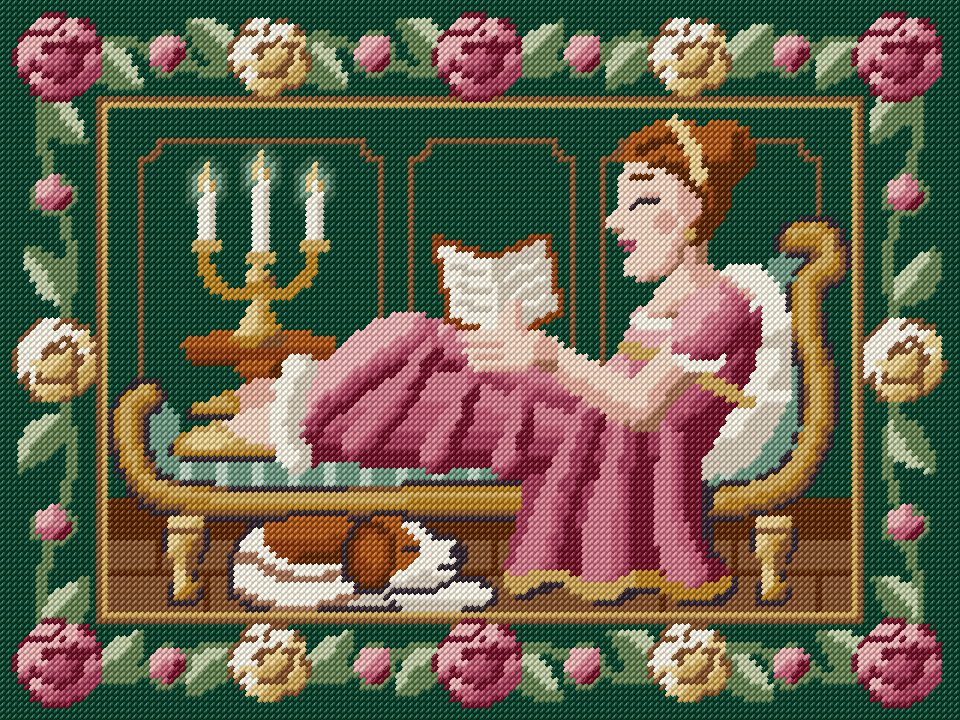
Reclining woman reading on a chaise
Advanced 14 × 14 in · 20 colors
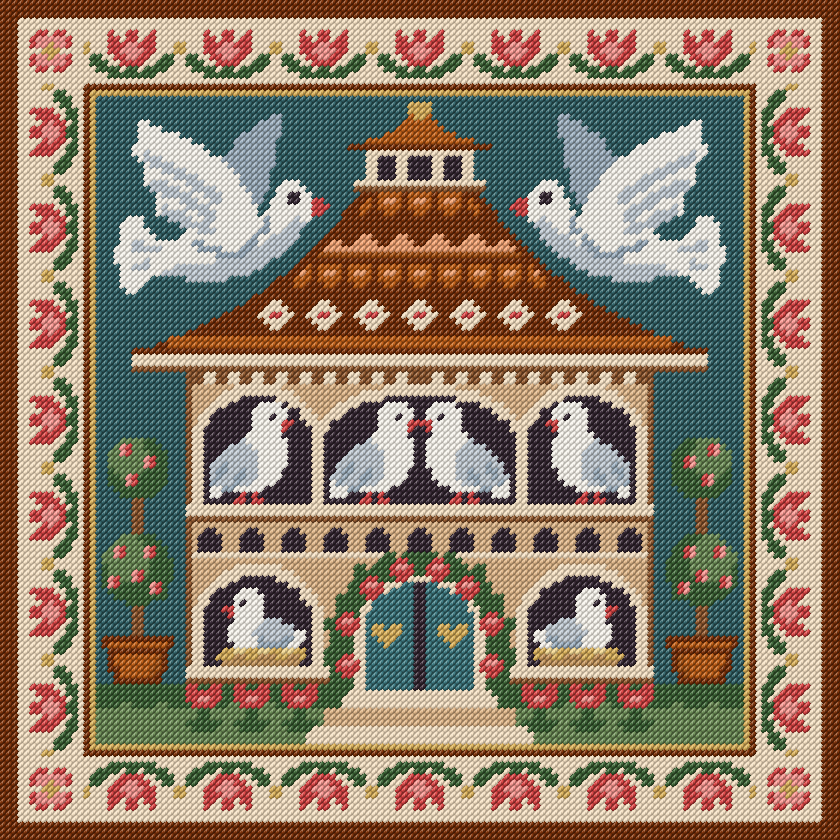
Dovecote sampler pillow
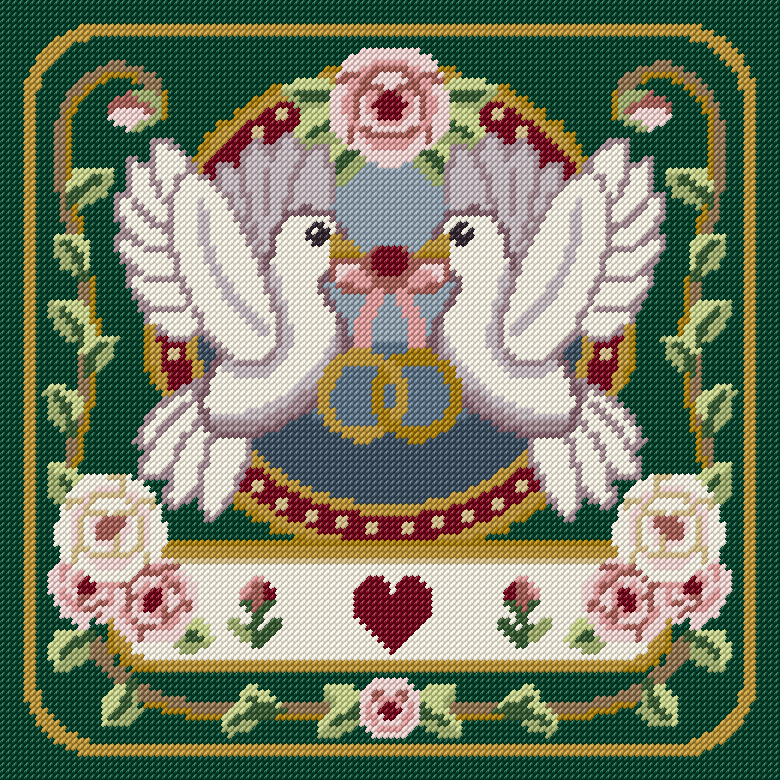
Advanced 10 × 10 in · 20 colors
Wedding sampler with doves and roses
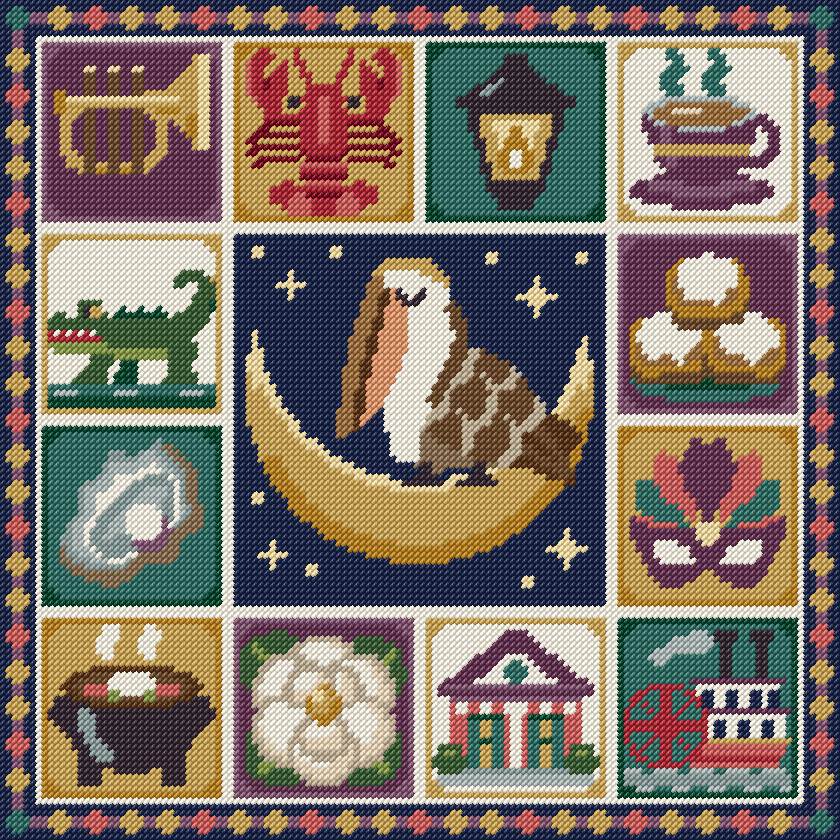
Advanced 14 × 14 in · 24 colors
Twelve days of New Orleans sampler
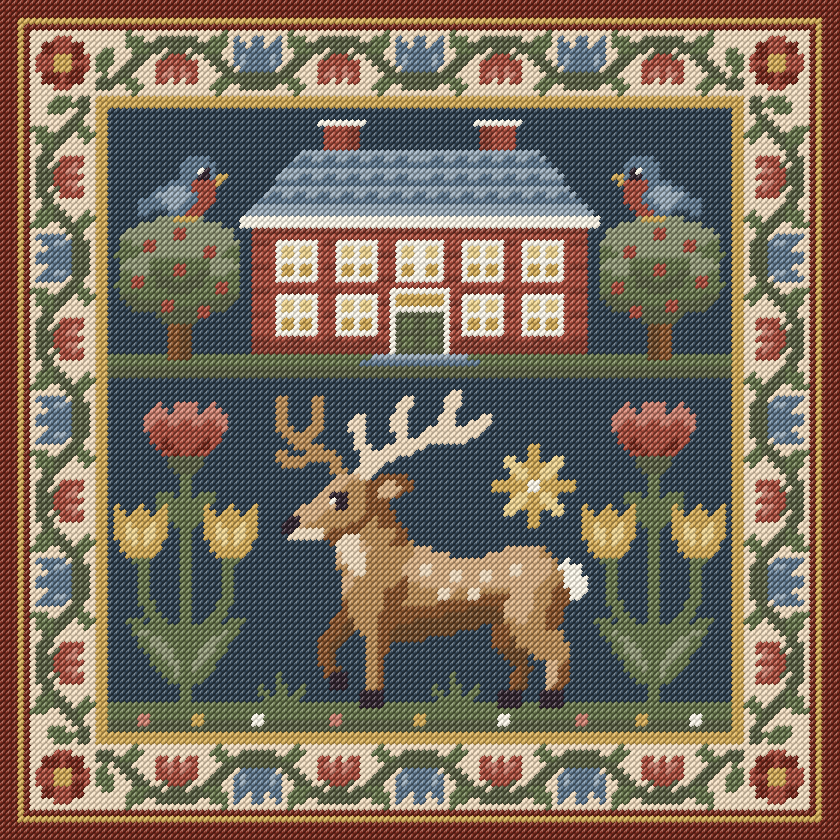
Advanced 14 × 14 in · 19 colors
Antique sampler with house and stag
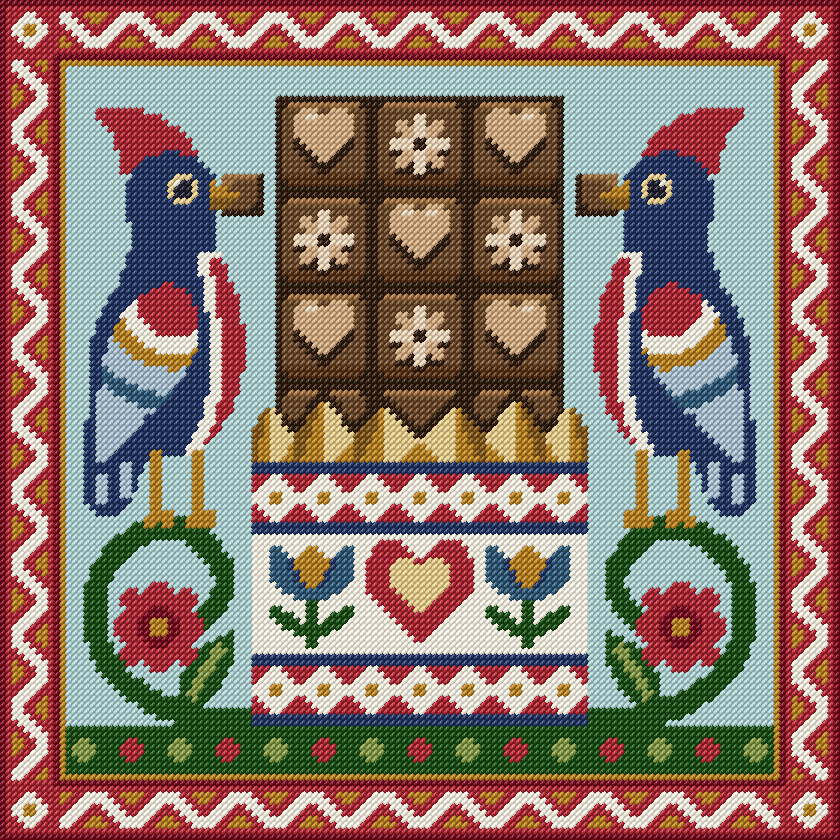
Advanced 14 × 14 in · 19 colors
Folk art chocolate bar sampler
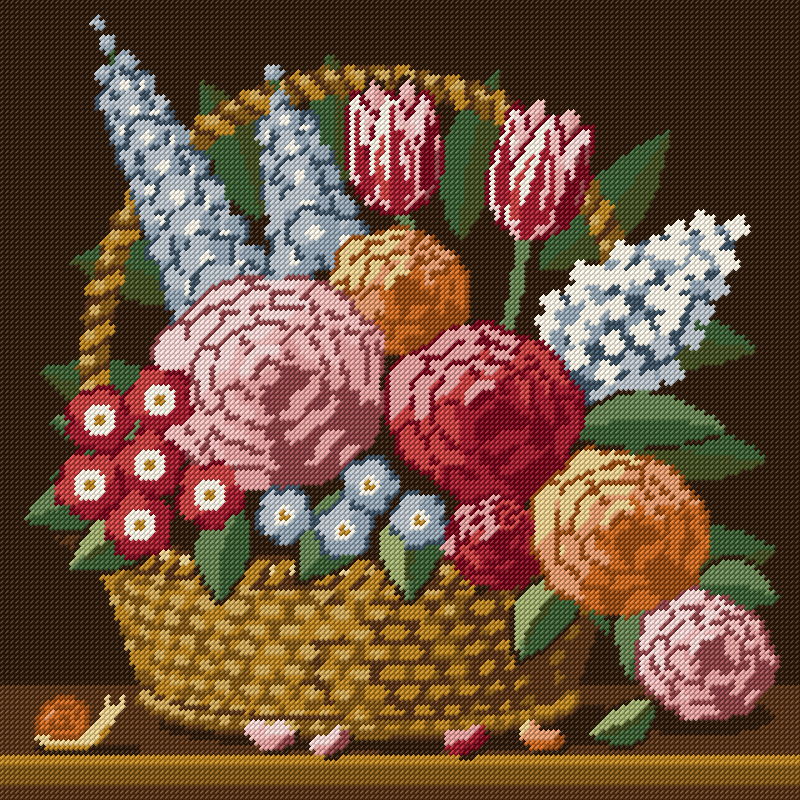
Advanced 16 × 16 in · 24 colors
Victorian basket of flowers pillow
New to needlepoint? How to needlepoint