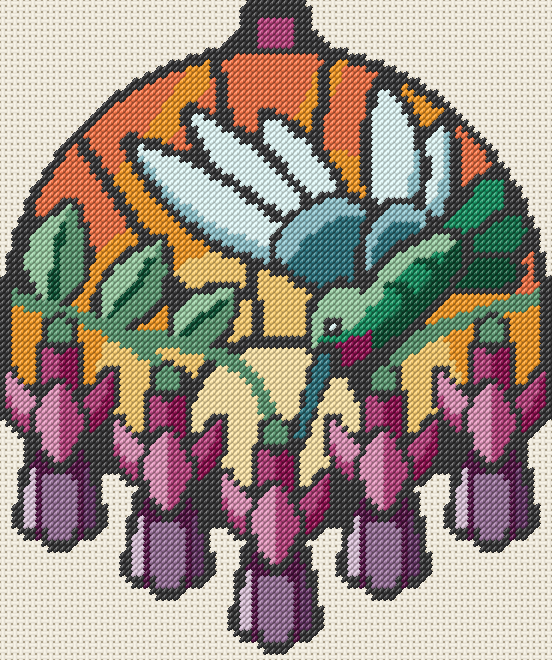
Wind chime with hummingbird and fuchsias needlepoint pattern
Advanced · 20 colors · 6.6 × 7.9 in · 14 mesh · 7,110 stitches
Download free PDFPDF, US Letter · 54 KBFor your own stitching, gifts and handmade pieces you sell. Do not resell or share this PDF or copies of it. Selling, classes and kits: the rules
You will need
- Canvas: 14 mesh, cut 10.6 × 11.9 in
- Needle: tapestry, size 20
- Thread: 20 colors of six-strand floss, 6 or 7 strands in the needle, about 22 skeins in all (an estimate)
- Thread: 20 colors of pearl cotton size 3, 1 strand in the needle, about 21 skeins in all (an estimate)
- Thread: 20 colors of tapestry wool, 1 strand in the needle, about 22 skeins in all (an estimate)
- Thread: 20 colors of Persian wool, 2 strands in the needle, about 21 skeins in all (an estimate)
Make it an ornament. Board, thin batting, backing fabric and twisted cord. Stitch two extra rows all round in DMC 3799, the color at its edge: the edge of the board takes them. They are in neither the chart nor the counts of thread. How to finish an ornament
Another thread. Stitch it in pearl cotton, tapestry wool or Persian wool: the skeins follow
An emerald hummingbird, pale blue wings flung up, dips its bill to the middle bloom of a row of hanging fuchsias in an arched leaded window. Amber and orange panes glow behind it, and the violet skirts of the flowers make the lower edge.
Size and details
The chart is 92 × 110 stitches at its widest and tallest: a stand-up on 14 mesh canvas, with 7,110 stitches inside its outline.
Worked in tent stitch throughout.
Advanced. Many colors, or changes every few stitches: best with a canvas or two behind you.
How the level is set
Advanced: 20 colors. Over the whole chart, changes of color are about 3.5 stitches apart. With 10 colors or more, closer than 4.5 apart is Advanced, 4.5 or more is Intermediate, and a design with this many colors is never Beginner.
| Mesh | Stitched size | Canvas to cut |
|---|---|---|
| 10 | 9.2 × 11 in 23.4 × 27.9 cm | 13.2 × 15 in 33.5 × 38.1 cm |
| 12 | 7.7 × 9.2 in 19.5 × 23.3 cm | 11.7 × 13.2 in 29.6 × 33.4 cm |
| 13 | 7.1 × 8.5 in 18 × 21.5 cm | 11.1 × 12.5 in 28.1 × 31.7 cm |
| 14 | 6.6 × 7.9 in 16.7 × 20 cm | 10.6 × 11.9 in 26.9 × 30.1 cm |
| 18 | 5.1 × 6.1 in 13 × 15.5 cm | 9.1 × 10.1 in 23.1 × 25.7 cm |
Mesh is the number of canvas threads to the inch; the row in bold is the mesh this chart is sized for. Canvas to cut includes a margin of 2 in (5.1 cm) of bare canvas on every side. Leave at least that much.
Paper for the PDF
Threads and canvas
Six-strand floss: 6 or 7 strands in the needle on 14 mesh, counted at 7, and a skein is 8.7 yd. The numbers in the list are its DMC numbers.
- DMC 3799 Very Dark Pewter Gray 2,388 stitches about 22 yards 3 skeins
- DMC 947 Burnt Orange 500 stitches about 5 yards 1 skein
- DMC 747 Very Light Sky Blue 446 stitches about 4 yards 1 skein
- DMC 741 Medium Tangerine 440 stitches about 4 yards 1 skein
- DMC 3607 Light Plum 390 stitches about 4 yards 1 skein
- DMC 3816 Celadon Green 383 stitches about 4 yards 1 skein
- DMC 209 Dark Lavender 305 stitches about 3 yards 1 skein
- DMC 743 Medium Yellow 301 stitches about 3 yards 1 skein
- DMC 3608 Very Light Plum 285 stitches about 3 yards 1 skein
- DMC 745 Light Pale Yellow 278 stitches about 3 yards 1 skein
- DMC 955 Light Nile Green 217 stitches about 2 yards 1 skein
- DMC 550 Very Dark Violet 195 stitches about 2 yards 1 skein
- DMC 917 Medium Plum 181 stitches about 2 yards 1 skein
- DMC 3766 Light Peacock Blue 172 stitches about 2 yards 1 skein
- DMC 3818 Ultra Very Dark Emerald Green 168 stitches about 2 yards 1 skein
- DMC 3765 Very Dark Peacock Blue 149 stitches about 2 yards 1 skein
- DMC 912 Light Emerald Green 100 stitches about 1 yard 1 skein
- DMC 211 Light Lavender 85 stitches about 1 yard 1 skein
- DMC 3837 Ultra Dark Lavender 85 stitches about 1 yard 1 skein
- DMC 910 Dark Emerald Green 42 stitches about 1 yard 1 skein
7,110 stitches inside the outline, about 71 yards in all. The yards are estimates for 14 mesh. The skeins are estimates too, about 22 in all.
Thread colors are approximate screen matches to DMC numbers. Check against real thread before you buy.
The numbers are DMC color numbers, which its six-strand cotton and its pearl cotton share. Wool and silk are numbered differently: match those by eye. For how many strands and which needle, see which thread suits which mesh.
You also need blank needlepoint canvas (mono canvas) in the mesh you choose (see mesh sizes), cut to the size in the table above, and a tapestry needle.
About the yards and skeins
The yards are of thread as it is threaded in the needle: stitched with several strands together, a thread takes that many yards of single strand for every yard listed. For six-strand cotton on 14 mesh, the thread and needle chart gives 6 or 7 strands.
An estimate. The length of thread one stitch uses on the front and back of the canvas, times the number of stitches, plus 30 percent for starting, ending and the tail left in the needle. Each count is estimated as basketweave or continental and rounded up to a whole yard, so the yards in all are a little more than the thread calculator gives for every stitch at once. The 30 percent is this site's own choice. The thread calculator works the same estimate for any count and mesh.
Getting it onto your canvas
This is a counted chart: one square of the chart is one stitch. Find the center of your canvas and the center of the chart (the red arrows above and to the left of the chart), and count out from there, a color at a time.
Nothing is printed on the canvas, so no transfer is needed. How to needlepoint covers the first stitches.
See the chart on this page
The chart is drawn when this is opened.
It opens in the pattern maker, with your colors and your name on it.
Downloads
- Chart for US Letter paper PDF · 3 pages
- Chart for A4 paper PDF · 3 pages
The same chart in squares of about 6 mm, on more pages.
Each file has the thread key, with an estimate of the yards and skeins of each color, and the sizes on its first page, then the chart with a symbol in every square and a heavier line every ten. A chart too large for one page is divided over several, with two rows or columns repeated in gray where the pages join; a page may be turned on its side for a part that is wider than it is tall.
More patterns like this
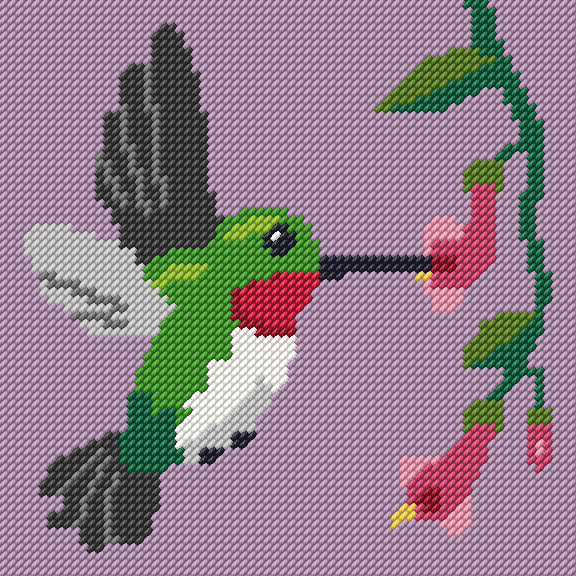
Advanced 5,184 stitches 4 × 4 in · 15 colors
Whimsical hummingbird
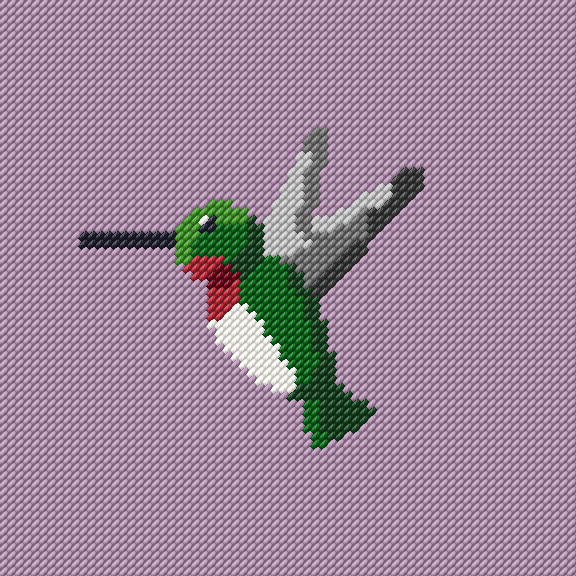
Advanced 5,184 stitches 4 × 4 in · 11 colors
Classic hummingbird
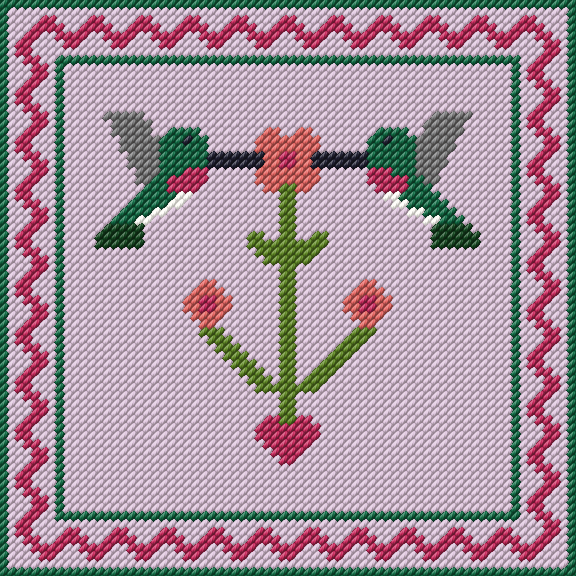
Intermediate 5,184 stitches 4 × 4 in · 9 colors
Folk art hummingbirds
Beginner 5,184 stitches 4 × 4 in · 6 colors
Preppy hummingbird
Advanced 5.3 × 6.7 in · 20 colors
Pocket tissue holder, funny frog
Advanced 4 × 6 in · 20 colors
Beagle puppy dog stand-up with a leash
Advanced 5 × 4.9 in · 19 colors
3D heirloom pumpkin and field mouse
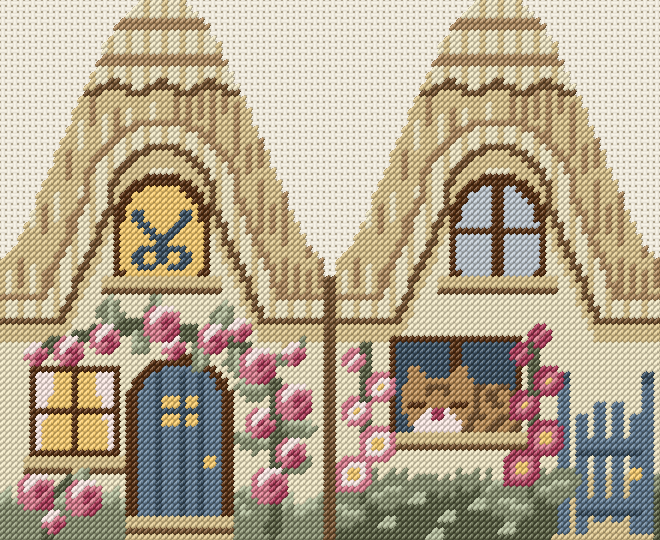
Advanced 6.1 × 5 in · 16 colors
Scissor case house to assemble
New to needlepoint? How to needlepoint